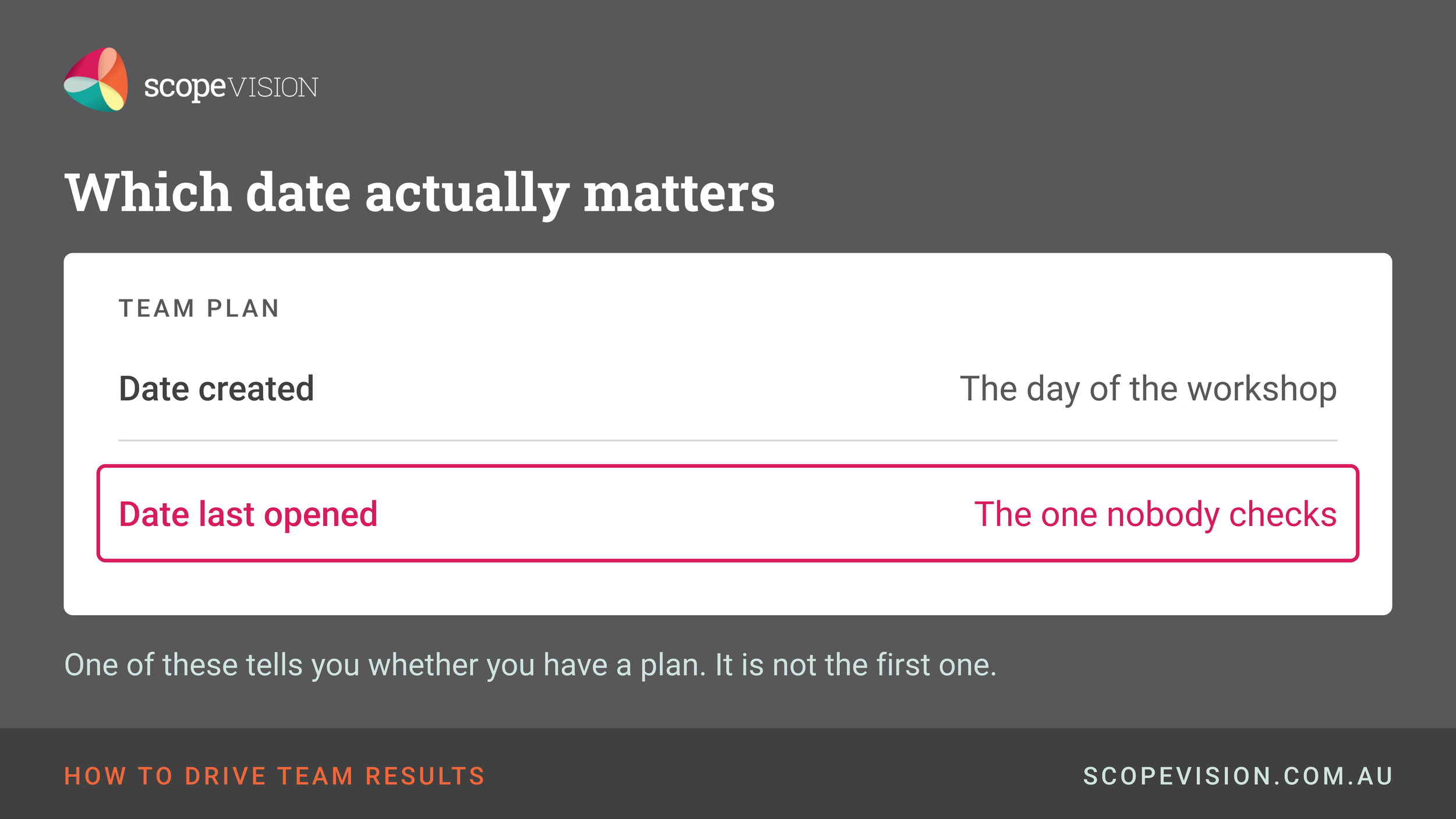
Find your team's plan. Wherever it lives, a shared folder, a whiteboard, a laminated sheet on the wall. Now work out when somebody last looked at it.
Not when it was written. When it was last used.
For most teams the answer sits somewhere between six weeks ago and never, and the plan itself is rarely the problem. It was built in a good session by people who meant every word of it.
Nobody abandoned it. Nobody decided to stop. If you asked the team when it fell over, you would get four different answers and none of them would be a date. It stopped being mentioned, and then it stopped being true.
There is a number that should bother a frontline leader more than the date does. Sull, Homkes and Sull surveyed 7,600 managers across 262 companies, and one of their questions was about the connections between an organisation's priorities. Among the people who report directly to senior executives, fewer than a third could see how those priorities connected to each other. Among frontline supervisors and team leaders, it was 16 per cent (Sull, Homkes and Sull, 2015).
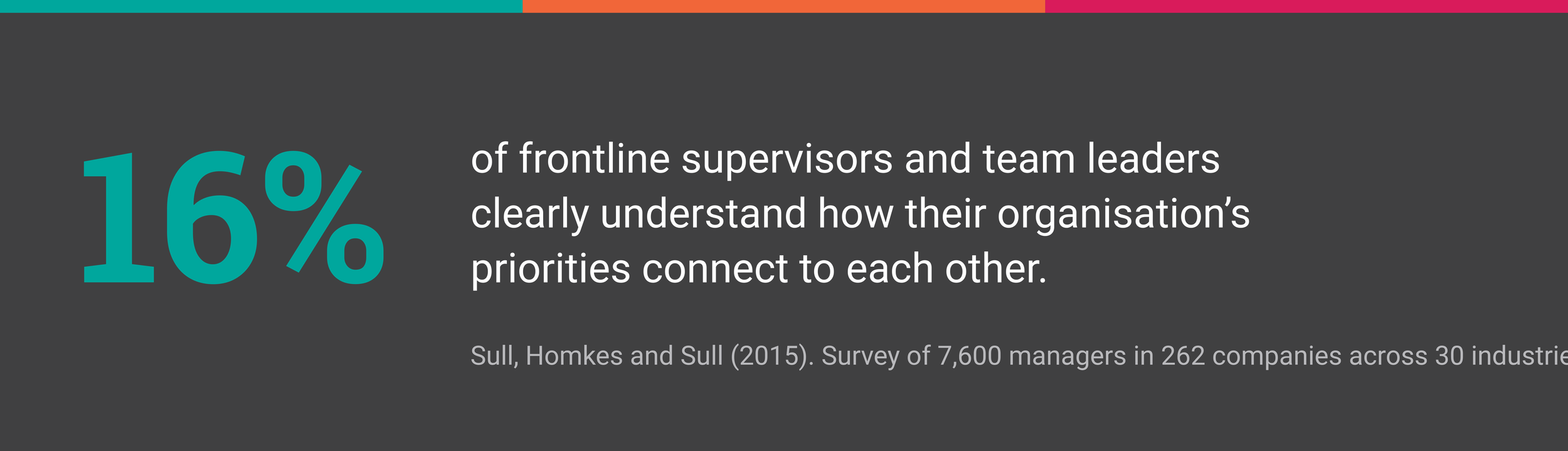
Sixteen per cent. Closest to the work. Least able to see how it fits together.
So this is not a discipline problem and it is not a plan quality problem. It is that most teams have no agreed way of going back to the thing they built.
The Plan Autopsy
Two questions decide everything that follows.
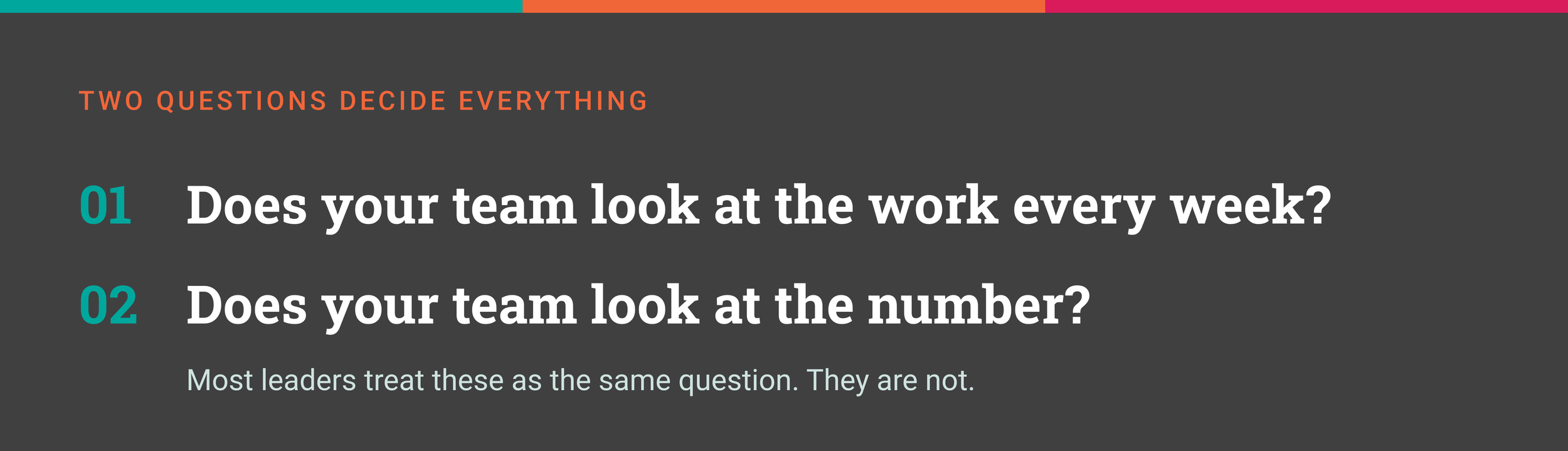
Most leaders treat those as one question, and answer both with the same meeting. That is the mistake. One tells you whether the team is doing the work. The other tells you whether the work is doing anything. Answer them separately and you get four states. You have led teams in all four.
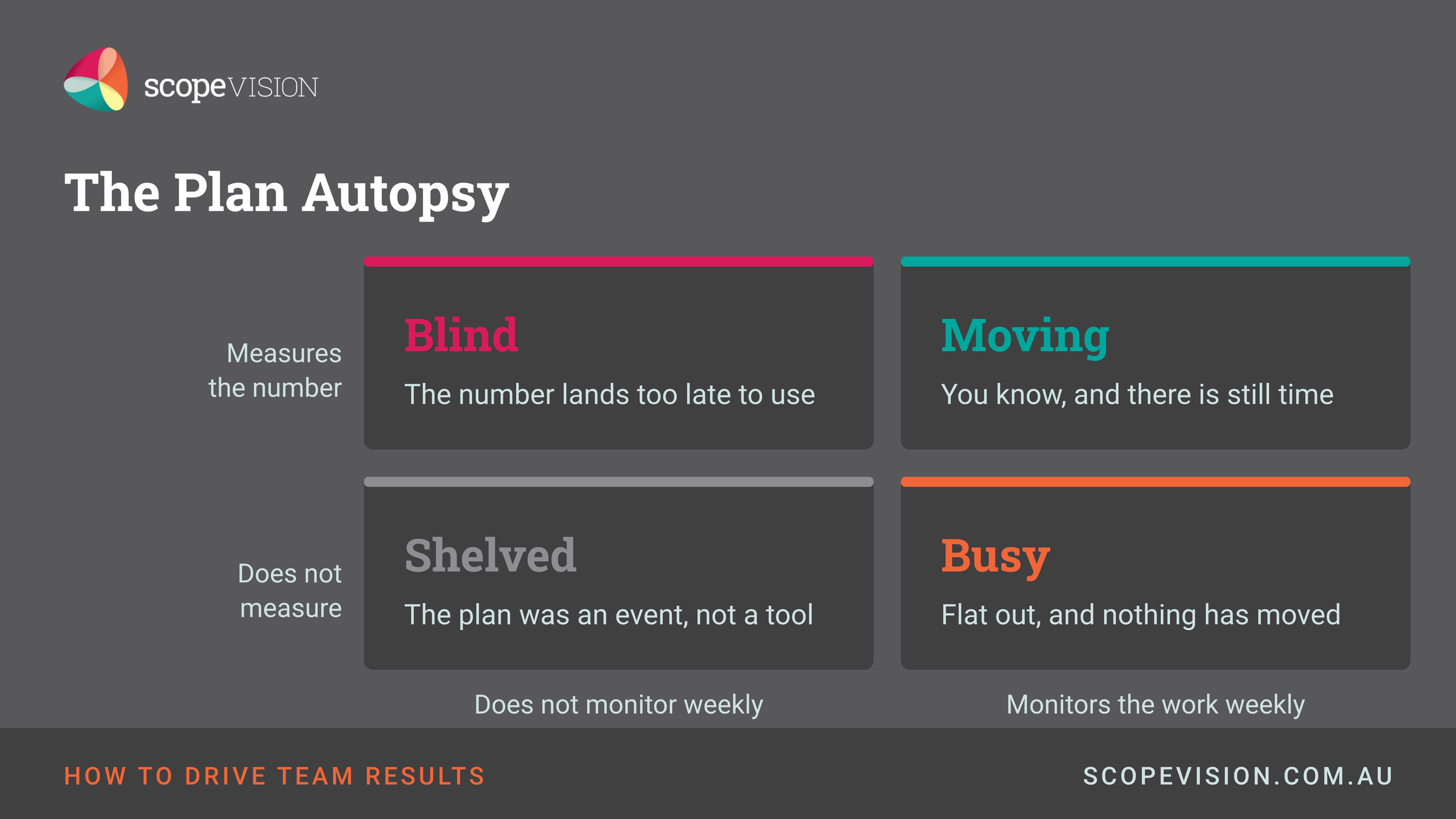
Here is what each one looks like from the inside, and what to do about it.
Shelved. Nothing happens. The plan was an event, not a tool. This is the most common state and the least discussed. The remedy is not another planning day. It is putting the plan where it gets seen without anyone choosing to look.
Busy. The team looks at the work but never at the number. Everyone is flat out, the effort is real, and in a room full of people who worked hard, nobody can say whether any of it moved. This state feels like the good one, which is what makes it dangerous. The remedy is one number, agreed in advance, reported monthly whether it is flattering or not.
Blind. The team measures but does not monitor. The number arrives at quarter end and by then the quarter is gone. There is nothing left to do but explain it. The remedy is a weekly look at the handful of things that produce the number, while there is still time to change it.
Moving. Both happen. The team knows what it is doing and whether it is working, in time to do something about it.
The grid tells you where your team is today. It does not tell you whether today's goal is still the right one. Conditions change. The market moves, someone resigns, the budget is cut in March. A team can sit squarely in Moving and still be marching at a goal that stopped making sense in week three. That is what Move is for, and it is the one almost nobody does on purpose.
Whose plan is it?
One more thing separates Moving from the other three, and it is not a behaviour. It is ownership.
A plan built by one person and issued to a team is a memo. It can be monitored, measured and moved, and still fail, because nobody in the room has any reason to defend a decision they did not make. Sull and colleagues found that execution driven from the top erodes over time. The leaders closest to the work are the ones best placed to make the call, and when senior people keep making it for them, middle managers stop resolving problems and start escalating them (Sull, Homkes and Sull, 2015).
Which is why the three habits in this article are written for a team, not for a leader with a team. The weekly fifteen minutes is the team asking itself three questions, not a leader collecting updates. The number is agreed, not allocated. And the quarterly keep, change or kill is a conversation, because the person who will tell you a goal is already dead is almost never the person who wrote it.
Built together, owned by someone. Collaborative does not mean unowned, and every goal still needs one name against it.
If the plan arrived from above and you had no hand in writing it, you cannot fix that this quarter. What you can do is decide together how the team will work it, which is what the rest of this article is about. The goals may be somebody else's. The weekly fifteen minutes, the number you watch and the quarterly decision are yours.
Monitor: the weekly fifteen minutes
Monitoring is the cheapest of the three Ms and the first one people drop, usually because it gets confused with the thing nobody wants: a meeting where eleven people take turns describing their week.
That is not monitoring. That is attendance.
Monitoring is the team asking itself three questions about the plan. Not a leader collecting updates from each person in turn. The distinction sounds small. One version produces information, the other produces performances. Fifteen minutes, the same slot every week, standing up if that helps keep it short.
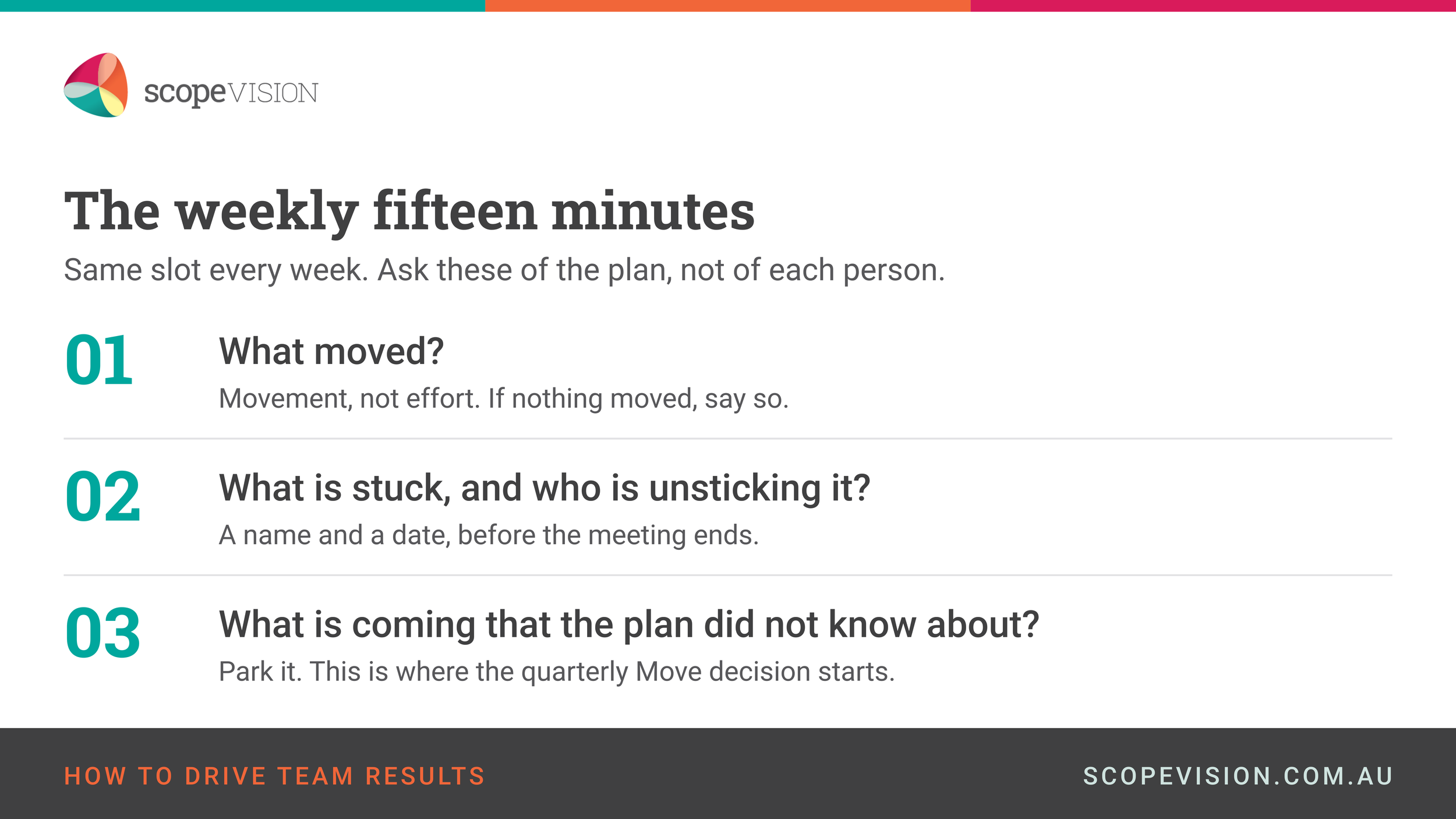
Notice what none of them ask. None of them ask what anybody has been busy with. Busy is not a finding.
There is a reason to do this weekly rather than monthly, and it has nothing to do with control. Amabile and Kramer analysed nearly 12,000 daily diary entries from 238 people across seven organisations and found that the strongest single influence on how someone feels about their working day is making progress on work that matters to them (Amabile and Kramer, 2011). Not praise. Not perks. Progress. A team that only opens its plan quarterly has no way of noticing its own progress, so the work feels like a treadmill even in the quarters when it is going well.
There is a way to get this wrong, and it is the opposite of what you would expect. Sull and colleagues describe what they call the alignment trap: when execution stalls, managers respond by tightening the screws, adding metrics and calling more meetings to monitor progress, until the scrutiny becomes micromanagement and kills the very adaptability the team needed (Sull, Homkes and Sull, 2015). More frequent is not the same as more tight. Fifteen minutes a week, asked of the plan, is frequent. Three dashboards and a daily check-in on each person is tight, and it will cost you the thing you were trying to protect.
If your team has no weekly slot and no appetite for a new meeting, do not create one. Take the single goal most likely to be quietly failing and put those three questions against it in a meeting you already hold.
Measure: one number, and the courage to name it early
Monitoring is the cheap habit. A team can run a flawless fifteen minutes every week for a whole quarter and still not know whether any of it worked, because what moved is not the same question as whether the number moved.
Every goal in your plan needs one number, agreed before the quarter starts, and a named person who reports it. One, chosen on purpose. If nobody can say what number would move if this goal succeeded, you do not have a goal, you have an intention.
Before you commit to a number, ask what behaviour it will produce.
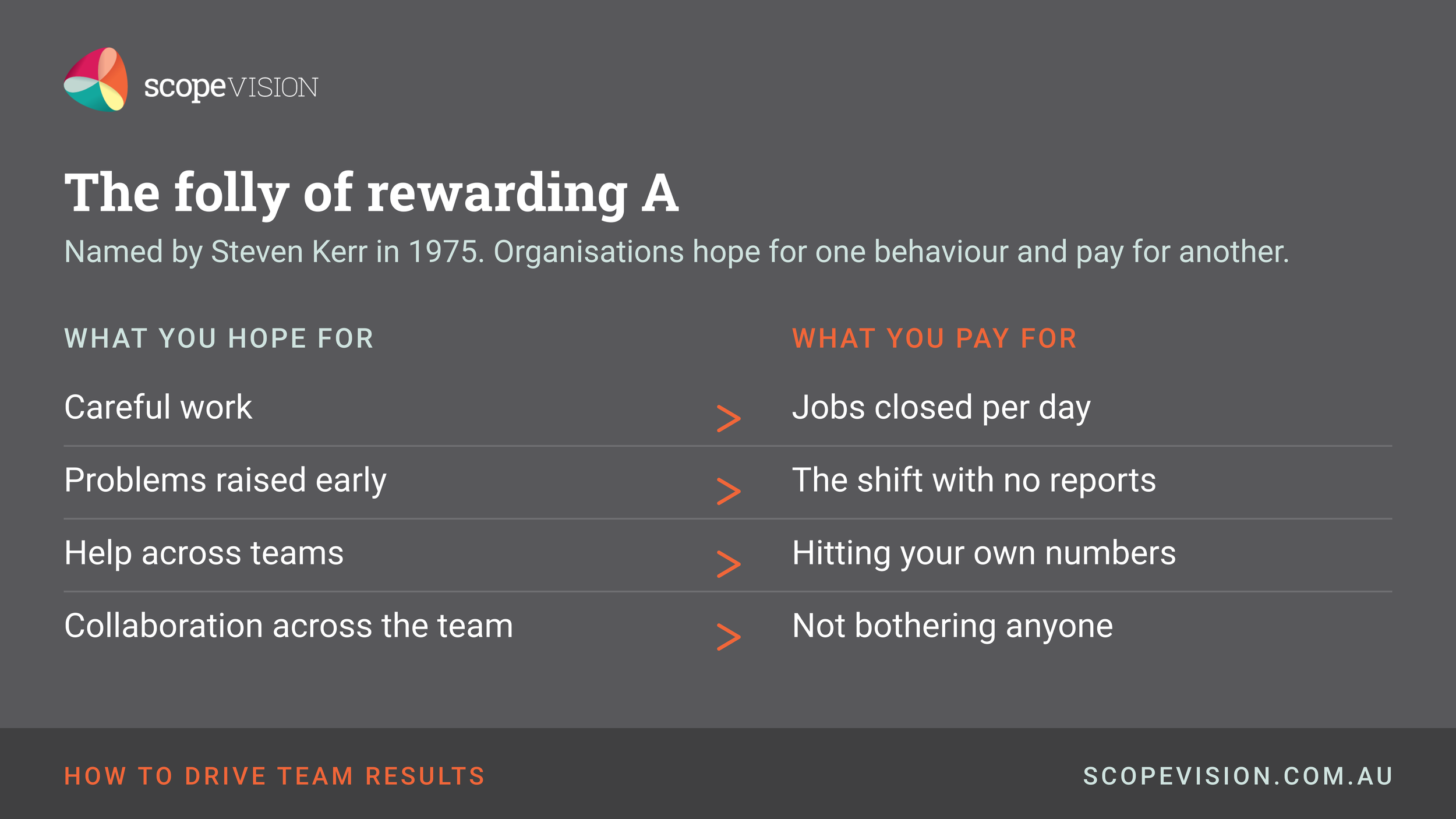
Steven Kerr named this fifty years ago and it is still the most common way a good team gets bent out of shape. Organisations, he argued, hope for one behaviour while paying for another, and people respond exactly as you would expect. They work out what is counted and they do that, often at the cost of everything else (Kerr, 1975). Count jobs closed per day and you will get jobs closed per day, including the ones that come back next week.
The fourth row happens somewhere this week. Collaboration gets asked for at the team meeting. An hour later the same manager asks people not to flood the part timers' inboxes, because coming back on a Tuesday to ninety unread messages is a real harm. Both requests are reasonable. Together they teach the team that helping across the group is admired in principle and costly in practice.
The same survey asked managers what advice they would give a new colleague. Two thirds said make commitments you can be certain of meeting. Fewer than one in three said stretch for something ambitious (Sull, Homkes and Sull, 2015). Nobody in that group is timid. They have read what gets counted, and they are answering it.
So the test is not whether a number can be measured. Almost anything can.
Ask instead: if this number improved and nothing else changed, would we actually be pleased?
If the honest answer is no, you have a proxy rather than a measure, and it will bend your team's behaviour in a direction you did not choose.
Then report the number when it is bad, in the month it is bad. Research by Marakon Associates, reported by Mankins and Steele, found that companies deliver on average only 63 per cent of the financial performance their strategies promise, and that much of the loss stays invisible because nobody surfaces it until the year is over (Mankins and Steele, 2005). That is consulting research rather than peer reviewed work, so hold the figure lightly. Hold on to the mechanism, because you will recognise it. Nothing is reported as failing until it is too late for the reporting to matter.
Move: the decision almost nobody makes on purpose
Sticking to the plan is not execution. That is the myth, and it keeps good teams marching at a target that stopped being right in March. No Gantt chart survives contact with reality, as Sull and colleagues put it, and the managers who adapt to what is in front of them are not undermining the plan. They are executing it (Sull, Homkes and Sull, 2015).
Which means the plan has to be allowed to change. In most teams it changes anyway, just never out loud. A goal stops being mentioned. A target gets remembered slightly lower than it was written. By December, nobody can tell the difference between a goal that was deliberately changed and a goal that was simply failed, because neither one left a mark.
Move fixes that with an hour a quarter and three possible outcomes.
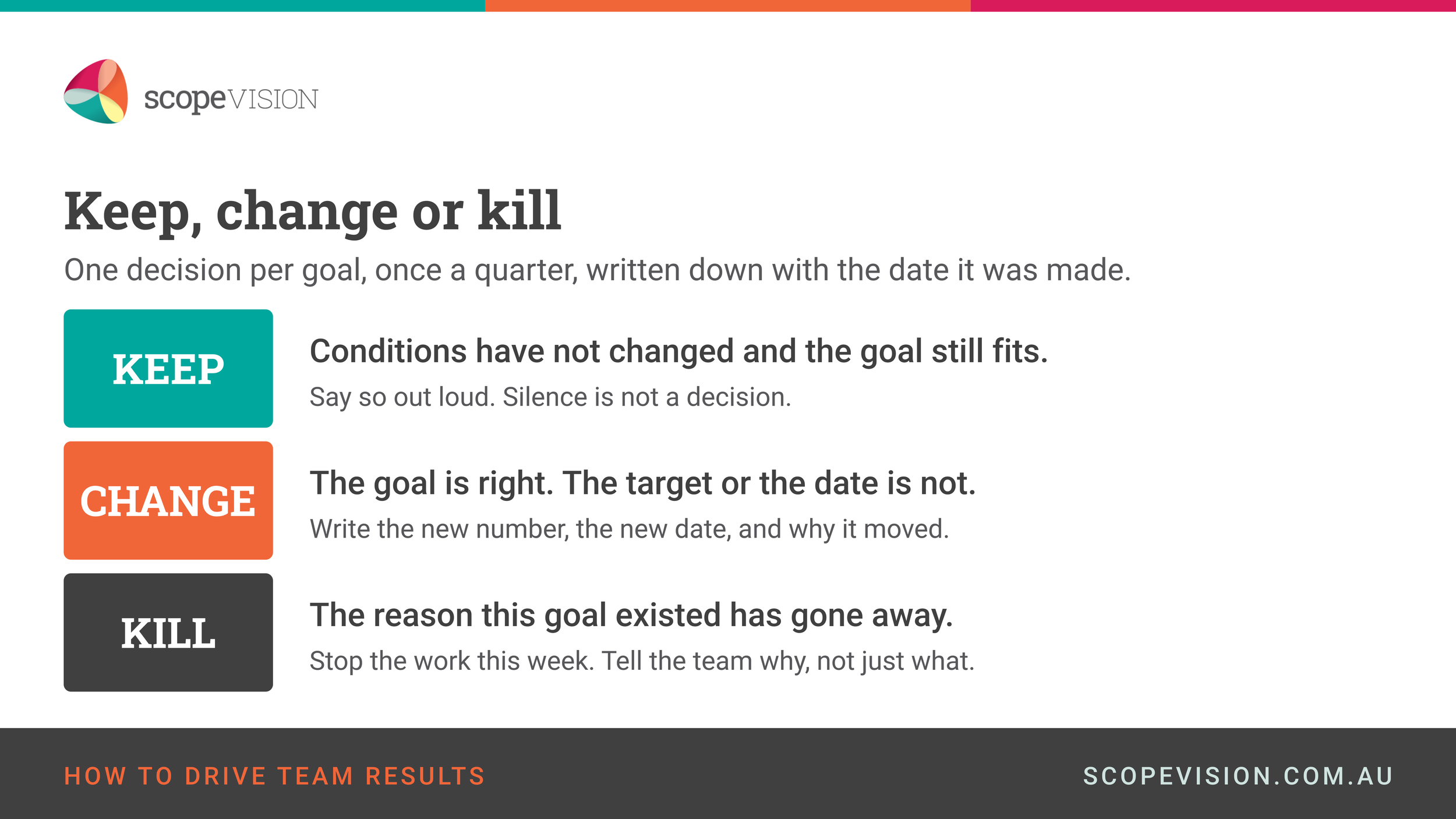
Kill is the one that will feel wrong, and it is the one with the most evidence behind it. Eight in ten managers say their organisation is too slow to stop work that is not succeeding. Only 11 per cent believe every one of their organisation's priorities has the resources it needs, which the authors call a shocking statistic, because it means nine managers in ten expect some of their organisation's major initiatives to fail for want of resources (Sull, Homkes and Sull, 2015). Meanwhile the resources are sitting inside work everybody privately knows is finished. Killing a goal is not defeat. It is the cheapest way you will ever find to fund the goals that are still alive.
Agility is not permission to chase whatever arrived this morning. The same study found half of middle managers believed they could get resources for attractive opportunities sitting outside their strategic objectives, which is how a team ends up with more initiatives than it can staff. Change a goal because conditions changed. Do not change it because something shinier turned up in week two.
Take the goals one at a time. Say the decision out loud, and write it down with the date before you move to the next one. An hour is enough for six goals. If you have more than six goals, that is the finding.
If your quarter has no Move session in it, put the hour in the calendar now, before the quarter starts rather than after it ends. An hour spent deciding is worth more than a day spent explaining.
Nobody walks past anybody any more
The three Ms used to get help from the layout of the building. You saw the whiteboard on your way past. You overheard that the delivery had not arrived. You caught someone at the printer and a problem got solved without a meeting ever existing. None of that was monitoring, but it did the job of monitoring for free.
Now almost nobody has a whole team in one place at one time. In an office that is two days a week at home, which is where most Australian arrangements have settled. On a shift roster it is worse, because nights has never met the new starter on days and the Tuesday crew inherits a problem the Sunday crew already solved. Either way the building has stopped helping, and it stopped quietly, which is why so many leaders feel busier and less informed at the same time.
The same survey asked managers who they could count on to deliver. Their own chain of command came out well. Everyone across a boundary did not, and the people in other departments scored lower than external suppliers under contract (Sull, Homkes and Sull, 2015).
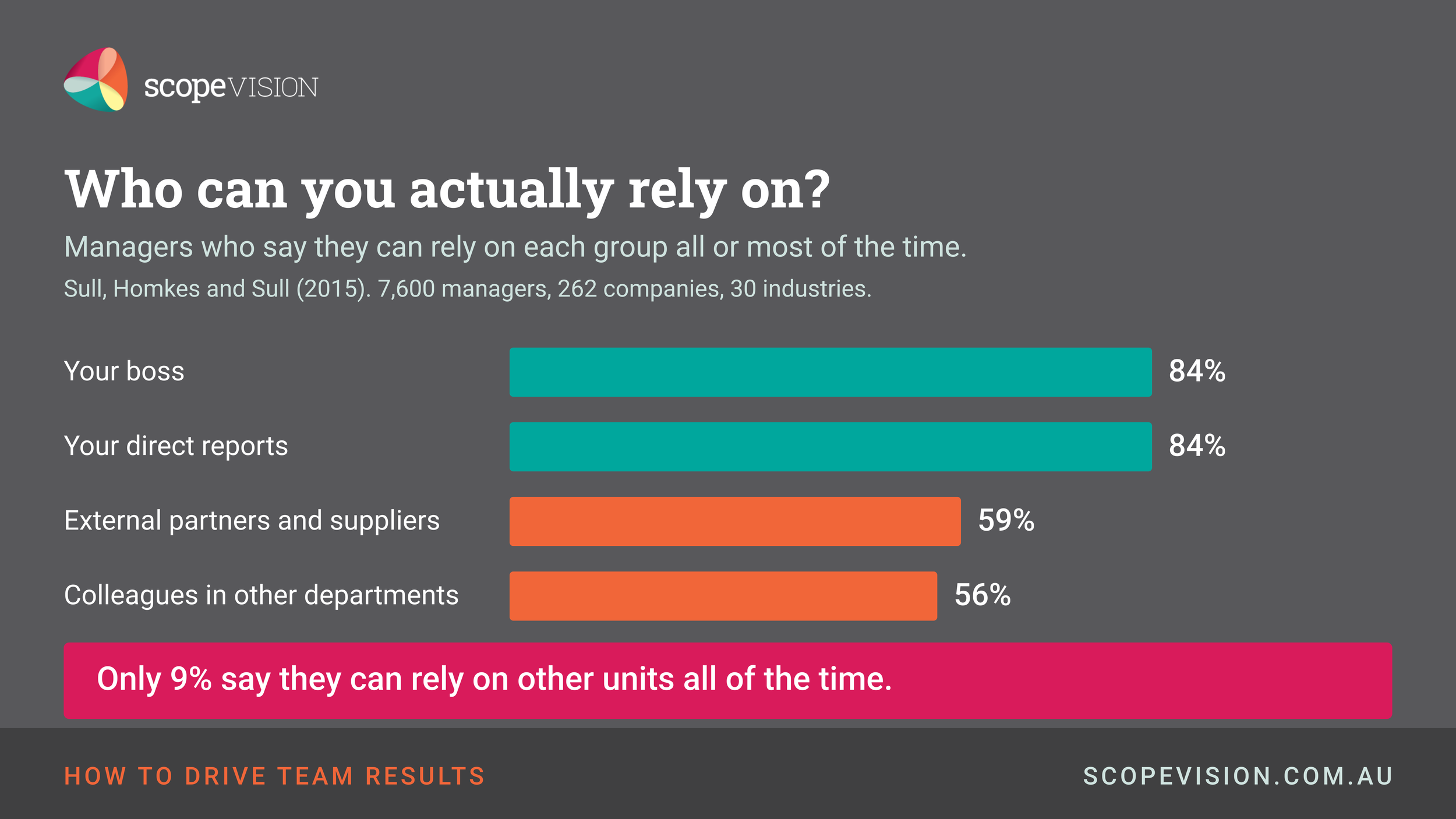
That research is about silos rather than about working from home, and it predates the hybrid shift. But the mechanism is the same one. When people cannot see each other's work, they stop relying on it and start duplicating it. Same gap, older problem, same three fixes.
Put the plan somewhere everyone can see it without asking anyone, and the person returning on Tuesday catches up by looking rather than by reading. Schedule the fifteen minutes rather than trusting it to happen. And write down every Move decision, because half the people it affects were not in the room when you made it.
Open it again
Go back to wherever your team plan lives, and this time open it.
You are not looking for whether it was a good plan. It probably was. You are looking for the three things that were supposed to happen to it after the session ended, and asking which of them your team actually does.
Then ask the one question the four states cannot answer for you. Has anybody made a deliberate decision about a single goal in this plan since the day it was written?
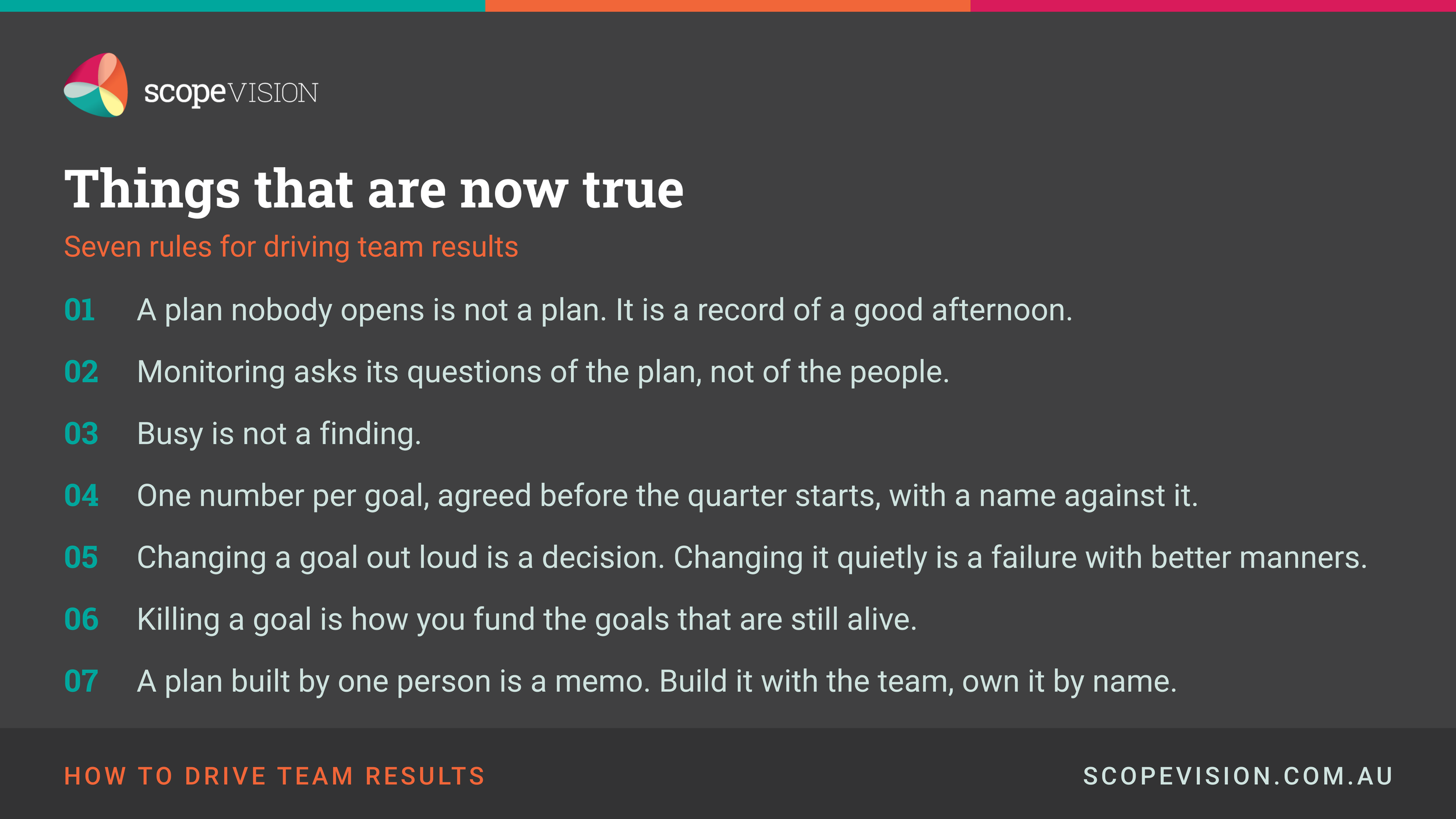
Your plan did not fail. It went quiet, and quiet is the cheapest thing you will ever have to fix. The three Ms are how you fix it. They are unglamorous, they cost about fifteen minutes a week and an hour a quarter, and they are the difference between a team that hits its numbers and a team that finds out in December that it did not.
Monitor the work. Measure the number. Move the plan, out loud, on purpose.
The hour a quarter
Running your own Move session is the hard one.
We facilitate the session where a team monitors what it agreed, measures what actually moved, and decides honestly what to do about the rest. Somewhere collaborative, a good deal more fun than a boardroom, and with somebody in the room whose job it is to ask the awkward question.
Email MJ about your team Use the contact form instead
The first button opens your email app with three questions already in it. If nothing happens when you tap it, your device has no mail app set up, so use the contact form.
Driving results through people is what we do.
For students, and anyone who wants the evidence
Every figure quoted in this article is listed below, in Harvard. Where a source has a limitation worth knowing about, it is named in the article rather than hidden here.
Amabile, T. and Kramer, S. (2011) The Progress Principle: Using Small Wins to Ignite Joy, Engagement, and Creativity at Work. Boston, MA: Harvard Business Review Press.
Kerr, S. (1975) 'On the folly of rewarding A, while hoping for B', Academy of Management Journal, 18(4), pp. 769-783. Available at: https://doi.org/10.5465/255378
Kerr, S. (1995) 'On the folly of rewarding A, while hoping for B', Academy of Management Executive, 9(1), pp. 7-14. Available at: https://doi.org/10.5465/ame.1995.9503133466
Mankins, M.C. and Steele, R. (2005) 'Turning great strategy into great performance', Harvard Business Review, 83(7), pp. 64-72.
Sull, D., Homkes, R. and Sull, C. (2015) 'Why strategy execution unravels, and what to do about it', Harvard Business Review, 93(3), March. Reprint R1503C. Available at: https://hbr.org/2015/03/why-strategy-execution-unravelsand-what-to-do-about-it
Three notes on the sources. The Sull title is punctuated with a dash in the original and is rendered here with a comma, to match house style. Published records disagree on its page range, so it is cited here by issue and reprint number, which are unambiguous. The 63 per cent figure is consulting research by Marakon Associates reported in a practitioner journal, not peer reviewed work, and is treated in the article as an illustration of a mechanism rather than as a precise measurement. All figures in this article are original artwork built from the sources above.
Cite this article
Reference list
Satterthwaite, M-J. (2017) How to drive team results: monitor, measure and move. Revised August 2026. Scope Vision. Available at: https://scopevision.com.au/blog/how-to-drive-team-results (Accessed: [insert date]).
In text
(Satterthwaite, 2017)
Keep reading
Align your Team's Vision, Behaviour and ConsequencesThe same three Ms, pointed at behaviour instead of goals, plus twenty conversations a team can work through two or three at a time.
Stop SWOTing. Start SOARing.Move needs something to move towards. This is the framework we use to run the quarterly session itself.
5 Keys to Holding Great Coaching ConversationsWhat is stuck, and who is unsticking it, is a coaching question. This is how to ask it without taking the problem off them.
Why do we tolerate porcupines in the workplace?For when the goal is not stuck on a process. It is stuck on a person, and everybody knows it.
Open it. That is the whole ask.
The like button just below is how I know.
And if someone came to mind while you were reading, send it to them. That is the better compliment.