Here's an uncomfortable truth about most planning sessions: they start with a dying whiteboard marker and someone saying "right, let's SWOT it."
Forty minutes later you've got a wall of Weaknesses and Threats staring back at you like a bad performance review. Everyone's gone quiet. Someone's checked their phone four times. The energy's left the building, people have checked out.
That's not a planning tool doing its job. That's a slow puncture.
SOAR is what you reach for instead and it might just be the best planning tool nobody's got you excited about.
SWOT isn't wrong. It's just tired.
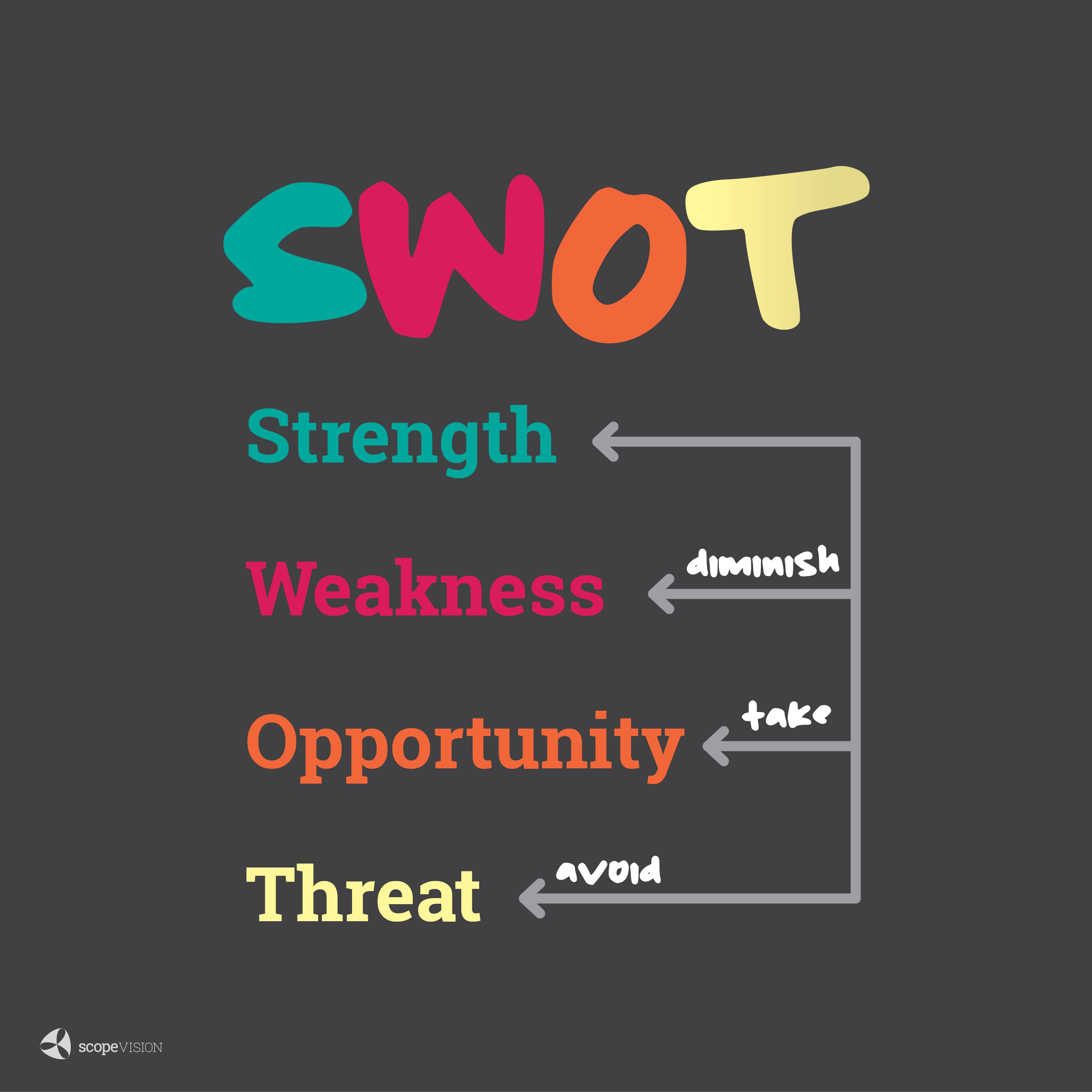
SWOT is an analysis tool. Brilliant for spotting gaps. Less brilliant for getting a room full of switched-on people fired up about the future.
Half of it is dedicated to what's broken — Weaknesses, Threats. Fair enough, you need to know where the exposed cables are. But if that's all you focus on, you train your best people to get really good at spotting problems and average at building exceptional solutions. And around here, average doesn't cut it.
Here's the thing about your teams: they already spend all day thinking about faults, failures and what could go wrong. That's the job, and they're brilliant at it. What they don't get nearly enough of is a proper conversation about what's going right, and where that could take them.
Enter SOAR
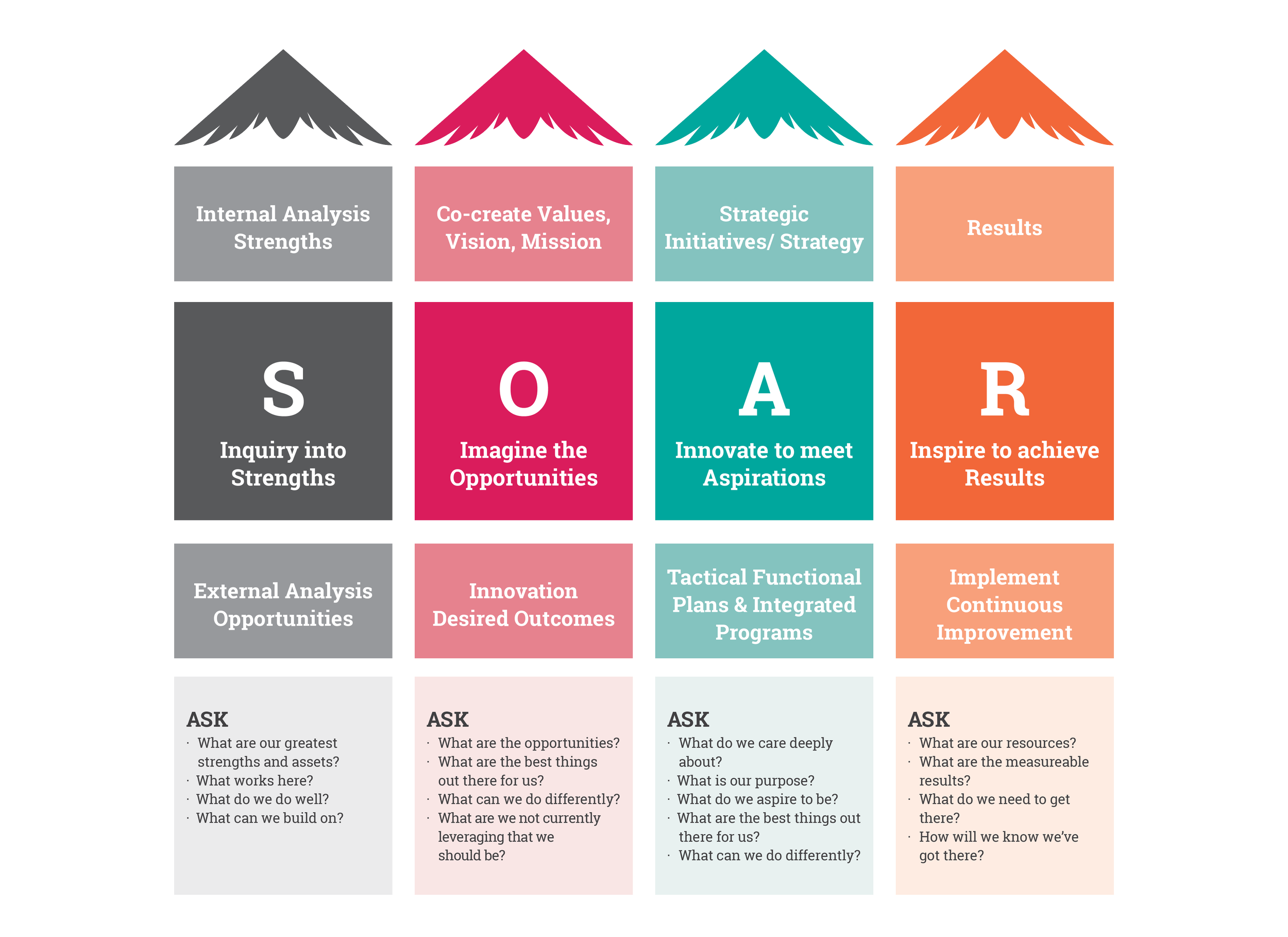
SOAR is a strengths-based planning framework. Same DNA as SWOT, completely different attitude:
● Strengths — what are we exceptional at?
● Opportunities — what big wins are sitting right in front of us?
● Aspirations — what do we want to be famous for?
● Results — what does winning actually look like?
Weaknesses don't vanish, they get reframed inside the Opportunities conversation. "We're bad at X" becomes "here's the gap, and here's what closing it opens up for us." Same issue. Completely different energy in the room.
Strategy researchers Stavros and Hinrichs describe SOAR as a strengths-based approach that brings in the voices of everyone with a stake in the outcome — not just the people at the top of the org chart. That's not corporate fluff. That's the whole point: the people closest to the work usually know exactly what's working. Someone just needs to ask them.
Why this actually matters in the room
Picture two team briefings.
Talk one: "Here's everything that went wrong last month, and here's the audit findings." Everyone nods. Half-listens. Gets back to it.
Talk two: "What did we do this month that we should be doing every month? What's one thing we're sitting on that could make next month easier, safer or faster?" Now people are actually talking — because you've made them the expert on something they're proud of, not the accused in something they didn't cause.
That's the whole engine here. It's called Appreciative Inquiry — a fancy term for a simple idea: people build more, and build better, from what's working than from what's broken. Ask "what's working around here?" and you get engagement. Ask "what's wrong?" and you get compliance, if you're lucky.
SOAR in 5 moves
SOAR runs on a "5-I" approach — five steps, one clear direction:
1. Initiate — make the call to actually use it
2. Inquire — dig into your real strengths
3. Imagine — get honest about the opportunities
4. Innovate — figure out what it'll take to reach your aspirations
5. Inspire to implement — turn all of that into measurable results
Simple on paper. The magic's in doing it properly; right questions, right people in the room, nobody let off the hook on the "Results" bit.
Steal this for your next team meeting
Skip the "what went wrong" agenda item. Open with these four instead:
● What's our proudest win from the last quarter, and what does it say about what we're good at?
● What's one opportunity sitting right in front of us that we haven't picked up yet?
● If we nailed the next 12 months, what would "nailed it" actually look like?
● How will we know we've got there?
Four questions. Twenty minutes. Watch the room change. Once a year is the right cadence for those four. SOAR is the annual rhythm, not a one-off workshop, and it works best when something smaller is happening in between. What that looks like across a year is the argument in Freedom Starts Between the Ears.
Don't just fly
SWOT still has its place; sometimes you genuinely need a hard, clear-eyed look at the threats. But if every planning conversation your team has starts and ends with what's broken, don't be surprised when nobody brings anything to the next one.
Give your people a framework that asks them to bring their best selves to the table, not just their problems. Strength in, strength out.
FREE EBOOK
Don't Just Fly... SOAR
Fourteen pages. The framework, a side by side comparison with SWOT, the appreciative inquiry thinking underneath it, the five stage process, four pages of prompt questions, and blank templates you can run a session from. Ask and I will send it.
The button opens an email with the request already written. If nothing happens when you click, your device has no mail app set up. Use Get in touch instead.
References and further reading
Stavros, J.M., Cooperrider, D.L. and Kelley, D.L. (2003) 'Strategic inquiry, appreciative intent: inspiration to SOAR, a new framework for strategic planning', AI Practitioner, November, pp. 10-17. The founding article. SOAR grew out of Stavros's 1998 doctoral work and was reworked into the four-part framework with Cooperrider and Kelley.
Stavros, J.M. and Hinrichs, G. (2009) The Thin Book of SOAR: Building Strengths-Based Strategy. Bend, OR: Thin Book Publishers. The practical handbook, and the source of the definition used in the eBook.
Coghlan, A.T., Preskill, H. and Catsambas, T.T. (2003) 'An overview of appreciative inquiry in evaluation', in Preskill, H. and Coghlan, A.T. (eds) Appreciative Inquiry and Evaluation. New Directions for Evaluation, 100, pp. 5-22. San Francisco: Jossey-Bass.
Anderson, H., Cooperrider, D. et al. (2008) The Appreciative Organization. Chagrin Falls, OH: Taos Institute Publications.
A note on SWOT. Its origins are genuinely murky. It is often credited to Albert Humphrey at Stanford Research Institute in the 1960s, but Humphrey never claimed it and researchers have not been able to confirm it. The earliest solid documented use is in Harvard business policy teaching of the late 1960s. So if you have ever been told confidently who invented SWOT, be a little suspicious.
Cite this article
Satterthwaite, M-J. (2026) 'Stop SWOTing. Start SOARing.', Scope Blog, 25 July. Available at: https://scopevision.com.au/blog/stop-swoting-start-soaring (Accessed: [insert date]).
In text: (Satterthwaite, 2026).
Keep reading
- Freedom Starts Between the Ears. Where the annual SOAR sits, and the two smaller rhythms that keep a plan alive between them.
- How to Drive Team Results: Monitor, Measure and Move. You have run the session and set the goals. This is what happens to them afterwards.
- 5 Keys to Holding Great Coaching Conversations. Asking what is working is a skill. This is how to ask it without leading the witness.
- Align your Team's Vision, Behaviour and Consequences. Same strengths-first approach, pointed at how a team behaves rather than what it plans.
That was a whole article about starting with what is working.
Go on. Practise.
The like button just below is how I know.
And if someone came to mind while you were reading, send it to them. That is the better compliment.