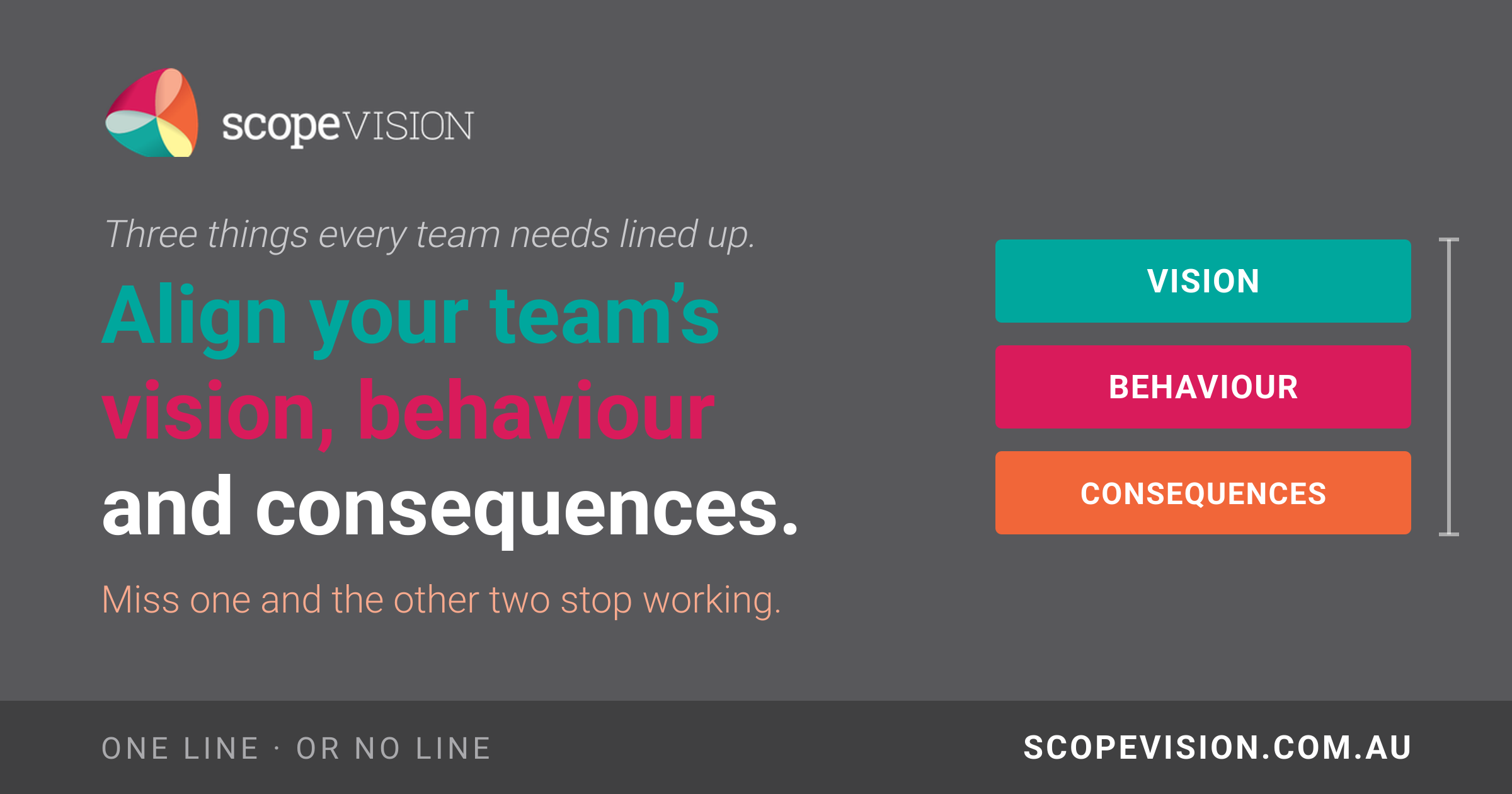
Three things every team needs lined up. Miss one and the other two stop working.
What causes a team to derail? A mismatch in values? The wrong membership from the outset? Ineffective recruitment and onboarding?
All of those contribute. But one thing is certain. The only way to build a high performing team is to align three things: vision, behaviour and consequences. Most teams manage one. Plenty manage two. Almost nobody lines up all three, and that’s exactly why the average team hits the skids and then can’t get traction back.
Heard it all before? Good. Then it’s time to get back to basics.
Why the three have to line up
Here’s what each one looks like on its own.
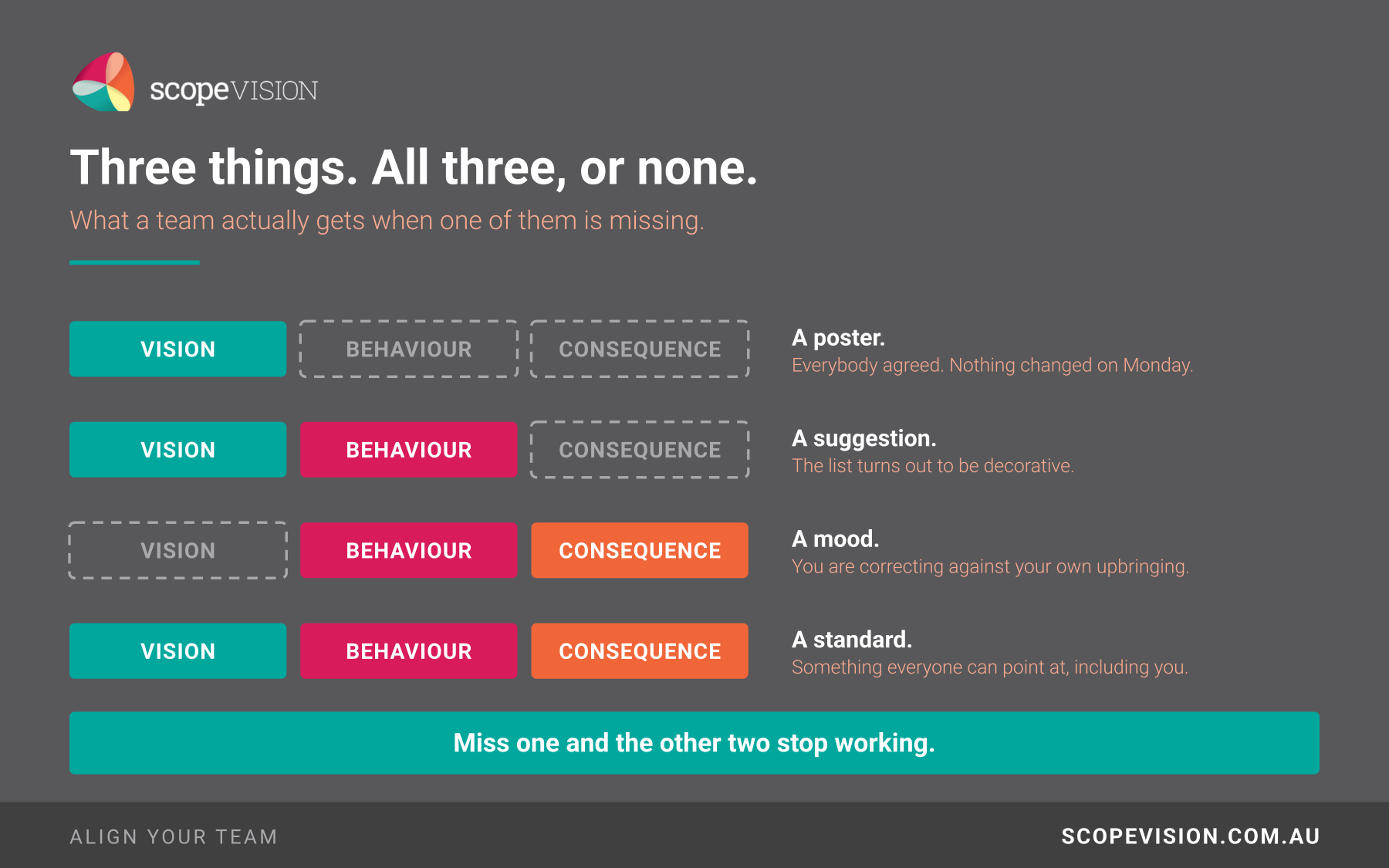
Vision, no behaviour. Everybody agreed with it in the workshop. Nobody argued. Then Monday comes around and nothing anybody does is any different, because no one ever said what “we support each other” actually looks like at four o’clock on a bad day.
Behaviour, no consequence. The people who were always going to do the right thing carry on doing it. Everybody else waits to see what happens the first time somebody breaks a rule. When nothing does, the list becomes decorative, and your best people quietly learn that the standard is optional.
Consequence, no vision. Now you’re just the boss who snapped. A correction has to point at something the team agreed to. Without that, you’re not holding somebody to the team’s standard. You’re holding them to your own, built out of your own upbringing and whatever “normal” looks like for you. And they were never invited to step inside your thinking.
So this isn’t a values workshop you can tick off and file. It’s three conversations, and they only hold each other up.
Start with vision, and test it honestly
Vision is the one everybody assumes is already handled, because there is a statement somewhere and somebody paid for it.
Here is the test. Ask three people on your team, separately, what this team is for. Not the organisation. This team. What would stop working if you all went home tomorrow?
If you get three different answers, you have found your first conversation, and it isn’t a behavioural one.
It doesn’t have to be inspiring. It has to be sayable. The measure isn’t whether people agree with the words, it is whether they can produce them without looking anything up, and whether they point at the same thing when they do. Get that far and behaviour has something to attach to. Skip it, and you are agreeing conduct in a vacuum.
The reason it feels harder than it should
Not everyone shares the same values, and not everyone finds the same behaviours appropriate or acceptable. Obvious, written down. And yet teams carry on as though everybody were working off the same rulebook.
I am drawn to the example of the dinner table.
Some of us were raised at tables where everybody talked over the top of one another, and jumping in mid-sentence was proof you were interested. Others grew up where you waited for the full stop, and interrupting was the height of rudeness.
Fast forward to Monday’s team meeting, the passionate one, where everybody actually cares about the outcome.
One colleague jumps in mid-sentence, because that is what interested looks like where they come from. And in that moment, one colleague has decided the other is rude. Another has quietly concluded their colleague has nothing to contribute. Both are wrong. Neither will ever say so out loud, and both will carry it into the work space.
Whose upbringing was the correct one? Neither. That’s the point. Unless a team invests the time to agree the behaviours that underpin how it works, everybody quietly assumes they were all raised in the same household. Which is a dangerous foundation to build anything on, let alone a high performing team.
Now multiply that by every unspoken rule a team never discusses. What counts as urgent. What deserves an apology. Whether silence means agreement. It is little wonder behaviour drifts away from vision without anybody meaning it to.
The conversations worth having
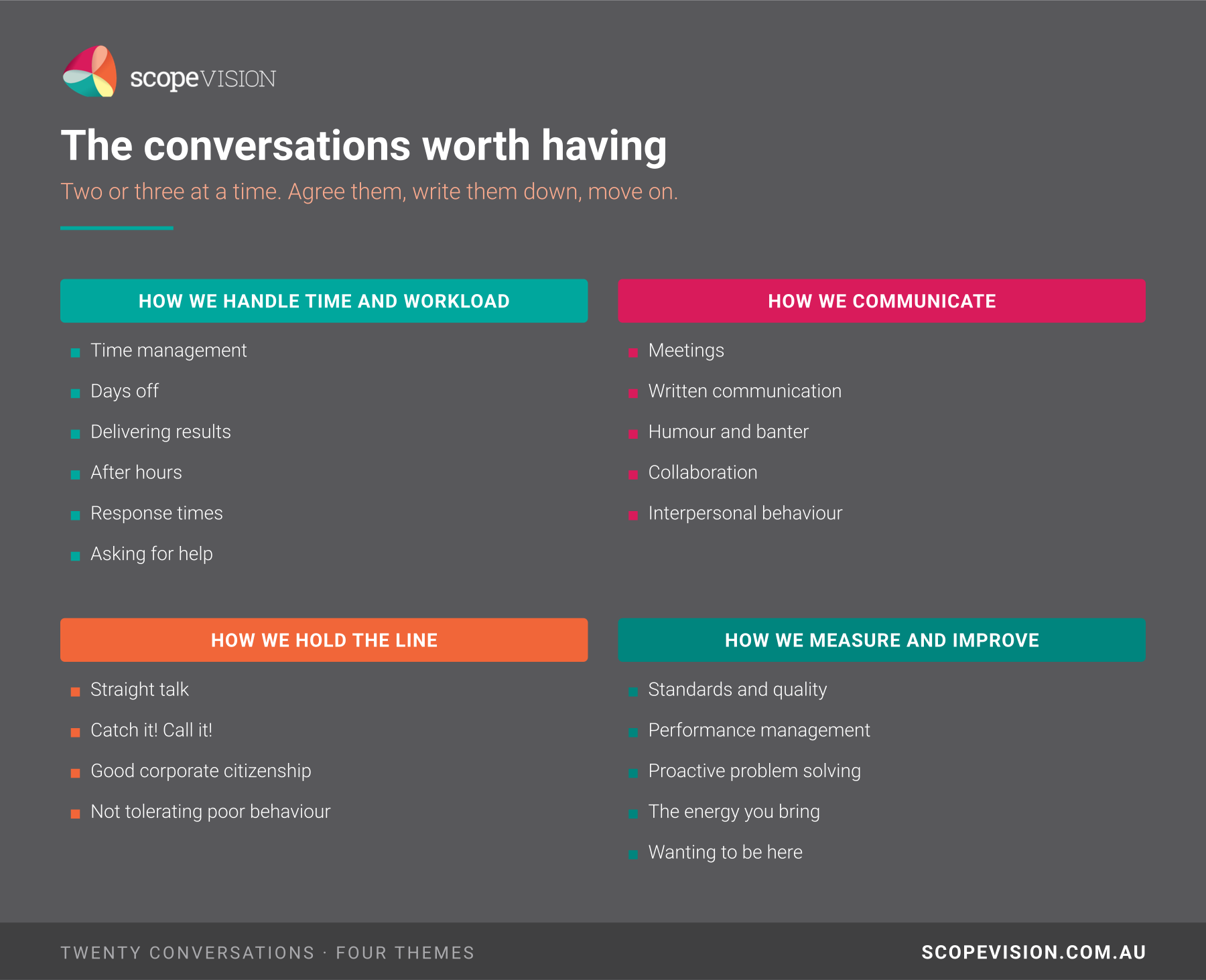
You won’t get through this in one meeting and you shouldn’t try. Take two or three at a time, agree them, write them down, move on.
As for which two or three: start with the theme where your team is already paying a price. If people are guessing what counts as urgent, start with time and workload. If nobody says anything when a line gets crossed, start with holding the line. If the same argument keeps happening in different clothes, start with how you communicate. Pick the one that matches the actual pain and you get a win early, which is what makes a team willing to come back for the harder ones.
The conversations worth having
Twenty conversations. Four themes. Tap any one to open it.
Two or three at a time · agree them · write them down
Time management+–
What is the norm if you think you may be late or absent? Who do you tell, and by when?
Days off+–
What’s the process for sick days and personal leave? Is honesty always the best policy here, and if not, why not?
Delivering results+–
When a due date is set, what’s the process for changing it? Who needs to know, and how early?
After hours+–
When is it reasonable to contact somebody outside their hours, and when is it reasonable not to reply? A message sent at nine at night without an expectation attached still lands like one. What is our rule, and what counts as a genuine emergency?
This one has law behind it. Under the Fair Work Act an employee can refuse to monitor, read or respond to work contact outside their working hours unless that refusal is unreasonable. It applied to employers with fifteen or more employees from 26 August 2024, and to small business employers from 26 August 2025.
Response times+–
What is a reasonable time to reply, and does it change depending on how the message arrived? If something is genuinely urgent, do we use email at all? And is “seen it, coming back to you Thursday” an acceptable answer? It should be. Most of the friction here is not slowness, it is silence.
Asking for help+–
What does it look like here when somebody is drowning? Do they ask, or wait to be offered? And when you have capacity, whose job is it to notice?
Meetings+–
How often do we meet, in what forum, and what actually gets decided there rather than reported?
Written communication+–
When do we copy people in, and when don’t we? What belongs in a channel, what belongs in an email, and what should have been a two minute conversation?
Humour and banter+–
What is funny here, and what isn’t? Where is the line between a joke that pulls a team together and one that lands as a dig? And what happens when somebody says they have had enough of it? I have written about what getting this wrong costs a leader.
Communication and collaboration+–
Where does the current version live? Who updates it, and what are the non-negotiables?
Interpersonal behaviour+–
What’s our internal customer standard? How do we greet and treat one another, including on the days we’re under pressure?
Straight talk+–
How do we approach one another when a crucial conversation is needed? Is there a word or phrase that signals a behaviour has crossed the line? Ours is “team value”.
Catch it! Call it!+–
Catching a breach as it happens and naming it there, rather than saving it up for later or for somebody else to deal with. What does that look like here? Who says something, how soon, and in what words? Agree the phrasing now, while nobody is upset, because nobody invents a good sentence in the middle of a bad moment.
Good corporate citizenship+–
We’re here to enable one another. Conversations aimed at devaluing a colleague don’t happen, including the ones held when they’re not in the room.
Not tolerating poor behaviour+–
Everyone contributes to team morale. Negative behaviour doesn’t get built upon, and it isn’t the manager’s job alone to say so.
Standards and quality+–
What if you can’t call the meeting?
Everything above assumes you are the person who can put this on an agenda. Plenty of readers aren’t, and if that is you, the honest answer is that you cannot agree twenty behaviours on your own.
You can agree one, with the person next to you.
“Can we agree that if either of us is annoyed about something, we say it within a day?”
That is a two-person norm. It costs nothing, it needs nobody’s permission, and it works immediately for the two of you. Then it spreads, because people notice a pair who sort things out quickly and stop dreading each other’s company.
Most team agreements start this way. Not in a workshop, but between two people who got tired of the alternative. If you are waiting for somebody senior to convene the conversation, you may wait a long while. Start with one person and one behaviour.
Now agree the consequences
This is the step teams skip. Skip it and everything you just agreed goes back on the wall and stays there.
There is always a consequence when somebody breaches what the team agreed. The only question is who pays it. Leave it alone and the cost doesn’t disappear. It transfers onto the people who work around it, cover for it, and eventually leave because of it.
And a consequence isn’t a punishment. Most are small and early: naming it in the moment, a quiet word afterwards, putting it right with the person on the receiving end. Agree them at the same time you agree the behaviours, not after somebody breaches one, because a consequence invented on the spot always feels personal. And this isn’t personal.
And if a behaviour has been left alone so long it has become somebody’s personality, you’ve got a porcupine. That one has its own article:
Why do we tolerate porcupines in the workplace?
Agreed is not finished
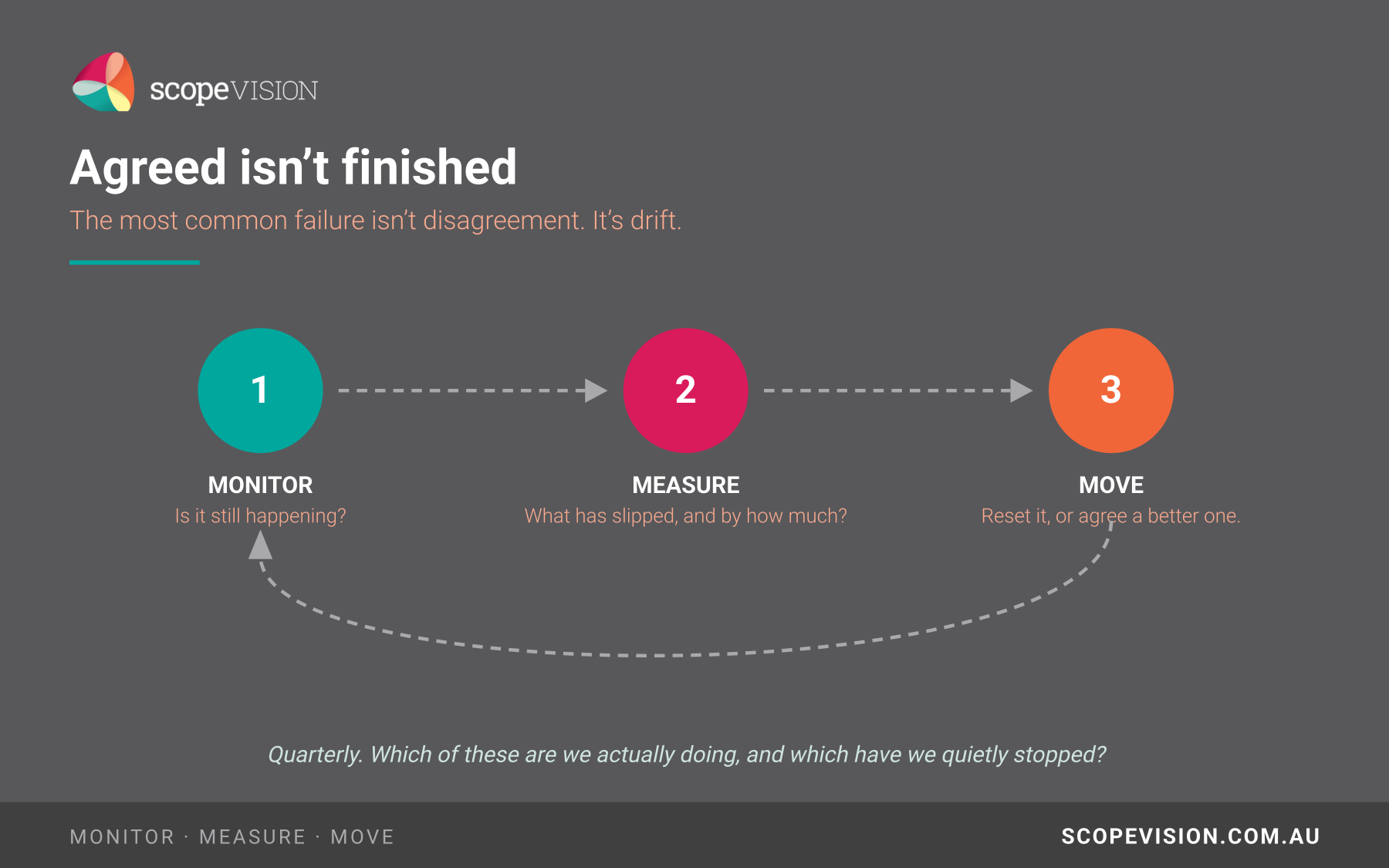
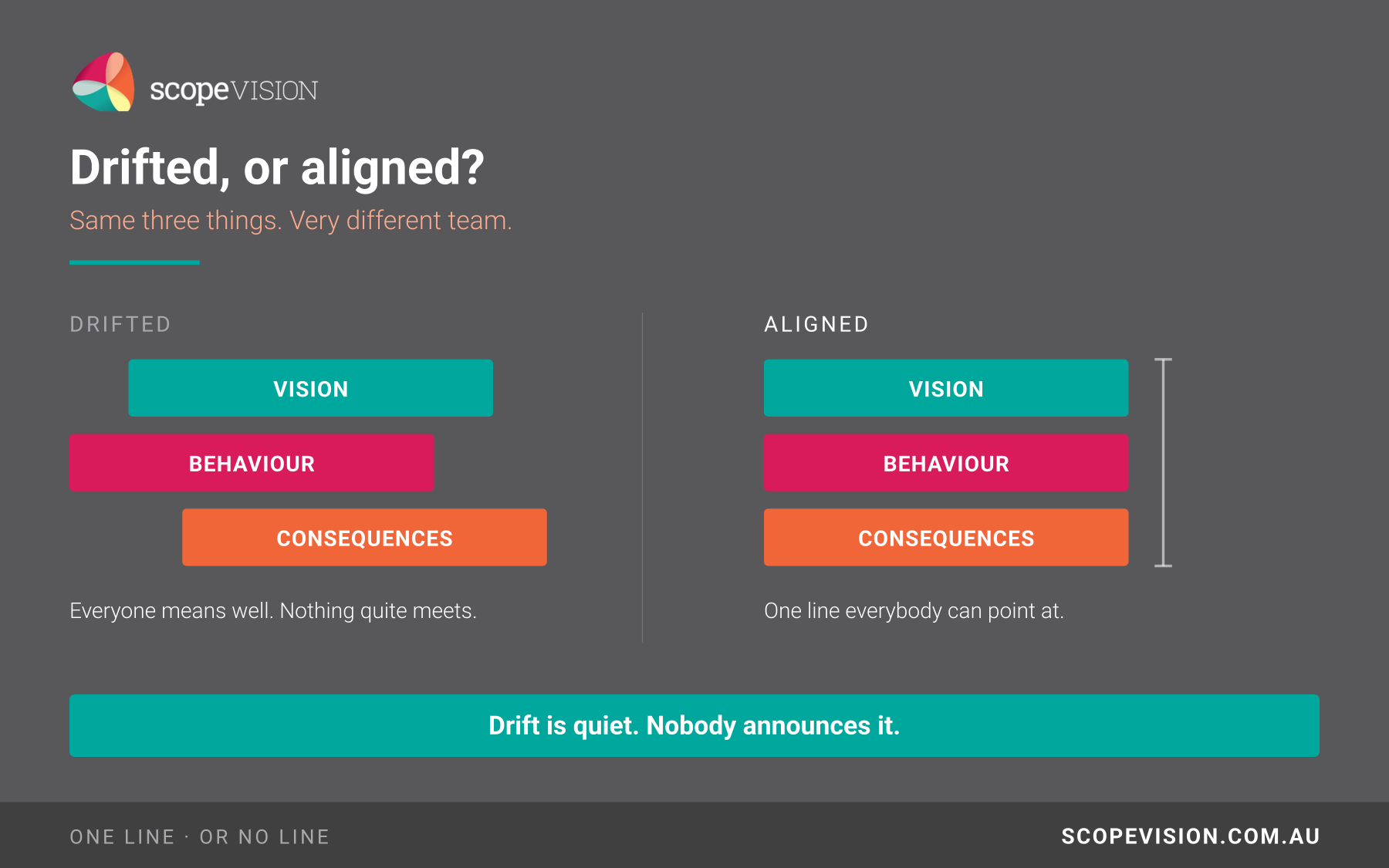
The most common failure isn’t disagreement. It’s drift. A team agrees a good set of behaviours in March and by August nobody could name three of them, because the agreement got made once and never looked at again.
Put them on the agenda. Not as a standing item nobody reads, but as a genuine question, quarterly. Which of these are we actually doing, and which have we quietly stopped? Same monitor, measure and move discipline that keeps team goals alive. It works exactly the same way on behaviours:
And the new person on Monday?
Back to the question this article opened with. Does a team derail because of ineffective recruitment and onboarding?
Sometimes, yes, and here is the mechanism. A team agrees a good set of behaviours in March. In September somebody new starts. Nobody tells them. Six months on there are two sets of norms operating in the same room, neither written down anywhere the new person could have found, and everybody is quietly annoyed with somebody who was never given a chance.
So give the agreement a home. Not a folder nobody opens, but somewhere a new starter is actually walked through it in their first week, by whoever runs their induction. And when you do, ask them one question: is there anything here you would change?
That question is the whole difference between handing somebody the rules and making them part of the agreement.
It also keeps the agreement honest. A new person is the only one in the room who can still see which of your behaviours are real and which are just written down.
This is how culture actually gets built
None of this stays agreed on its own. What keeps a set of behaviours alive is the hundred small moments afterwards where somebody either holds the line or lets it go.
Which is what culture really is. Not the words you agreed in the workshop, but the residue of the conversations that followed. Agree the behaviours and you have given your team something to point at. Have the conversations and you move where the whole team sits.
Where this comes from
This article is practitioner work, not a research paper. The framework is mine and the examples come from the room. Several of its claims do rest on established research, though, and they are set out below so they can be followed up or cited.
The gap between what a team agrees and what it then does is Argyris and Schön's distinction between espoused theory and theory-in-use (1974). The idea that the deepest layer of a culture is a set of assumptions nobody has ever said out loud is Schein's (2017), and it is the reason two people can each behave impeccably by their own upbringing and still offend one another.
That unaddressed breaches invite further breaches is not just an impression. Across six field experiments, Keizer, Lindenberg and Steg (2008) found that people who could see one rule had been broken and left standing became more likely to break other, unrelated rules. In one of those experiments the rate of petty theft roughly doubled. Felps, Mitchell and Byington (2006) reviewed how one member's sustained poor behaviour degrades a whole team's functioning, and why early intervention matters.
Mutual accountability between team members, rather than accountability upward to a manager, is one of Katzenbach and Smith's (1993) defining features of a real team. Hackman (2002) makes clear norms one of the enabling conditions for team effectiveness, and Edmondson (1999) shows why a team where people can speak up outperforms one where they cannot. And West's (1996) work on team reflexivity, the habit of a team stopping to examine how it is working, is the thinking behind revisiting the agreement rather than setting it once.
Energy is not a soft item either. Barsade (2002) put a trained confederate into managerial decision-making groups and found that the mood they carried in transferred measurably to everybody else, and that the pleasant version improved cooperation and reduced conflict. Whatever you walk in with, the room catches it.
The instinct to agree the standard before you need it, rather than inventing one at the moment of correction, is also the logic of Blanchard and Johnson's One Minute Goals (2015). Their re-direct makes the same distinction this article does between somebody who knew the standard and somebody who never had it explained.
A note on evidence. These sources support the underlying principles, not the specific model set out here. Vision, behaviour and consequences as a trio is a practitioner framework, and the four groupings of conversations are a teaching device rather than a tested instrument.
References
Argyris, C. and Schön, D.A. (1974) Theory in Practice: Increasing Professional Effectiveness. San Francisco: Jossey-Bass.
Barsade, S.G. (2002) 'The ripple effect: emotional contagion and its influence on group behavior', Administrative Science Quarterly, 47(4), pp. 644-675.
Blanchard, K. and Johnson, S. (2015) The New One Minute Manager. New York: HarperCollins.
Edmondson, A. (1999) 'Psychological safety and learning behavior in work teams', Administrative Science Quarterly, 44(2), pp. 350-383.
Fair Work Act 2009 (Cth), s 333M (right to disconnect, inserted by the Fair Work Legislation Amendment (Closing Loopholes No. 2) Act 2024).
Felps, W., Mitchell, T.R. and Byington, E. (2006) 'How, when, and why bad apples spoil the barrel', Research in Organizational Behavior, 27, pp. 175-222.
Hackman, J.R. (2002) Leading Teams: Setting the Stage for Great Performances. Boston: Harvard Business School Press.
Katzenbach, J.R. and Smith, D.K. (1993) The Wisdom of Teams: Creating the High-Performance Organization. Boston: Harvard Business School Press.
Keizer, K., Lindenberg, S. and Steg, L. (2008) 'The spreading of disorder', Science, 322(5908), pp. 1681-1685.
Schein, E.H. and Schein, P. (2017) Organizational Culture and Leadership. 5th edn. Hoboken: Wiley.
West, M.A. (1996) 'Reflexivity and work group effectiveness: a conceptual integration', in West, M.A. (ed.) Handbook of Work Group Psychology. Chichester: John Wiley & Sons, pp. 555-579.
Cite this article
Satterthwaite, M-J. (2016) Align your team's vision, behaviour and consequences. Revised August 2026. Scope Vision. Available at: https://scopevision.com.au/blog/2016/2/1/align-your-teams-vision-behaviour-and-consequences (Accessed: [insert date]).
In text: (Satterthwaite, 2016)
Originally published February 2016 and fully revised in August 2026. The framework is unchanged; the examples, the grouping of the conversations, and the guidance on vision, consequences and onboarding have been updated.
Twenty conversations
Would rather not run these conversations alone?
We facilitate them. Somewhere collaborative, a good deal more fun than a boardroom, and with somebody in the room whose job it is to ask the awkward question.
Email MJ about your team Use the contact form instead
The first button opens your email app with the questions already in it. If nothing happens when you tap it, your device has no mail app set up, so use the contact form.
Driving results through people is what we do.
Keep reading
Why do we tolerate porcupines in the workplace?For when a behaviour has been left alone so long it has become somebody's personality.
How to Drive Team Results: Monitor, Measure and MoveThe same discipline, pointed at goals instead of behaviour, and the two questions that tell you whether the plan is still alive.
The 13 Counterfeits of TrustEvery behaviour you agree has a forgery. This is what yours turns into when the pressure comes on.
The Keys to Holding Great Coaching ConversationsAgreeing the behaviour is the easy half. This is how to hold the conversation when somebody breaches it.
Start with one.
Start with the person next to you.
The like button just below is how I know.
And if someone came to mind while you were reading, send it to them. That is the better compliment.