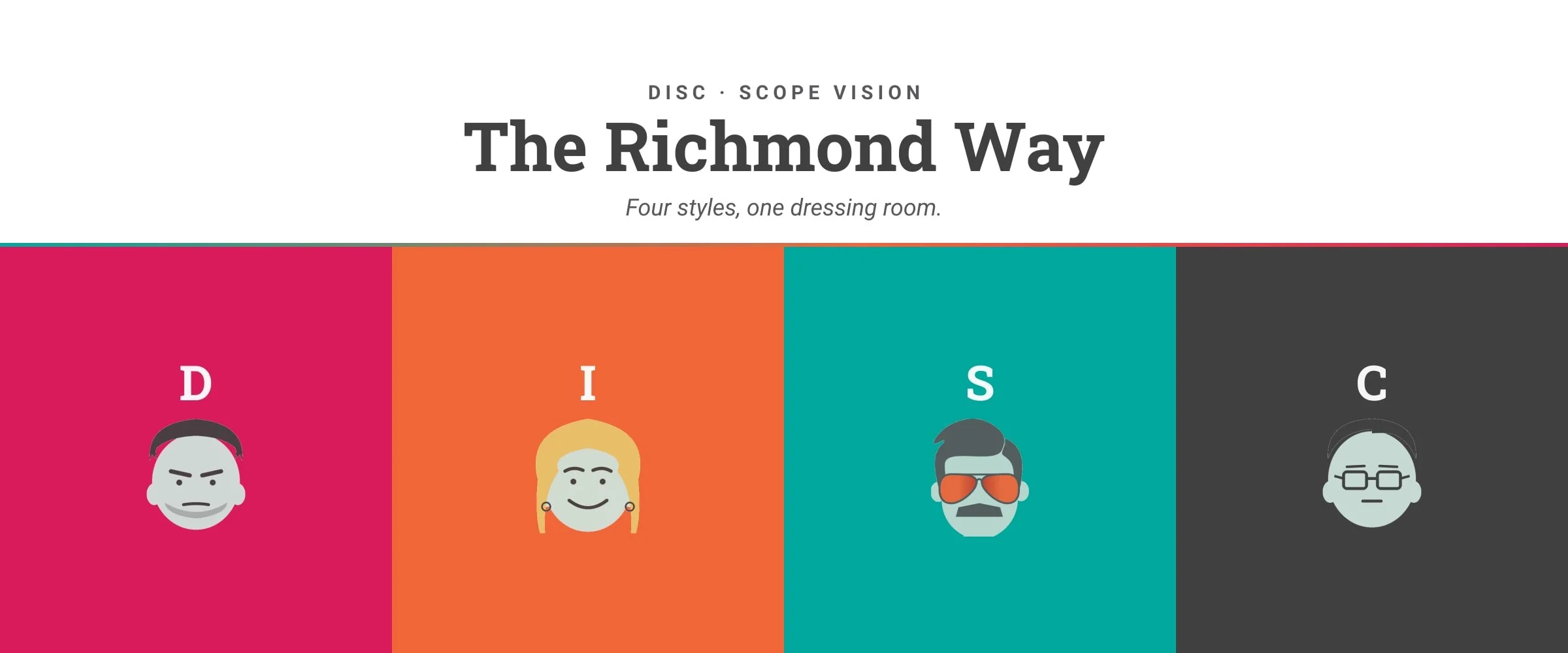
Ask a room of leaders to define a high D and you’ll get a serviceable definition. Ask them to name one and the room goes quiet.
Ask the same room whether Roy Kent is a D and every hand goes up.
That’s the whole case for teaching DISC through characters. A shared fictional world is the closest thing a workshop gets to a controlled experiment: everyone watched the same performance, everyone saw the same behaviour, and nobody has to take anybody’s word for it.
And there is no better DISC classroom on television than AFC Richmond.
Ted Lasso gives you all four styles, fully drawn, in one dressing room. It gives you them under pressure. It gives you what happens when they collide. And — unusually for a comedy — it gives you what happens when one of them breaks.
Everyone remembers the moment Nate turned. Almost nobody can tell you why.
That’s the part of this article worth staying for, and it’s the part most DISC training never reaches. We’ll get there. First the four styles, and an honest account of what the model can and can’t do — because a break only makes sense once you know what was breaking.
This is how we explain it, written down.
First, what DISC actually is
Worth being straight about this, because a lot of DISC content isn’t.
DISC traces back to William Moulton Marston, a Harvard-trained psychologist who described four patterns of emotional expression in his 1928 book Emotions of Normal People. He was a genuinely odd figure: he also helped develop an early lie detector, and he created Wonder Woman.
Here’s the part almost nobody mentions. Marston never built an assessment. He wasn’t especially interested in personality testing. The instruments came later and from other people — Walter Clarke in the late 1940s, John Geier decades after that — and they revised the model as they went. Marston’s original four were Dominance, Inducement, Submission and Compliance. Two of those words didn’t survive. Submission became Steadiness. Compliance became Conscientiousness.
DISC is not a fixed scientific object. It’s a language that has been revised, commercialised and re-revised for nearly a century.
That’s not a reason to bin it. It’s a reason to be precise about what you’re claiming for it.
What the evidence supports — and what it doesn’t
The honest summary: DISC’s strongest case is as a communication and self-awareness framework. Its weakest is as a predictor of job performance, where the peer-reviewed evidence is thin.
Compare the Big Five. Barrick and Mount’s 1991 meta-analysis found conscientiousness predicted performance consistently across all five occupational groups they examined — professionals, police, managers, sales, and skilled and semi-skilled workers. That’s an evidence base DISC simply doesn’t have, and any practitioner who implies otherwise is selling you something.
One more limit worth naming, because almost nobody does. Most DISC instruments are forced-choice: you pick the word most like you and the word least like you. That produces an ipsative score — it ranks your own preferences against each other, not against anybody else’s. Your profile is a useful map of you. It is not a measurement you can line up next to the person sitting beside you, however tempting the bar chart makes it look.
So use DISC to help a team talk to each other. Don’t use it to hire, promote, or decide who gets the stretch assignment. That isn’t a limitation we’re admitting reluctantly — it’s the boundary that keeps the tool honest.
Two questions, four styles
Before the characters, the map. DISC is really two questions wearing a four-letter coat: how fast do you move, and do you lead with the task or with the people? Answer both and you’ve placed yourself.

Nobody sits in one box permanently — you’ll recognise yourself in two, and one will be louder under pressure. That’s the point, not a flaw in the map.
Before you read on: which one annoys you?
Four things people say at work. Tap the one that makes your jaw tighten — it opens to show what that says about you.
1“I’ve made the call. We’ll sort the fallout later.”
YOU’RE PROBABLY
S — Steadiness
Patient, loyal, steady under load.
2“Let’s get everyone in a room and talk it out — I’ll bring the energy.”
YOU’RE PROBABLY
C — Conscientiousness
Precise, analytical, evidence first.
3“Let’s not rush this. People are still recovering from the last change.”
YOU’RE PROBABLY
D — Dominance
Direct, decisive, moves first.
4“I’m not signing off until I’ve been through the numbers again.”
YOU’RE PROBABLY
I — Influence
Warm, verbal, thinks out loud.
The sentence that irritated you isn’t your style. It’s the one sitting diagonally opposite you on the map.
We are rarely irritated by people who work the way we do. We are irritated by people whose pace or focus is the opposite of ours — and irritation is a faster read than self-description, because nobody manages their honest answer.
Four sentences is not an assessment. It tells you where to start looking, not what you are.
The dressing room
Four styles. One club. Here’s how they show up.

D Dominance
Direct. Decisive. Results now.
At Richmond: Roy Kent
Roy is the D style with nothing sanded off. Blunt to the point of comedy, allergic to sentiment, visibly impatient with anything that wastes time. He doesn’t manage his delivery and he doesn’t apologise for it. He is also, consistently, the most reliable person in the building — which is the D paradox in one character. The bluntness people complain about and the dependability they count on come from the same place.
The D style reads the world as a problem to be solved and moves first. Comfortable with conflict, impatient with process, far more interested in the outcome than the atmosphere. Rebecca Welton is the second D at Richmond — same decisiveness, different expression: cool, strategic, and initially willing to burn the whole club down to settle a score.
Elsewhere on screen
- Miranda Priestly — The Devil Wears Prada. Never raises her voice, terrifies everyone regardless.
- Furiosa — Mad Max: Fury Road. Decides, commits, drives.
- Okoye — Black Panther. Command presence without theatrics.
- Princess Leia and Darth Vader — Star Wars. Same style at opposite ends of the moral scale — a useful point in itself.
“Don’t be frightened to be a disrupter.” · “Courage is about being willing to try.” — Ted Lasso


I Influence
Enthusiastic. Persuasive. Thinking out loud.
At Richmond: Keeley Jones
Keeley builds an entire career out of warmth. She connects people, reads a room instantly, and moves things forward through relationships rather than authority — she has almost no formal power for most of the series and enormous actual influence. She’s also the counter-argument to everyone who thinks I is the unserious style: she’s the one who spots what people need and says it out loud.
The I style moves the room by connecting with it. Optimistic, verbal, quick to trust and quick to enthuse — brilliant at starting things, less reliable at the admin that follows. Jamie Tartt is the other I at Richmond, and a sharper lesson: same charisma, but pointed at himself rather than the group. Same style, very different outcome, depending entirely on what it’s aimed at.
Elsewhere on screen
- Michael Scott — The Office. Every I strength and every I blind spot, at maximum volume.
- Bandit Heeler — Bluey. The I style at its best — playful, present, genuinely persuasive.
- Jake Peralta — Brooklyn Nine-Nine. Charm as a working method.
- Miles Morales — Spider-Verse. Energy first, plan second.
“Inspire confidence in those around you.” · “Be curious, not judgemental.” — Ted Lasso


S Steadiness
Patient. Loyal. Steady under load.
At Richmond: Ted himself — and Higgins
Ted is high S with a strong I overlay: relentlessly supportive, deeply consistent, conflict-avoidant in a way that occasionally costs him. The biscuits every morning aren’t a gag, they’re the S style in miniature — small, repeated, reliable, relationship before task. Higgins is the purer S: loyal, self-effacing, absorbing far more than he lets on, and the person who quietly keeps the club functioning while louder people take the credit.
The S style keeps the thing running. Cooperative, consistent, dependable, and quietly resistant to sudden change. Dislikes conflict enough to absorb a great deal before saying anything — which is a strength right up until the moment it isn’t.
Elsewhere on screen
- Samwise Gamgee — The Lord of the Rings. Still the finest S ever written.
- Uncle Iroh — Avatar: The Last Airbender. Patience as an active strategy, not a passive one.
- Chilli Heeler — Bluey. Calm, consistent, and the reason the household works.
- Marge Simpson — The Simpsons. Holding the line, every single episode.
“‘We’ is greater than me.” · “Be a goldfish.” — Ted Lasso


C Conscientiousness
Precise. Analytical. Show me the data.
At Richmond: Nate Shelley — and Coach Beard
Nate is the kit man who sees the tactical detail nobody else notices. That’s C: sustained attention to something everyone else skims, and the standards to go with it. Coach Beard is the settled version — quiet, analytical, reads constantly, contributes precisely when it matters and not before. Two Cs, one settled and one about to come apart. That’s the promise from the top of this article, and it’s three sections away.
The C style wants it right more than it wants it fast. Systematic, careful, quality-obsessed, uncomfortable committing without evidence. Under pressure it retreats into detail — and it feels criticism far more sharply than the other three styles, because for a C the work and the self are hard to separate.
Elsewhere on screen
- Hermione Granger — Harry Potter. Preparation as a personality.
- Amy Santiago — Brooklyn Nine-Nine. Binders. So many binders.
- Chidi Anagonye — The Good Place. C taken to its logical, agonising conclusion.
- Sydney Adamu — The Bear. Standards under genuinely extreme pressure.
“Find out before you flip-out.” · “Doing the right thing is never the wrong thing.” — Ted Lasso


Why the ensemble matters more than the individual
Single examples teach you the style. The dressing room teaches you the dynamic — and the dynamic is the part that actually shows up at work, because nobody works alone.
Watch what Richmond does that most teams don’t: it adapts to the style rather than demanding the style adapt. Ted doesn’t try to make Roy warmer. He gives Roy a role where bluntness is an asset. He doesn’t try to make Keeley more systematic. He puts her where connection is the job.
That’s the entire practical payoff of DISC, and it’s the only reason the model earns its place. Not so people can announce their letter. So a team stops reading style as character.
“He’s difficult” becomes “he’s direct, and he needs the headline before the detail.” Same behaviour. Completely different response.
Nate’s arc, and the thing most DISC sessions miss
Here’s why Ted Lasso earns its place over every other ensemble we could use: it shows a style break.
Nate starts as a high C doing exactly what high Cs do well — noticing, analysing, improving the detail. Then he gets promoted, exposed, and praised inconsistently. And under that pressure the style doesn’t disappear. It distorts.
The precision curdles into criticism. The attention to detail becomes an obsession with status. The sensitivity that made him notice what others missed turns into a grievance he can’t put down. He doesn’t become a different person. He becomes an extreme version of the same one.
That’s the lesson most DISC workshops skip, because it complicates the fun bit. Your style under load is not your style at its best — it’s your style with the volume stuck up and the adjustment switched off. The C who is thorough on a good day is nitpicking on a bad one. The D who is decisive becomes bulldozing. The I who is engaging becomes exhausting. The S who is steady becomes immovable.

Which means the useful question isn’t “what’s my style?” It’s “what does my style turn into when I’m under pressure — and who around me sees it before I do?”
Worth watching for: Ted’s own arc is the subtler version. His relentless optimism is genuine and it is also a defence — the warmth is real, and it is doing a job for him. High S under sustained load doesn’t explode. It absorbs, and absorbs, and then something gives somewhere else entirely.

THIS HAS A NAME
Nate doesn’t become a different person. He becomes an extreme version of the same one — precision curdling into criticism, standards hardening into status anxiety. That pattern is called derailment, and there is a serious body of research behind it: Robert and Joyce Hogan found that leaders come apart not through a lack of ability, but through strengths that turn into liabilities under stress.
Every trust behaviour has a version like Nate’s. That’s the follow-up to this article: The 13 Counterfeits of Trust.
Why characters, and not real people
We get asked for lists of famous real people by style. We don’t publish them, for three reasons.
You can’t type a persona. DISC measures self-reported behaviour in a specific context. What you see of a public figure is a performance — coached, edited, and constructed by people whose job is to make it compelling. Typing a media image and calling it a person is a category error.
Lists age badly. Any list of public figures is one election, one scandal or one obituary away from being a problem — and a light L&D article is the worst possible place to discover that.
Characters are simply better teaching material. They’re scripted, so the behaviour is consistent. They’re observable, so everyone has identical evidence. They can’t be defamed and they can’t object. And a character is written to be legible — a screenwriter’s entire job is making motivation visible, which is exactly what real life never does.
The warning that has to come with this
There’s a reason a DISC profile feels uncannily accurate the first time you read it. It’s been studied since 1949.
Bertram Forer gave 39 students what they believed were individual personality assessments. Every one received the same text, assembled from a newsstand astrology book. They rated it 4.26 out of 5 for accuracy. Forer called it the fallacy of personal validation; Paul Meehl renamed it the Barnum effect in 1956, after the showman who built a business on having a little something for everybody. Both names describe the same trick.
Any framework that describes you in broad, largely flattering terms will feel like it knows you. That feeling is not evidence. It’s the most important caveat to put in front of a room before you hand out profiles — and the one most often skipped, because the delight is good for the session.
Treat recognition as the start of a conversation. Never as proof the instrument was right.
How to use it well
Do build a shared vocabulary, so someone can say “I need this in writing before I can commit” without it becoming an argument about attitude.
Do treat style as preference, not capacity. High C doesn’t mean can’t decide. High I doesn’t mean can’t focus.
Do talk about style under pressure. It’s where the real conversation is.
Don’t type your colleagues. Self-assessment is the only version with legitimacy, and typing someone else is how a language for understanding becomes a label for dismissing.
Don’t compare scores across people. Forced-choice results aren’t built for it, and a league table is the fastest way to turn a shared language back into a judgement.
Don’t use it for selection or promotion. See the evidence section.
The best outcome from a DISC session isn’t that everyone learns their letter. It’s that a team stops treating difference as a defect — and starts treating it as something they can actually work with.
Which is, more or less, the Richmond way.
Which one is you? And the more revealing question — which one would your team pick for you?
Want to know your actual profile?
Recognising yourself in an article isn’t the same as being assessed — that’s the whole point of the Barnum warning above. Scope Vision is an accredited DISC provider, and we can run individual or team profiling with a proper debrief: your own results, read against the limits set out here rather than oversold past them.
Enquire at scopevision.com.au — and if you want the honest version, have someone who works with you guess your letter first.
References
Barrick, M. R., & Mount, M. K. (1991). The Big Five personality dimensions and job performance: a meta-analysis. Personnel Psychology, 44(1), 1–26.
Forer, B. R. (1949). The fallacy of personal validation: a classroom demonstration of gullibility. Journal of Abnormal and Social Psychology, 44(1), 118–123.
Hogan, R., & Hogan, J. (2001). Assessing leadership: a view from the dark side. International Journal of Selection and Assessment, 9(1–2), 40–51.
Marston, W. M. (1928). Emotions of Normal People. London: Kegan Paul, Trench, Trubner & Co.
Meehl, P. E. (1956). Wanted — a good cookbook. American Psychologist, 11(6), 263–272.
A note on sourcing. The account of how DISC became an instrument — Walter Clarke in the late 1940s, John Geier in the decades after — is drawn from secondary histories of the model rather than primary sources, and is flagged here as such. Marston, Forer, Meehl, Hogan and Hogan, and Barrick and Mount are cited from the original publications.
Cite this article
Satterthwaite, M-J. (2026) 'The Richmond Way: DISC styles explained through Ted Lasso', Scope Blog, 15 August. Available at: https://scopevision.com.au/blog/famous-disc-characters (Accessed: [insert date]).
In text: (Satterthwaite, 2026).
You have just spent the whole article typing everyone you work with.
Go on then. Type yourself.
The like button just below is how I know.
And if someone came to mind while you were reading, send it to them. That is the better compliment.