Originally published 24 October 2025. Fully revised August 2026.
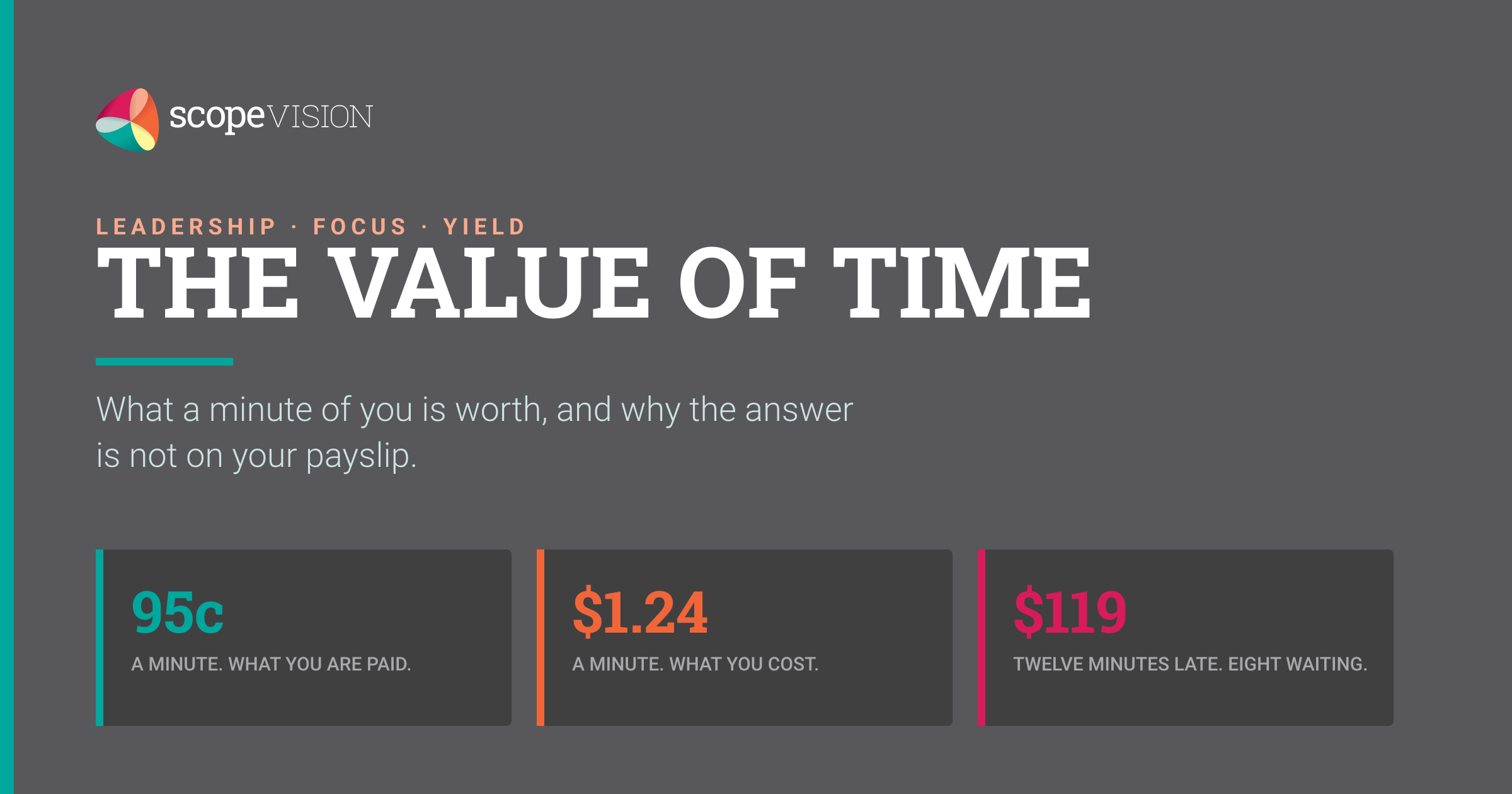
Your nine o'clock started twelve minutes late. Eight people waited.
That cost $119.
Nobody wrote it down. There is no line for it in any budget, no code to charge it to, and not one person in that room will ever mention it. It is the most invisible money in your organisation and you spend it every single day.
Here is where the number comes from.
What is your time worth?
Find your own row. The middle columns are what the payslip says. The last one is what you actually cost, once superannuation, leave loading, insurance and overheads are counted.
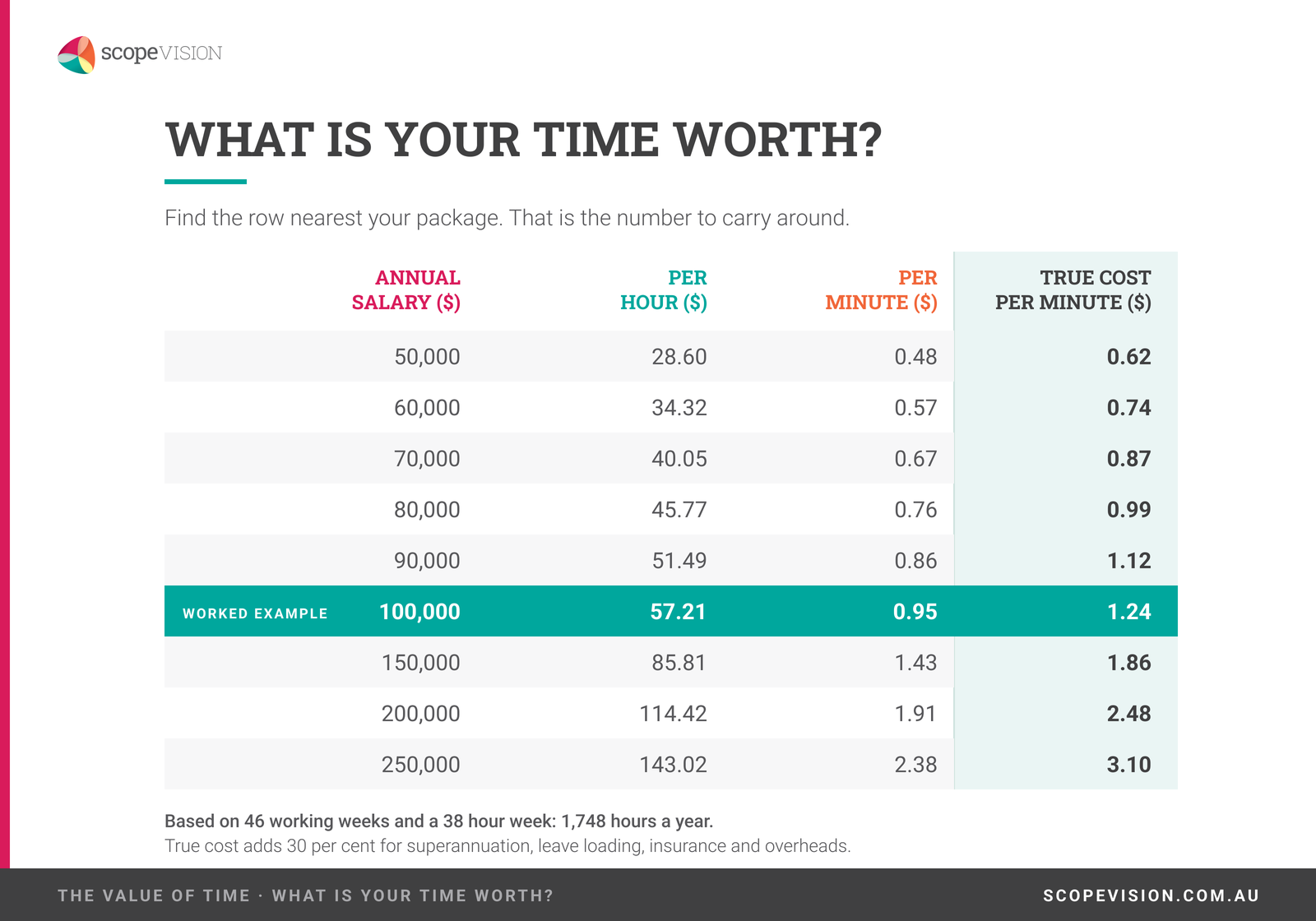
On $100,000 you are worth about a dollar a minute. That is the number worth carrying around, because it scales in your head without a calculator. On $150,000 you are a dollar fifty. On $200,000, two dollars.
Now do the thing everyone does at this point and start costing your day. The report you rewrote because the brief was vague. The forty minutes spent chasing an approval that should have taken four. The thirty minute team check in at 10.30 most mornings, which nobody has ever proposed shortening.
That last one is worth a moment. Ten people, thirty minutes, most mornings. If the room averages $100,000 that is about $372 a meeting and $86,000 a year, or roughly two thirds of a full time salary.
It might be worth every cent. Nobody has checked.
Costing your day like this is a fun exercise. It is also where most time management advice stops, and stopping there will make you a worse leader.
The wrong ledger
Here is the trap. Once you know your time has a price, every interruption starts to look like theft.
Someone puts their head around the door. Got a minute? And a small, tired part of your brain does the sum. Ten minutes. Twelve dollars. Off the ledger.
That instinct is the most expensive one in this article.
Because for a leader, that ten minutes is not an interruption to the work. It is the work. It is the conversation where you find out the job is about to go sideways. Where someone tells you about the near miss instead of quietly deciding it was not worth the paperwork. Where you catch a good performer running on empty before they hand you a resignation you did not see coming.
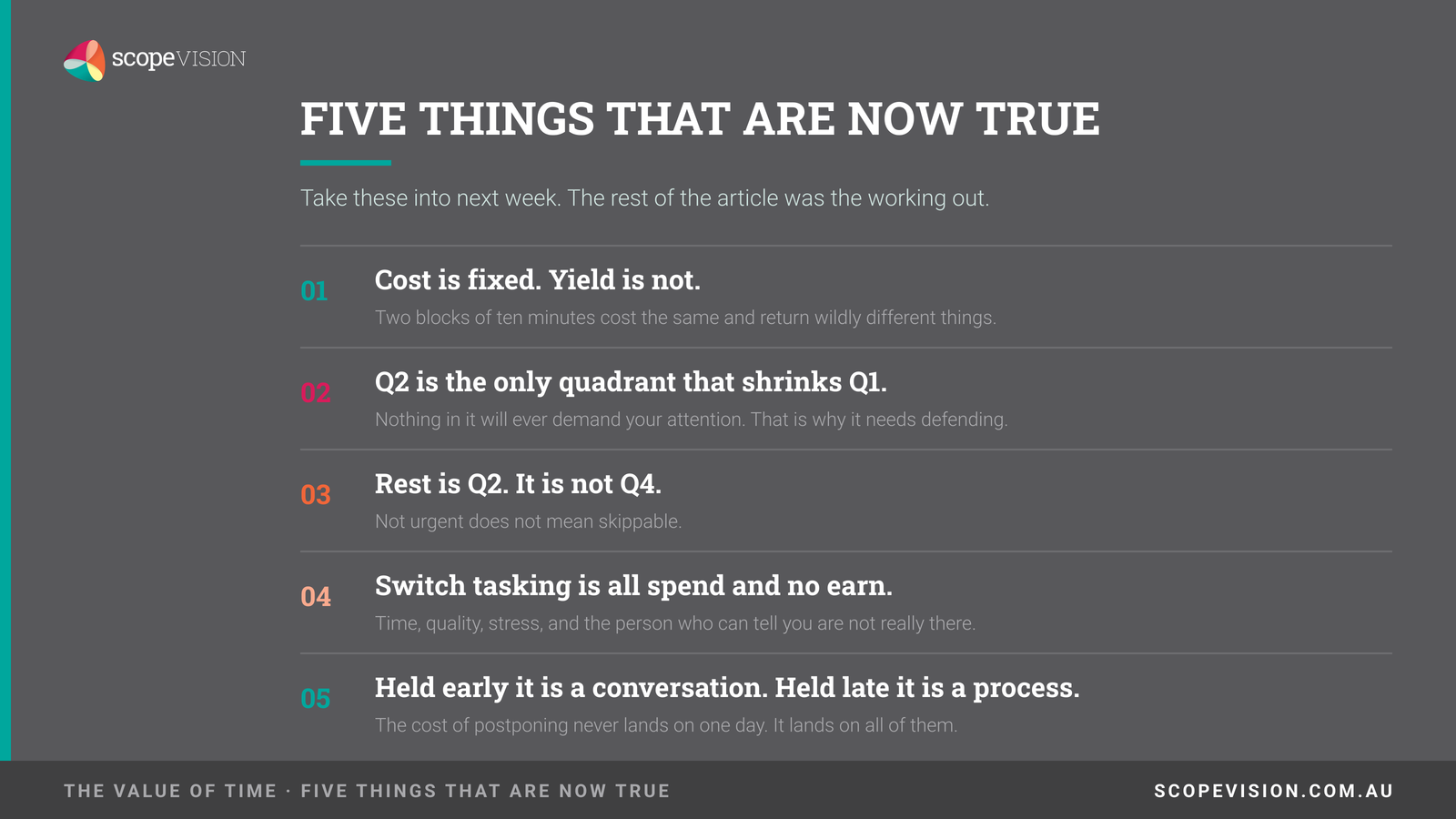
Cost is a fixed number. Yield is not. Two blocks of ten minutes cost you exactly the same and can return wildly different things, and the difference is entirely down to what you spent them on.
So the question was never what is my time worth. You have a table for that now.
The question is where my time earns, and where it is only spent.
The four quadrants, labelled properly
Stephen R. Covey's time matrix in The 7 Habits of Highly Effective People (1989) still holds up, and it is still routinely mislabelled. Here it is straight.
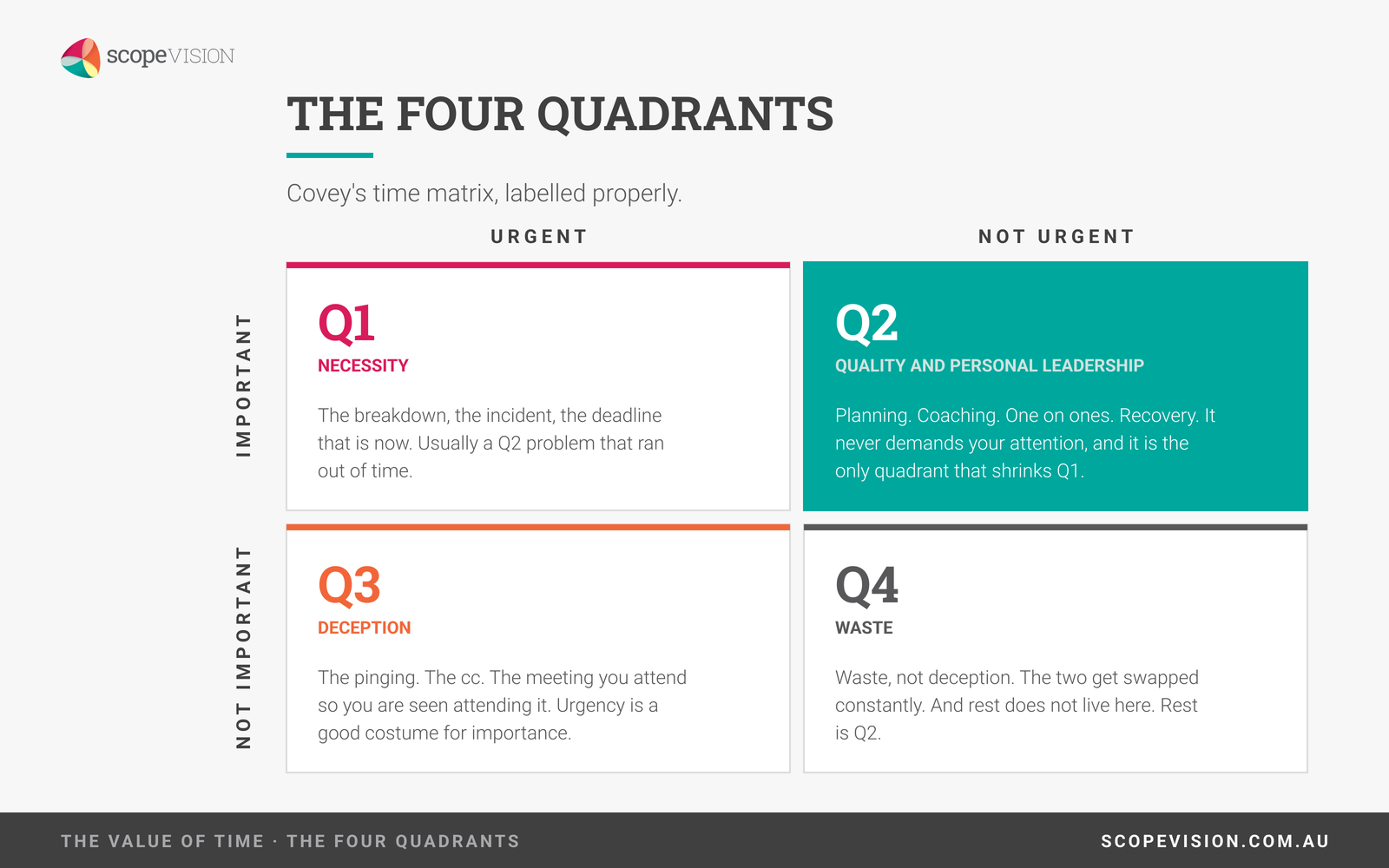
Q1. Important and urgent. The quadrant of necessity.
The breakdown, the incident, the deadline that is now. You cannot avoid Q1, but if you are living there, something upstream is broken. Q1 is rarely a workload problem. It is usually a Q2 problem that ran out of time.
Q2. Important, not urgent. The quadrant of quality and personal leadership.
Planning. Coaching. One on ones. Building capability in someone so you stop being the bottleneck. Nothing in Q2 will ever demand your attention, which is exactly why it does not get it. This is the highest yield quadrant you have, and it is the only one that shrinks Q1.
Q3. Urgent, not important. The quadrant of deception.
It feels like work. The pinging. The cc. The meeting you attend so you are seen attending it. Deceptive, because urgency is a very good costume for importance.
Q4. Not urgent, not important. The quadrant of waste.
The fifteen minutes between meetings that dissolve into your phone. The report you still produce every month because you always have, which nobody has opened since the restructure. This is waste, not deception, and the two get swapped constantly.
And one correction worth making loudly: rest is not Q4.
Recovery, actually switching off, actually taking the leave, is Q2. It is important and it is not urgent, which is precisely why leaders file it under later until their body files it under now. If you read "not urgent" as "skippable", you will skip the one thing that keeps you any good to anyone.
The Yield Test
Three questions. Ask them of any block of time before you spend it.
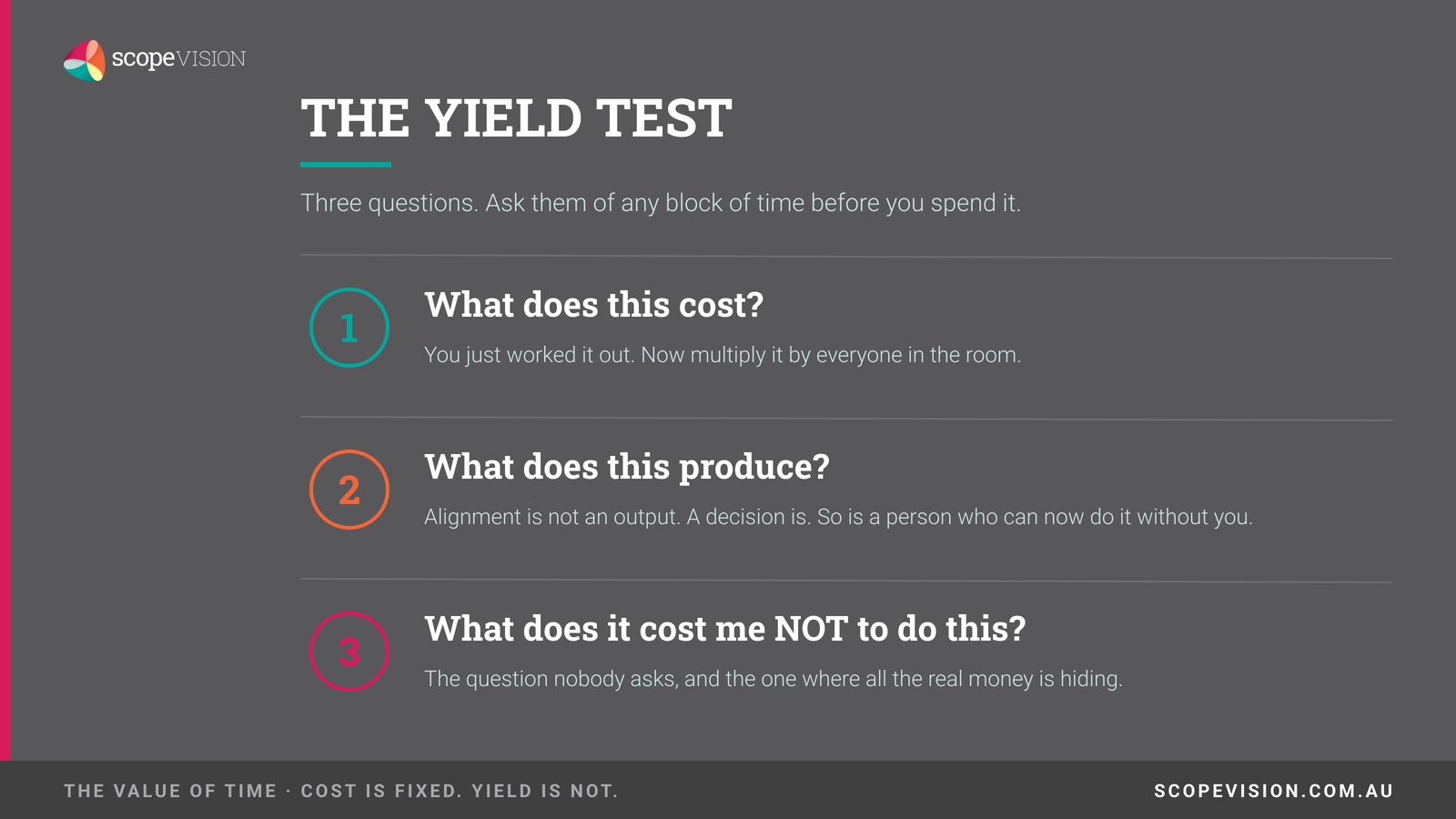
1. What does this cost?
Easy. You just worked it out. Multiply by everyone in the room.
2. What does this produce?
Be specific. Alignment is not an output. A decision is. A person who can now do the thing without you is. A risk someone finally told you about is.
3. What does it cost me not to do this?
This is the one nobody asks, and it is where all the real money is.
Skipping a one on one costs nothing today. It costs you a resignation in March. Not walking the floor costs nothing today. It costs you the thing nobody mentioned because you were not there to mention it to.
Q3 activities score well on question one and collapse on question three. Q2 activities look expensive right up until you ask what happens without them.
Which gives you the rule the whole article has been circling. Not prioritise by urgency, not prioritise by who asked loudest. Prioritise Activities by Yield.
Where a leader's yield actually sits
Almost always in the same places.
The recurring one on one you keep moving. It is the cheapest early warning system ever invented, and it is the first thing off the calendar when things get busy, which is the exact moment it is worth the most.
The instruction you give once, properly. Two minutes of clarity at the front removes an hour of rework at the back. Vague briefs are not faster. They are borrowing time at a bad rate.
The hour you book to look at the plan. Nothing will ever arrive to remind you about it, which is why it goes first when the week gets loud. Freedom Starts Between the Ears is about what that hour is protecting, and why the plan you actually run is rarely the one anybody approved.
The conversation you keep postponing
There is one on your list right now. It has been there six weeks. And every day you do not have it, it charges you twice.
It costs you money. The rework. The workaround. The quiet redistribution of someone's job to the people who will not complain about picking it up. None of that appears as a line item, but you are paying it at the rate in the table above, every day, across everyone who absorbs it.
It costs you culture, which is the more expensive half. A team reads what you tolerate far more accurately than anything you say, and every day a behaviour stands unchallenged it quietly becomes the standard. That is the argument in Align your Team's Vision, Behaviour and Consequences: behaviour without consequence is just permission with extra steps.
Postponing feels cheaper because the cost never lands on any single day. It lands on all of them. And the longer you leave it, the more expensive the conversation itself becomes, because now you are not addressing a behaviour, you are addressing six weeks of it.
Never postpone that conversation. The right one, held early, is the cheapest thing on your calendar. Held late, it is the most expensive, and by then it is not a conversation, it is a process.
Why do we tolerate porcupines in the workplace? takes the next step: nine ways to move the behaviour up, or move it off the team. That is not a time management problem. That is a courage problem wearing a time management costume.
The cost of switch tasking
None of this means an open door all day.
Multitasking is a lie. In The Myth of Multitasking, Dave Crenshaw (2021) argues that nobody has ever done two things at once when both of them needed attention. You can let the machine run while you write the report. You cannot read an email on your phone and be present in the team meeting. What we call multitasking is really rapid switching between the two, quick enough that it passes for one thing. He calls it switch tasking, and he counts the cost in three places: time, the quality of the work, and stress.
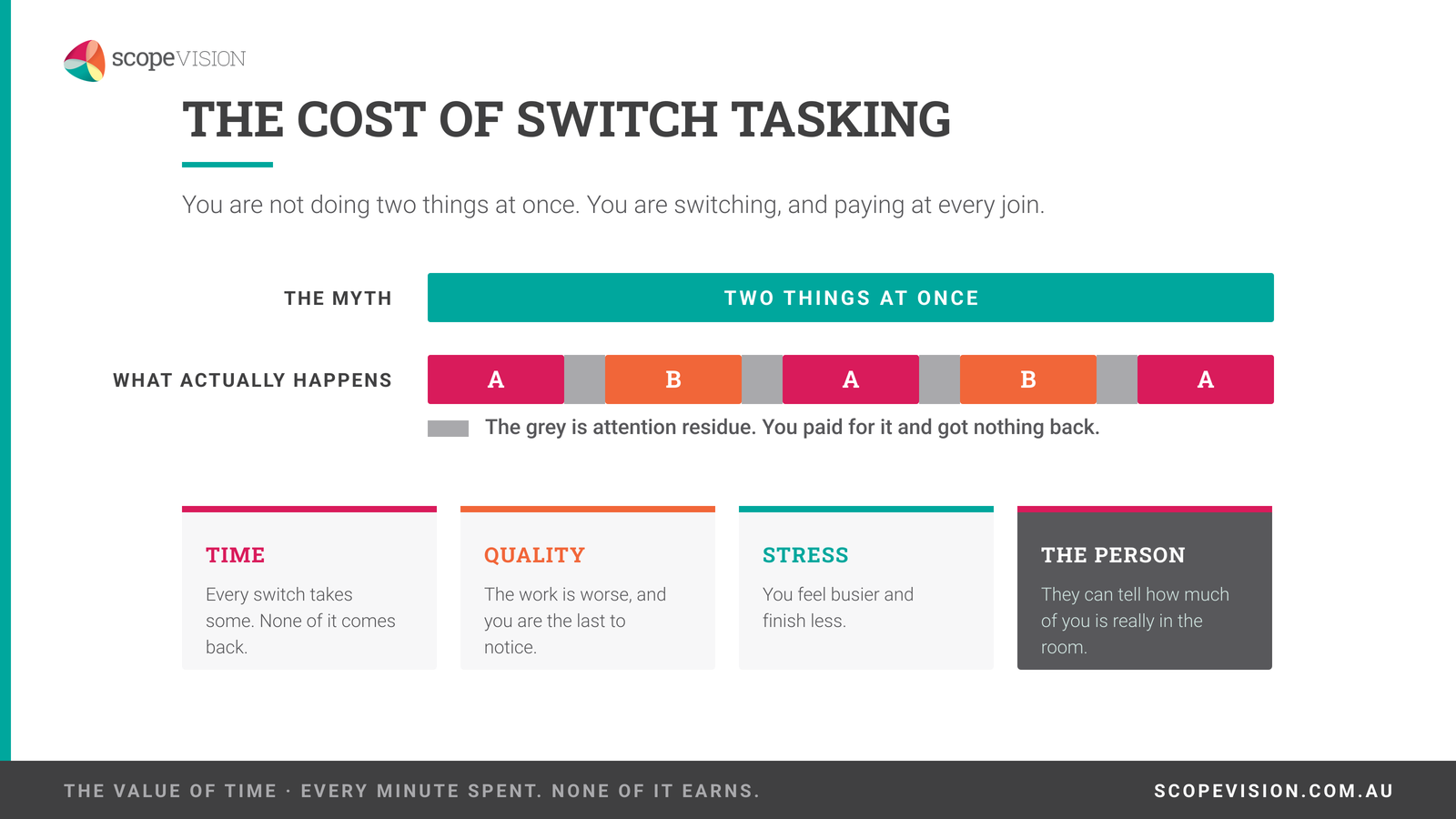
Sophie Leroy (2009) explains the mechanism. She calls it attention residue. Part of your head stays parked on the task you just left, and the residue is worst when that task was left unfinished. You do not arrive at the next thing at full capacity. You arrive at whatever is left.
Put switch tasking in the ledger and it is the worst line on the page. Every minute of it is spent. None of it earns. You pay in minutes, you pay in rework, and you pay a third time in the person sitting opposite you who can tell precisely how much of you is in the room.
There is a fourth cost, and it is the one most people forget. Switch tasking does not only cost you the task. It costs you the relationship. Nobody in the history of work has felt valued by someone half watching a screen while they talk.
The fix is not willpower, it is scheduling. Give the things that keep interrupting you somewhere to land. A set time each day for the inbox. A recurring slot for the person who currently catches you in the corridor. People interrupt because they have no other way in. Give them one and most of the interruptions stop being interruptions.
Which is an argument for finishing the conversation, not for avoiding it. Ten minutes properly closed costs you ten minutes. The same ten minutes half had, cut off by your next meeting, costs you the ten minutes and then follows you into the afternoon.
So the answer is not to be endlessly available. It is to be deliberately available. Protect the focus, not the door.
Block the deep work and defend it like a meeting with someone important, because it is. Then block the people time and defend that harder, because it is the block that looks optional and it is the one that is not.
Your calendar is not an administrative record. It is a statement of what you actually believe matters, written in a language your team reads fluently.

Start Monday
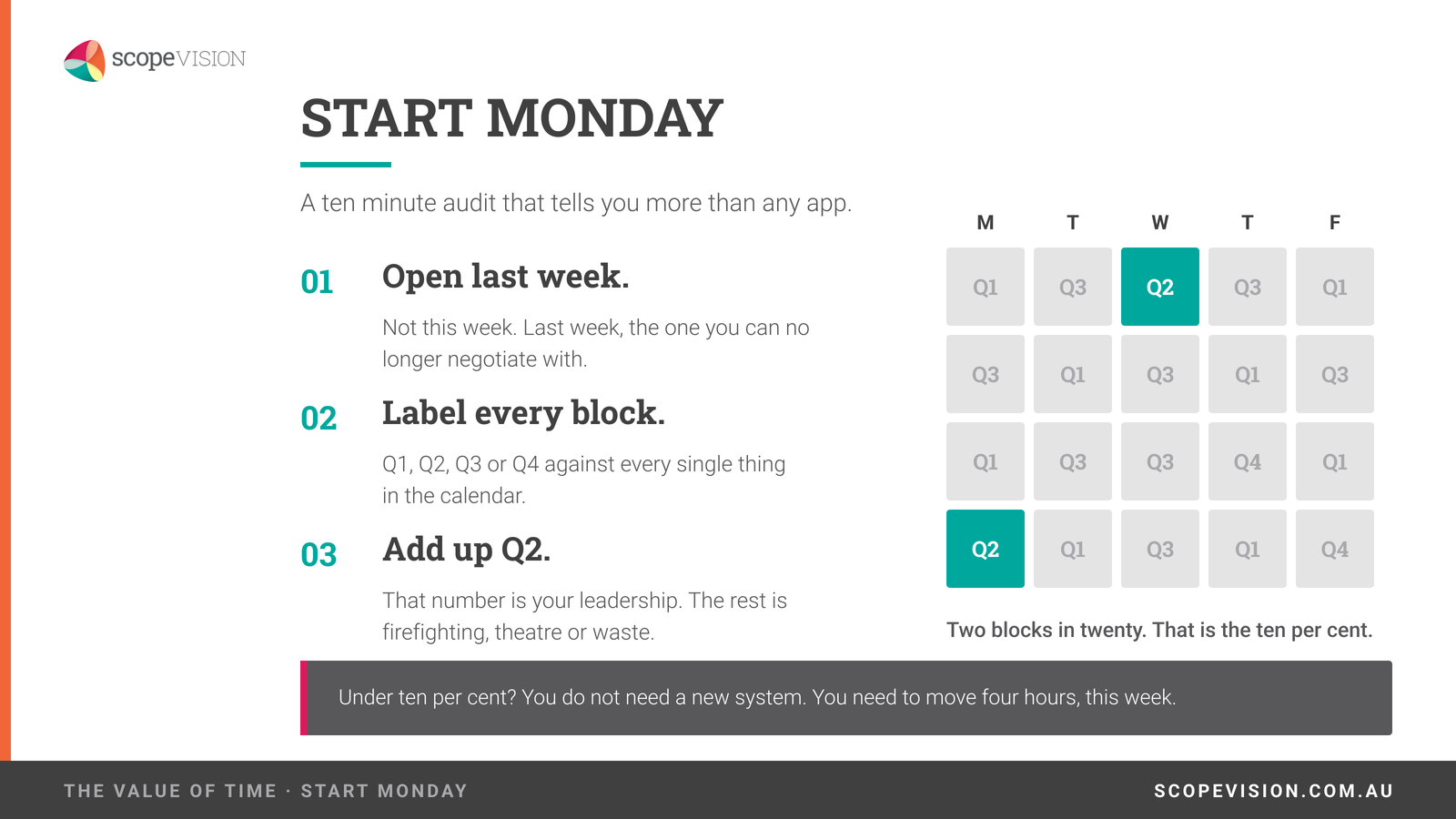
Open last week's calendar. Label every block: Q1, Q2, Q3 or Q4.
Add up Q2. That is your leadership. Everything else is firefighting, theatre or waste.
If Q2 comes in under ten per cent, you do not need a productivity system. You need to move four hours.
Move them this week. Not when it quietens down. It does not quieten down. That is the whole point of the quadrant.
Then go back to the 10.30 check in and run it through the three questions.
What does it cost? You already know. $372. What does it produce? Name it specifically, or admit out loud that it does not have a name. And what would it cost you not to have it at all?
It may survive that easily. Plenty of daily check ins are the cheapest early warning system a team has, and cutting one to save $86,000 would be a very expensive kind of thrift. Or it may turn out to be thirty minutes of theatre that nobody has ever had the standing to question.
Either way you will know, and right now you do not. The number was never the argument. The yield is.
TEAM ENGAGEMENT SOLUTIONS
Urgent Beats Important. Every Time.
Ambition was never the problem. Follow-through is. Practical planning that survives a real workload: how to protect the time, how to decide what does not get done, and how to finish what you start. Runs for any team, at any level.
Enquire Now opens an email with a few questions already in it. If nothing happens when you click, your device has no mail app set up. Use Get in touch instead, for the phone number and email address.
Keep reading
- 13 Behaviours of High-Trust Leaders. Where those ten minute conversations actually deposit.
- Freedom Starts Between the Ears. You know what an hour is worth. This is how to make sure something is booked into it.
- The Keys to Holding Great Coaching Conversations. How to make the Q2 time count.
- Coach, Mentor, or Personal Board of Directors? Building capability is the highest yield thing you do. Worth asking who is doing it for you.
References
Covey, S.R. (1989) The 7 Habits of Highly Effective People. New York: Free Press.
Crenshaw, D. (2021) The Myth of Multitasking: How 'Doing It All' Gets Nothing Done. 2nd edn. Mango Publishing. First published 2008.
Leroy, S. (2009) 'Why is it so hard to do my work? The challenge of attention residue when switching between work tasks', Organizational Behavior and Human Decision Processes, 109(2), pp. 168-181. Available at: https://doi.org/10.1016/j.obhdp.2009.04.002
Note on the figures. The loaded cost multiplier of 1.25 to 1.4 times salary is an illustrative planning range, not a published figure. Salary, hourly and per minute values are the author's own calculation on 46 working weeks and a 38 hour week. The worked example uses an indicative salary only.
Cite this article
Satterthwaite, M-J. (2025) 'The Value of Time', Scope Blog, 24 October. Revised August 2026. Available at: https://scopevision.com.au/blog/the-value-of-time (Accessed: [insert date]).
In text: (Satterthwaite, 2025).
You have just spent nine minutes on this.
Two seconds tells me whether it earned.
The like button just below is how I know.
And if someone came to mind while you were reading, send it to them. That is the better compliment.