In 1981 Jan Carlzon took over Scandinavian Airlines while it was heading for a loss of around twenty million dollars. Within a year it was making a profit. He did not do it with a new fleet.
He did it by counting.
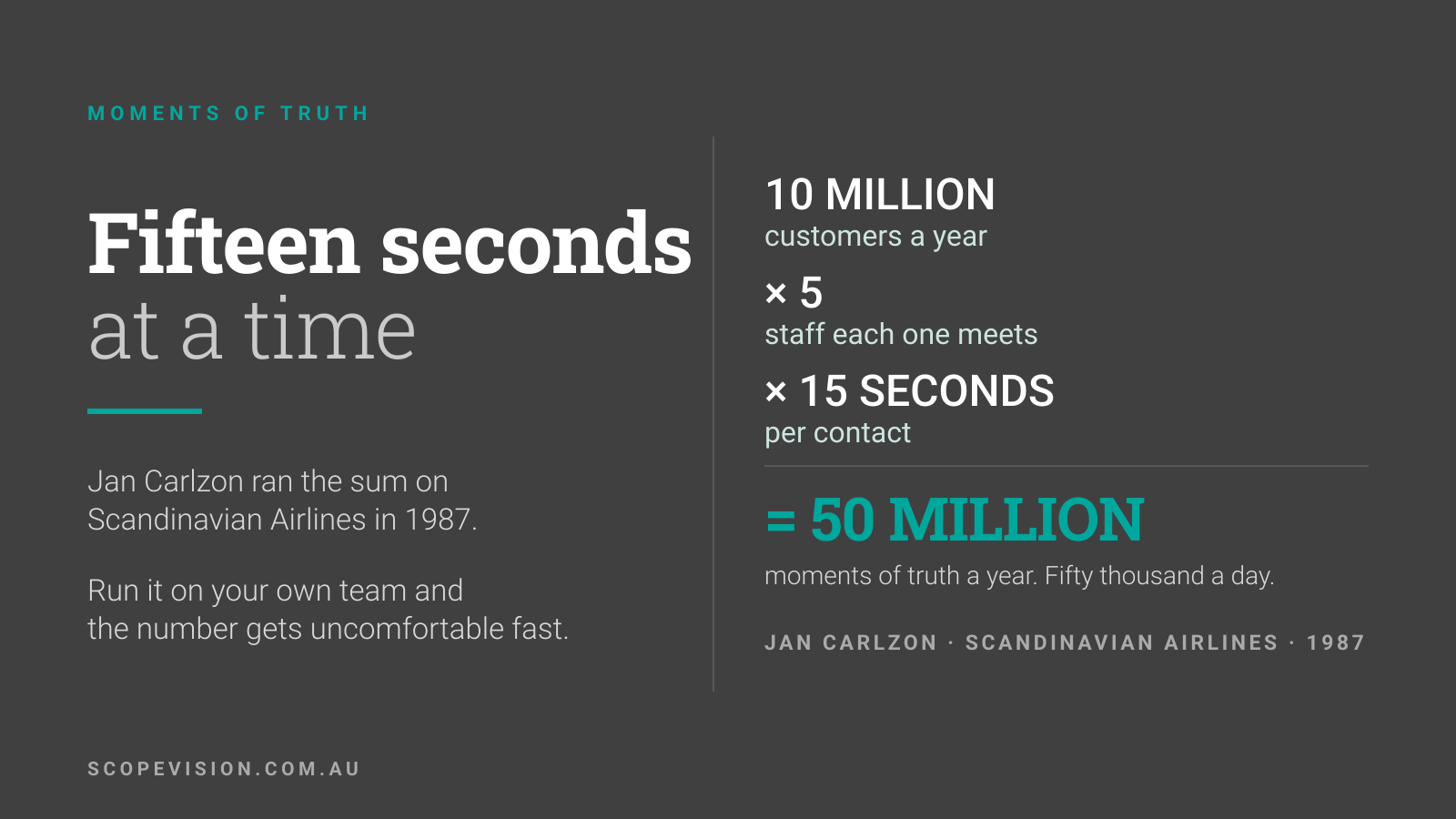
Carlzon worked out that SAS had roughly ten million customers a year. Each of them came into contact with about five staff. Each contact lasted about fifteen seconds. Which meant the airline was not really made of aircraft and hangars at all.
“SAS is ‘created’ 50 million times a year, 15 seconds at a time.”
Jan Carlzon, Moments of Truth (1987)
Fifty thousand of those moments happened every single day, and not one of them happened in his office. They happened at a check-in desk, on a jet bridge, at a baggage carousel, in the hands of people several rungs below him on the chart. So he pushed the authority down to them. His line on it was blunt: problems get solved on the spot, and no frontline employee should have to wait for a supervisor’s permission.
That is a leadership article dressed up as a customer service one. It has been sitting in plain sight since 1987.
Magic, mediocrity, misery
The three ways a moment can land
Carlzon named the moment. He said each could go well or badly, and left it there.
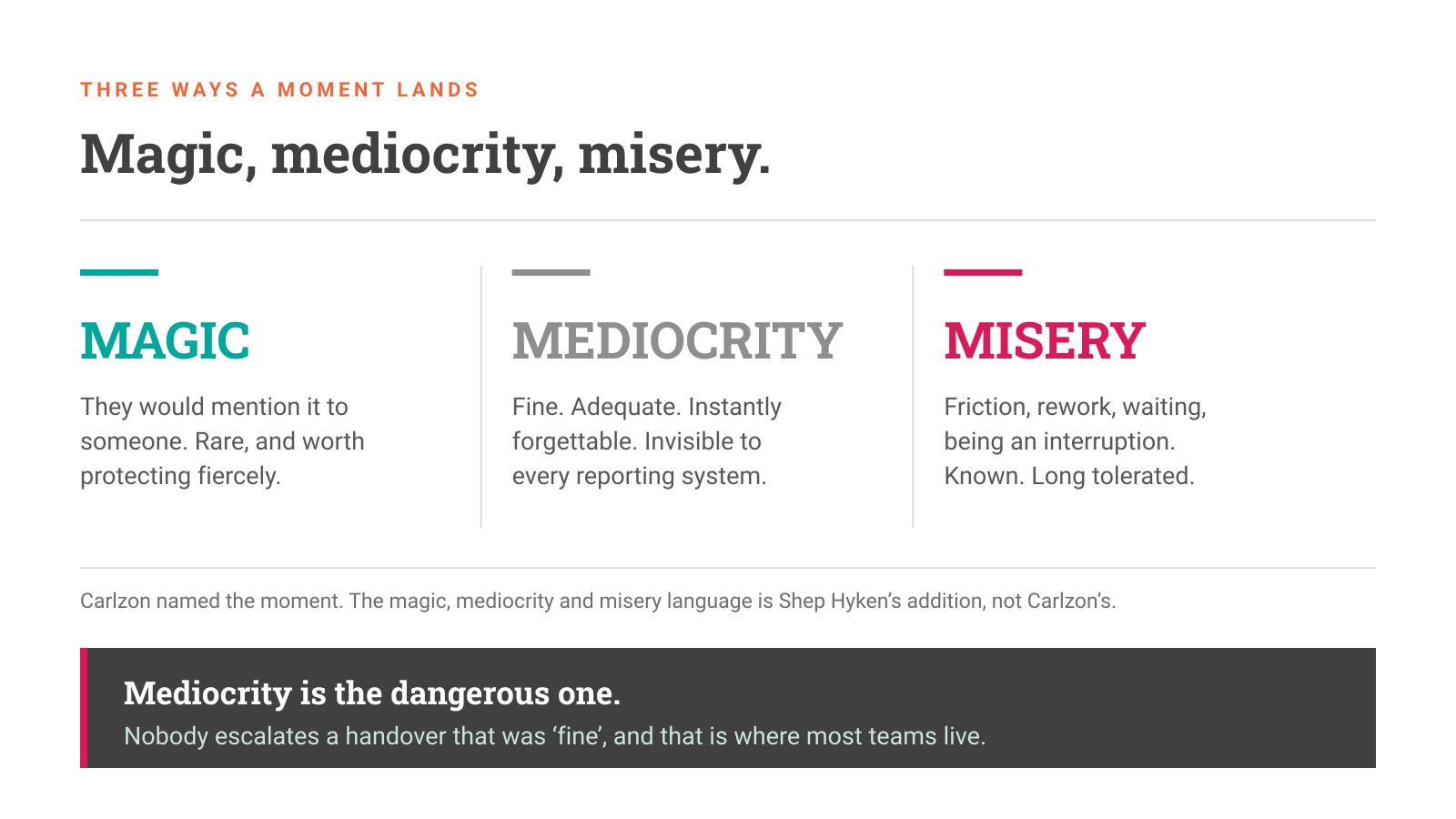
Customer experience writer Shep Hyken added the missing rung. A moment of truth becomes a Moment of Magic, a Moment of Misery, or, the one nobody plans for, a Moment of Mediocrity. Fine. Adequate. Instantly forgettable.
Mediocrity is the dangerous one, because nothing about it triggers a response. Nobody escalates a shift handover that was fine. Nobody debriefs a team briefing that was alright. It slides straight past the reporting system, and it is exactly where most teams live.
“Nobody raves about average.”
Bill Quiseng
The complaint you will never hear
You have seen the statistic on a slide somewhere: for every person who complains, twenty-six stay silent, and word of it reaches fifteen hundred more. It is a good line and it is thirty years past its use-by. It traces back to research done for the White House Office of Consumer Affairs in the 1970s, and the word-of-mouth arithmetic behind it was built in a world without a phone in every pocket. One tagged post now beats fifteen hundred quiet conversations before lunch.
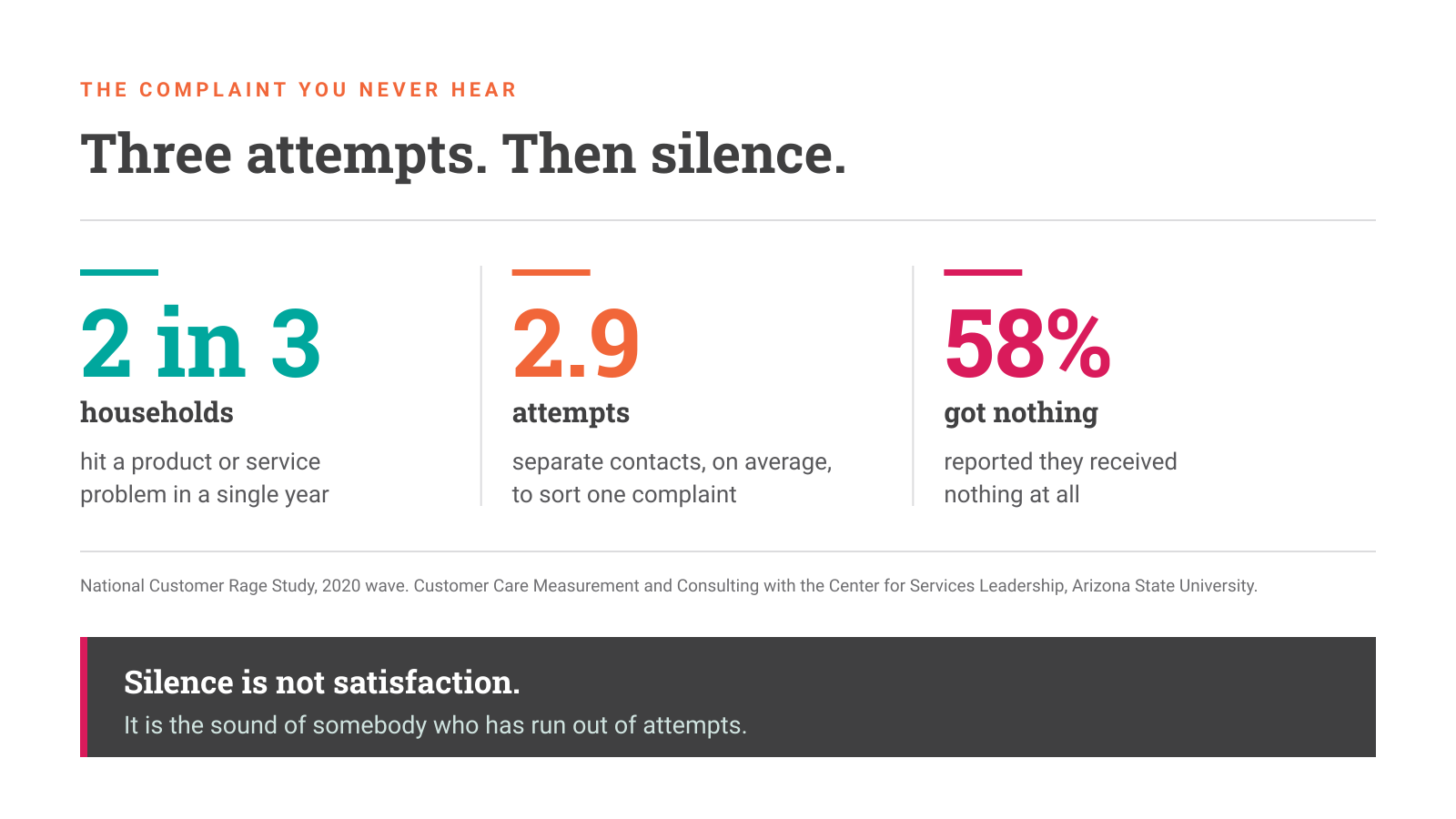
The version worth quoting is the study that succeeded it. The National Customer Rage Study, run by Customer Care Measurement and Consulting with Arizona State University’s Center for Services Leadership, has been repeating those original 1976 questions for decades. Its 2020 wave found that two-thirds of households hit a product or service problem in a year, that people averaged 2.9 separate contacts trying to sort one complaint, and that 58 per cent walked away with nothing at all.
Read that as a leader rather than a consumer. Three attempts. Nothing to show for it. Then ask how many times one of your people has raised the same concern, the same frustration, the same fault, the same broken process. And how many attempts they made to improve it before they stopped bothering.
Silence is not satisfaction. It is the sound of somebody who has run out of attempts.
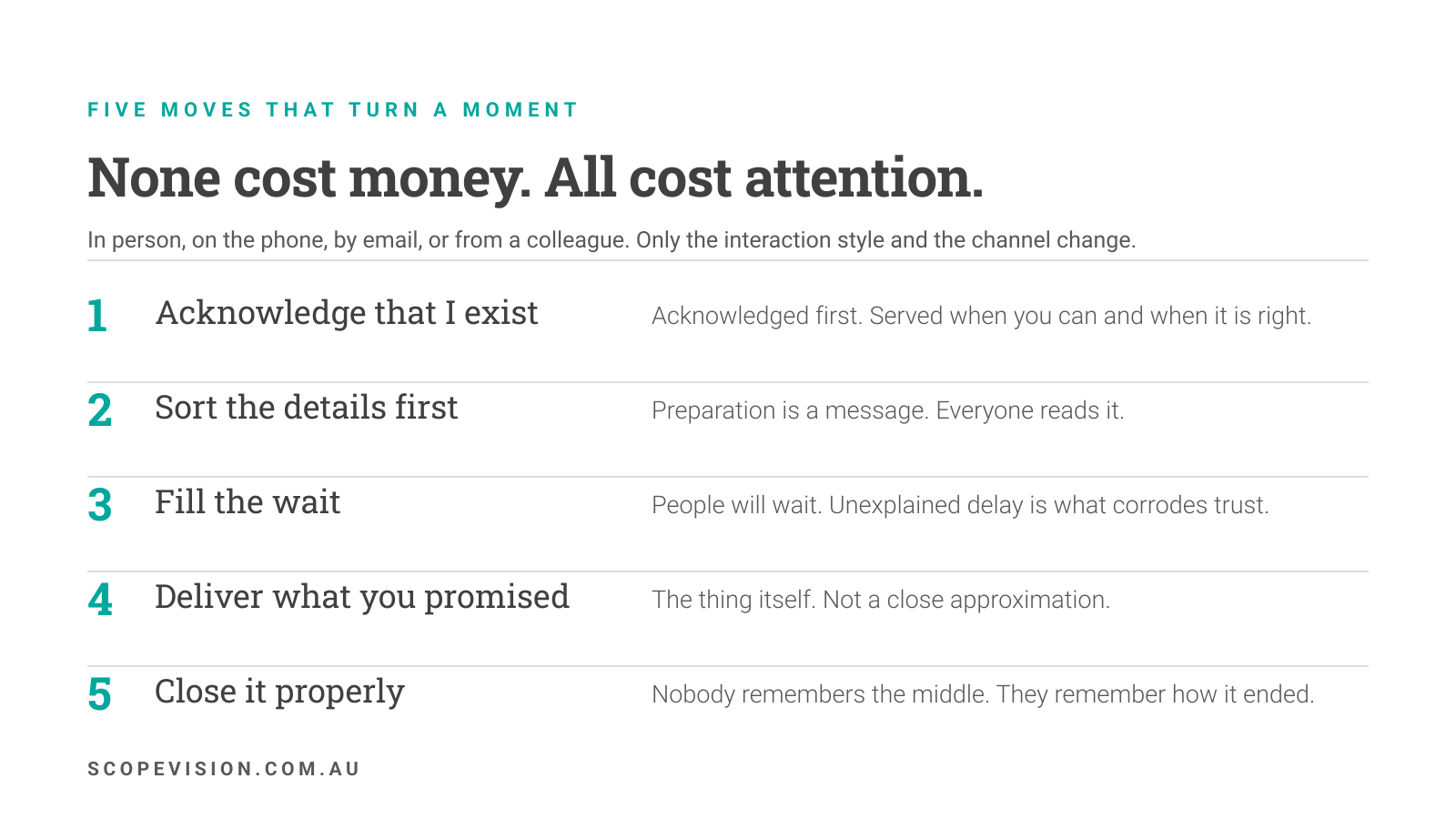
Five moves that turn a moment
None of them cost money. All of them cost attention.
Before the five, one thing worth saying out loud. I might be standing in front of you. I might be a voice on the phone, an email you have not opened yet, a website you have never tested, or the colleague who brought you an idea last Tuesday.
Every one of those is a moment of truth, and every one of them is somebody experiencing your brand. The moves do not change. Only the interaction style and the channel do.
1. Acknowledge that I exist
Recognition inside three seconds. Seen now, served when you can and when it is appropriate. You do not have to be free to acknowledge someone, which is exactly why it costs nothing. When it does not happen, the cause is rarely workload. It is your personality under pressure.
In person. The visitor who has been standing at your reception desk for eleven minutes has already formed a view of your organisation, and nobody has acknowledged them yet.
By email. Same move, longer silence. “Got it, I am on it, you will hear from me Thursday” takes nine seconds. It acknowledges them, and it tells them somebody is on the job.
2. Sort the details before I arrive
Preparation is a message. What I walk into tells me what passes for good enough here, long before anyone says a word about standards.
In the room. A break room with a broken chair and a three year old noticeboard says exactly how much this team matters. Everyone reads it. Nobody mentions it.
On your website. A form that asks me for information you already hold, or a page pointing to a phone number that rings out, sends the same message as the broken chair. You just cannot see people looking at it.
3. Fill the wait
People will wait a surprisingly long time without complaint, as long as they know what they are waiting for. Unexplained delay is what corrodes trust. Not delay.
On the phone. Four minutes of hold music tells me nothing. Four minutes with someone coming back twice to say where they are up to tells me I have been acknowledged and somebody is working on it.
Anywhere. “The part is three days out, here is what we are doing meanwhile” buys you goodwill. Silence for three days buys you a rumour, and the version they invent is usually worse than the truth.
4. Deliver the thing you actually promised
Not a close approximation. The thing. They asked for an outcome, not a tour of how you got there.
On Friday. You said you would raise it with your manager by Friday. Friday is the moment of truth, not the conversation where you agreed to it.
Quietly. Delivering exactly what you said, when you said, to the standard you implied, with no fanfare, is the most underrated brand-building act available to a leader.
5. Close it properly
The last thirty seconds carry more weight than the middle twenty minutes. Most people are excellent at hello and hopeless at goodbye.
With a colleague. Somebody brought you an improvement idea in March. Whatever happened to it, going nowhere included, they are owed the answer. Even “we looked at it and we are not doing it, here is why” closes the loop. No response is a response. It teaches them that thinking was not worth the trouble.
At the end of a shift. Nobody remembers the middle. A good day that ends badly gets remembered as a bad day, and that is the version carried into tomorrow.
Now point it inward
Your moments of truth are not at a counter
Here is where this stops being a customer service article. Hyken makes the point himself: every bit of this applies to the internal customer. Carlzon’s version was sharper. If you are not serving the customer directly, your job is to serve someone who is.
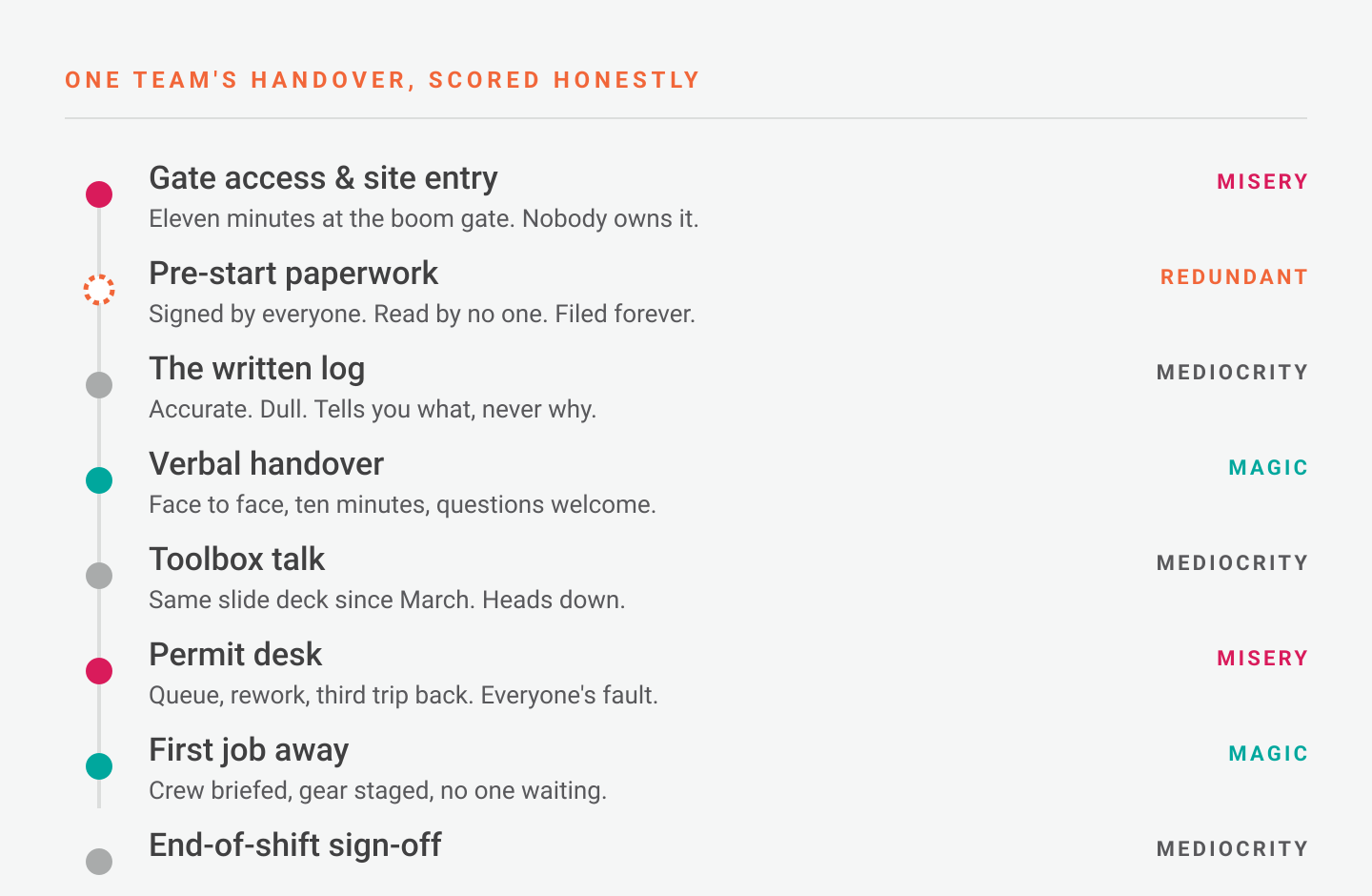
Which means every frontline leader has a sequence of moments of truth every single shift, and almost nobody has ever mapped it. The handover. The first briefing. The paperwork. The request that has to go through you. The escalation. The sign-off.
The labels change with the industry. The shape does not. A ward has one. A depot has one. A store, a control room, a classroom, a call centre. Eight or so touch points, twice a day, three hundred and sixty-five days a year.
Carlzon’s word for it was created. That is how many times a year your team gets created, and never once by you.
Run the map yourself
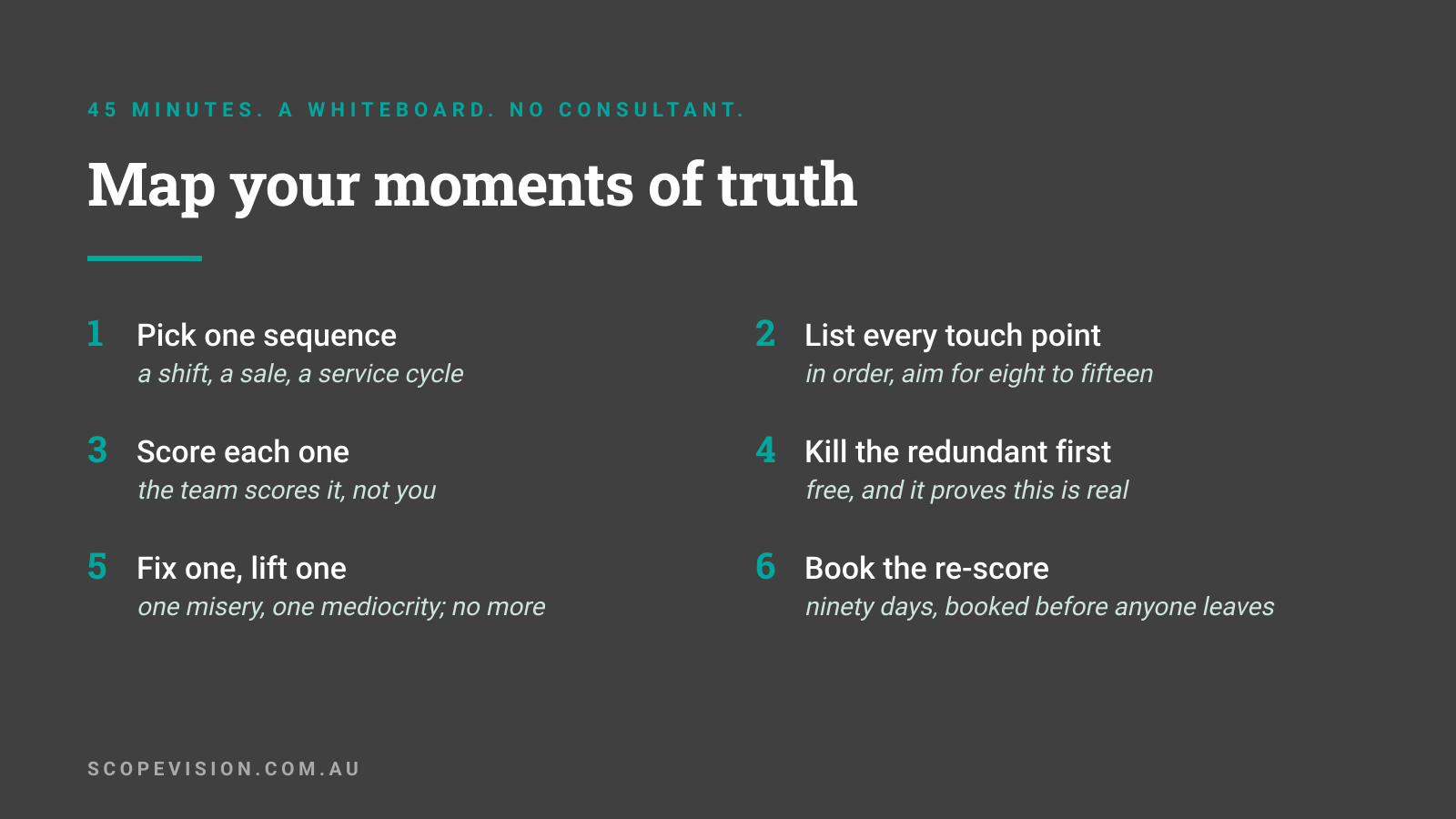
Forty-five minutes, a whiteboard, no consultant required
- Pick one sequence. A single shift, start to finish. A sale from first contact to delivery. One customer service cycle. One onboarding. Not the whole business. You will never finish it and you will learn nothing.
- List every touch point in order. Anything where a person meets your team, experiences your process, or has to get through your paperwork. Include the ones with no human in them at all. Most sequences start earlier than you think: whether they could find you online, whether the contact details were right, whether there was anywhere to park, whether the carpark was clean, whether the signage got them to the door or three doors past it. All of that happened before anyone said hello. Aim for eight to fifteen. If you get three, you are not looking hard enough.
- Score each one. Magic, mediocrity, misery, or redundant. The team scores it. Not you. You will mark your own homework generously and everyone will let you.
- Kill the redundant ones first. This is Carlzon’s most ignored point: some touch points serve nobody and exist because they always have. Deleting one is free, and it answers the question everyone in the room is quietly asking: is anything actually going to change?
- Fix one misery. Lift one mediocrity. One each. Two is a promise you can keep. Fourteen is a promise they have heard before.
- Book the re-score. Ninety days. Put it in the calendar before anyone leaves the room, and it will happen.
The four scores, for when the room asks
Magic. They would mention it to someone. Rare, and worth protecting fiercely once you find it.
Mediocrity. Fine, adequate, invisible to every reporting system you own. Where most of your shift lives.
Misery. Friction, rework, waiting, being treated as an interruption. Usually well known and long tolerated.
Redundant. Serves no one. Survives on habit. Delete it and watch nothing bad happen.
The brand nobody designed
Where your reputation is actually assembled
Every organisation has two brands.
The first one costs money. It has a colour palette, a font, a set of values on a wall, and a document explaining how the logo may and may not be used. Someone was very careful about it.
The second one was never designed at all. It is assembled, fifteen seconds at a time, by people who have never opened that document, in moments the people who wrote it will never witness.
Only one of those two is real, and it is not the one that costs money.
This is what Carlzon actually worked out, and it is usually filed under customer service because that is where he found it. But read his sentence again. SAS is created fifty million times a year. Not represented. Not communicated. Created. He is saying the airline did not exist in the boardroom or the brand guidelines. It came into being at a check-in desk, over and over, in the hands of whoever happened to be standing there.
Nobody has ever chosen a supplier because of a values statement. Plenty have left because of a Tuesday.
Go back to the broken chair in move two. That was a brand message. Nobody wrote it, nobody approved it, nobody signed it off, and everybody who walked past it read it.
Your team has one too
Here is the uncomfortable version, and it is the one that matters to a frontline leader.
Your team has a brand inside your own organisation, and you did not design that either. It is the answer other departments give when your team comes up in conversation and you are not in the room. Easy to deal with, or hard work. Straight answer, or three emails and a chase. Worth ringing, or worth avoiding.
That answer already exists. It was assembled from moments of truth, most of them mundane, none of them reported. And it is doing quiet work every day, deciding whether people bring you problems early or late, whether your requests go to the top of somebody’s pile or the bottom, and whether your best operator takes the call from the recruiter.
A brand is not decided at its best planned moment. It is decided at its worst staffed one. Anyone can be excellent on the day of the audit. Your reputation is built on the Tuesday when two people called in sick, the system was down, and somebody still had to meet whoever walked through the door.
Which is why you cannot rebrand your way out of a bad handover. A rebrand changes what people see. Moments of truth change what people say. Only one of those two travels.
When the scoring stings
Here is the part that catches leaders out. You will run this session, your team will score something you built as misery, and your jaw will tighten.
Ken Blanchard’s line is that feedback is the breakfast of champions. Fine in a book. Harder at six in the morning when someone has just called your handover process a waste of everybody’s time.
Getting defensive in that moment is not a personality flaw, it is a reflex. It is also the exact moment your team decides whether the next one is worth participating in. It is the same muscle as Listen First and Right Wrongs. The counterfeit is nodding along, thanking everyone warmly, and changing nothing. Your team will know which one it was by the time you reach the door.
“Although your customers won’t love you if you give bad service, your competitors will.”
Kate Zabriskie
Swap customers for your best people and read it again. The market for good operators has rarely been tighter, and the ones worth keeping are scoring you long before they say anything.
The number that matters
Carlzon’s fifty million was never really about airlines. It was about scale, and about the fact that a reputation is not built in a strategy session. It is assembled from thousands of fifteen second fragments handled by people the strategy session never mentions.
Count yours. Two shifts, eight touch points, three hundred and sixty-five days is close to six thousand moments of truth a year, and you personally will witness almost none of them.
Which is the whole point. You do not get to be there. You only get to decide what happens when you are not.
TEAM ENGAGEMENT SOLUTIONS
The first map is easy. The second one is where it gets real.
Running the session is straightforward. Holding your nerve while your own team scores your handover as misery is the part worth preparing for. We facilitate the first map, then hand the whiteboard marker to your leaders. Every solution is built around the team it is for.
Enquire Now opens an email with a few questions already in it. If nothing happens when you click, your device has no mail app set up. Use See all solutions instead.
A note on attribution. Jan Carlzon coined the moment of truth and said each could go well or badly. The magic, mediocrity and misery language is Shep Hyken’s addition, not Carlzon’s. It is widely misattributed, so it is worth saying plainly. Moments of Magic and Moments of Misery are Hyken’s marks.
References
Carlzon, J. (1987) Moments of Truth. Cambridge, MA: Ballinger.
Customer Care Measurement and Consulting, Center for Services Leadership and Kraft Heinz (2020) Key Findings and Implications from the 2020 National Customer Rage Study. Tempe, AZ: W.P. Carey School of Business, Arizona State University. The ninth wave of a survey that repeats core questions first asked for the White House study of 1976. Completed February 2020, from an internet panel of 1,026 respondents.
Hyken, S. (1993) Moments of Magic. St Louis, MO: Shepard Presentations.
Also drawn on. Ken Blanchard, for feedback as the breakfast of champions, and Kate Zabriskie, quoted above. Both are used for their substance rather than cited, and neither source has been verified against an original.
Cite this article
Satterthwaite, M-J. (2026) ‘Fifteen seconds at a time’, Scope Blog, 23 August. Available at: https://scopevision.com.au/blog/moments-of-truth-frontline-leaders (Accessed: [insert date]).
In text: (Satterthwaite, 2026).
This article replaces ‘I have a confession. I’m a SECS addict.’, published in June 2016. The earlier piece used the same Carlzon material for a customer service audience; this one is written for frontline leaders and points the framework inward.
Keep reading
- The 13 Counterfeits of Trust. Nodding warmly and changing nothing is its own moment of truth, and your team scores it.
- 13 Behaviours of High-Trust Leaders. Listen First and Right Wrongs, which is what the scoring session asks of you.
- The Keys to Holding Great Coaching Conversations. What to do with the misery once the team has named it.
You just gave me nine minutes.
I am asking for fifteen seconds.
The like button just below is how I know.
And if someone came to mind while you were reading, send it to them. That is the better compliment.