
The conversation you need to have is not with them
Your best person is still here. That is not the same as still having them.
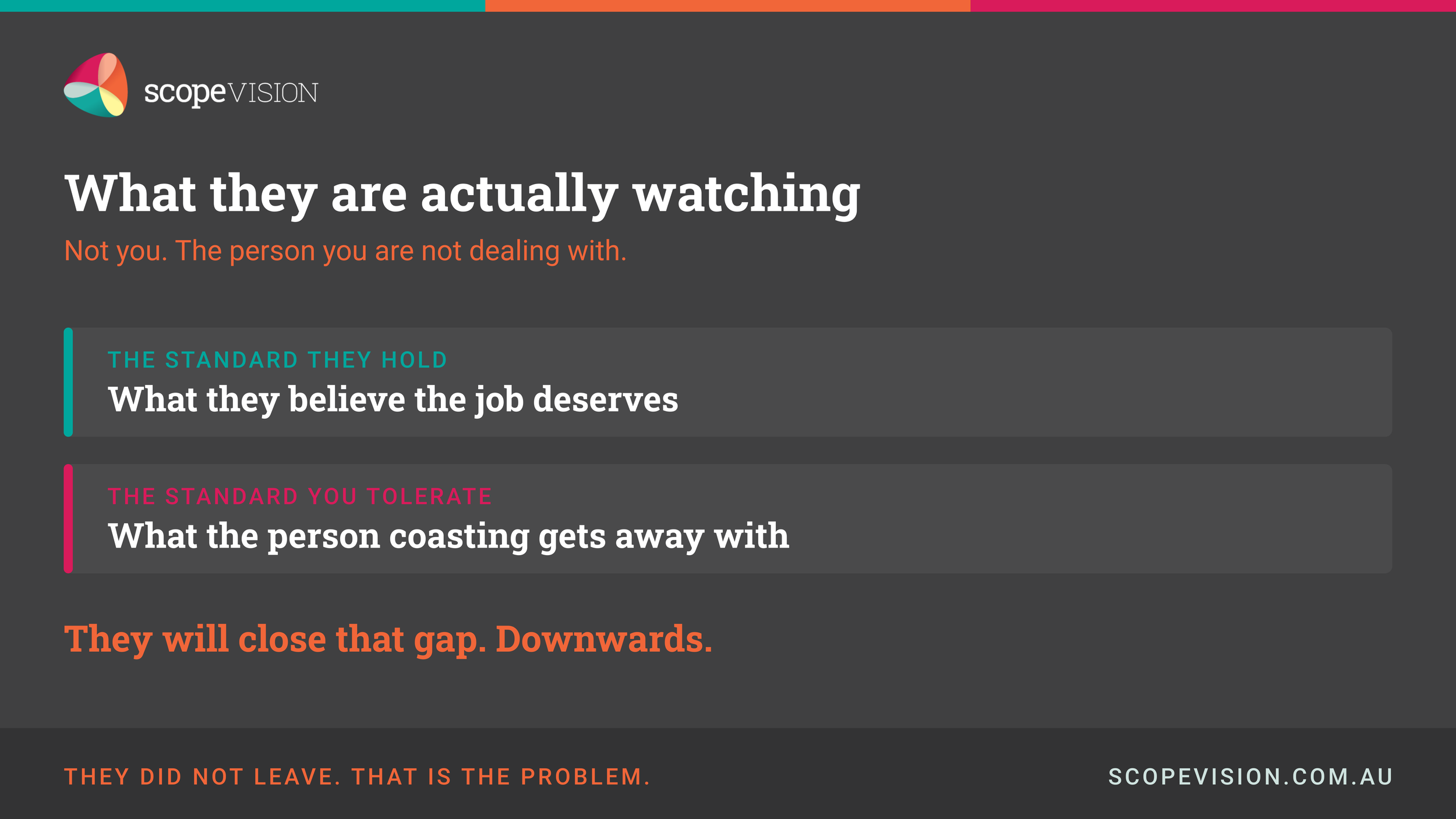
There is a moment when a high performer works out that the standard they hold themselves to is not the one anybody else is being held to.
Not because anyone told them. They watched. They saw what got tolerated, what got escalated, and what got nothing at all. And at some point they noticed that the extra they put in did not land anywhere.
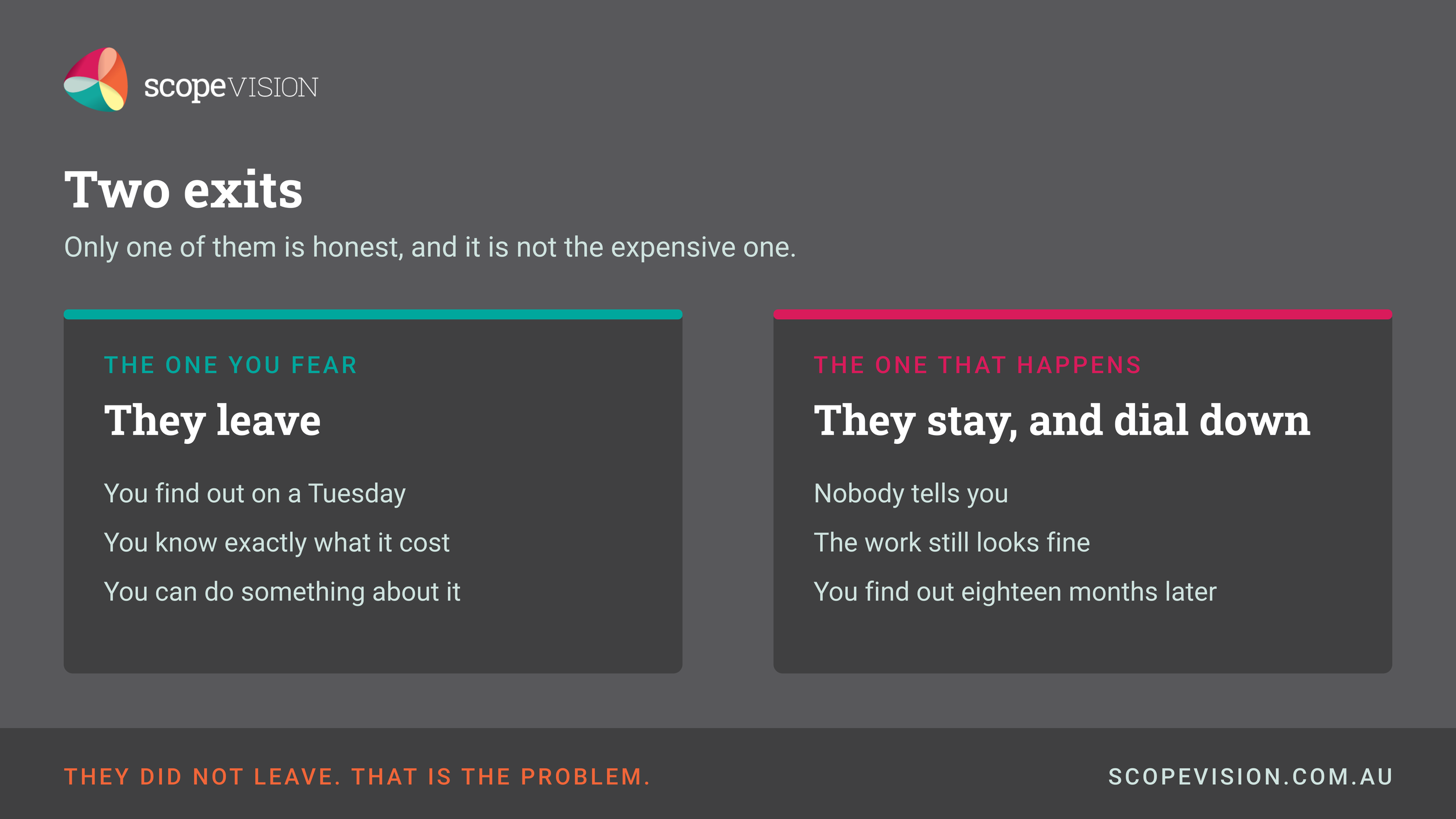
Most people assume the risk is that they leave. Sometimes they do, and at least that is honest. The more common outcome is quieter and more costly. They stay, and they ramp down to the level everyone else is getting away with.
This is not a feeling. It is a finding.
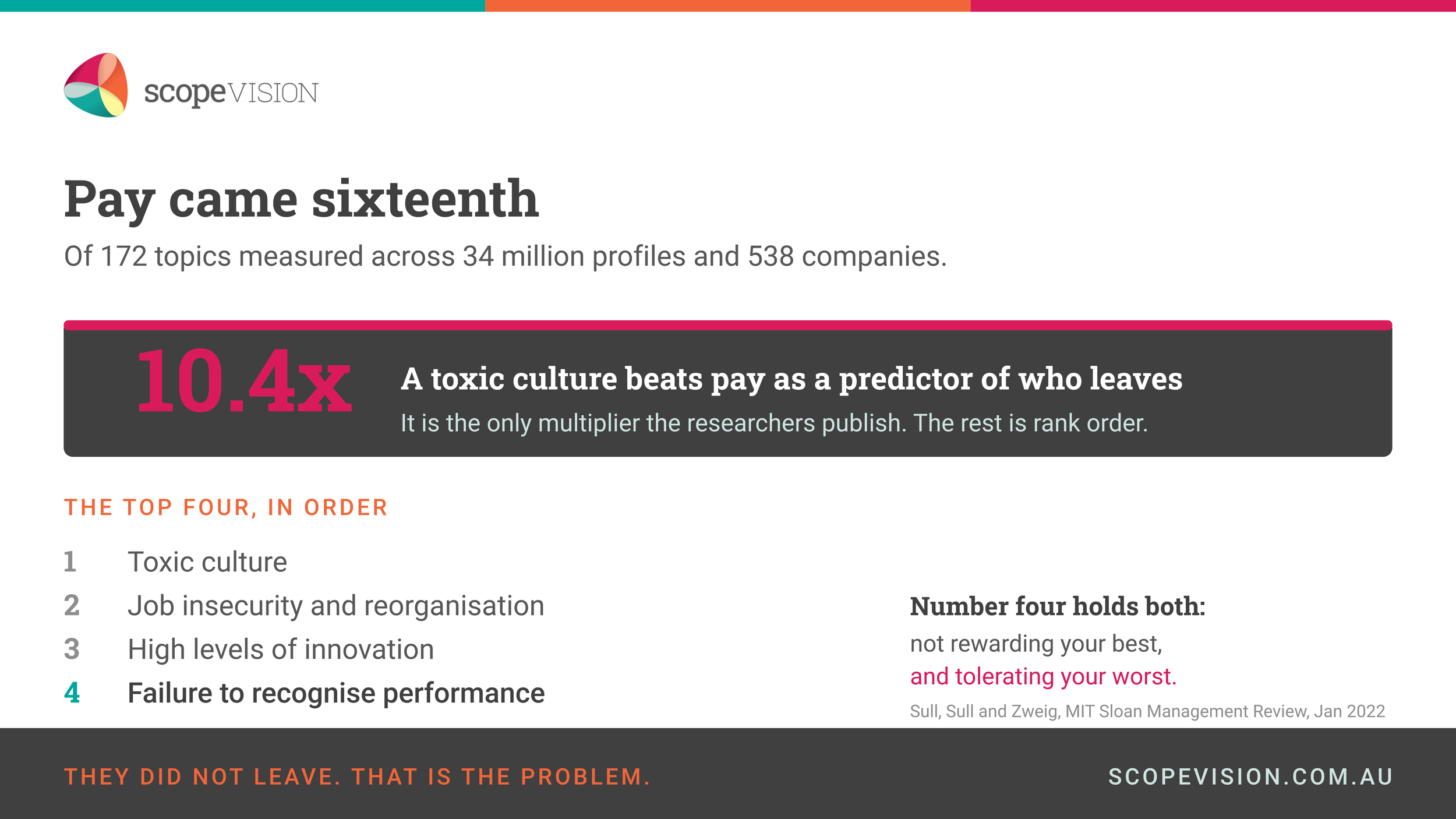
Donald Sull and colleagues analysed 34 million employee profiles and 1.4 million Glassdoor reviews across 538 large companies, looking at who resigned during the second half of 2021, when American quit rates hit a record.
Pay came sixteenth. Not sixteenth among the important things. Sixteenth among all the topics they measured for predicting who left.
What did predict it, in the top five, was failure to recognise performance. And the finding has two halves that matter here. Companies that do not recognise strong performers lose people. So do companies that tolerate weak ones.
The issue was not pay below market rates, but recognition not linked to effort and results.
Read that twice. The thing that pushes your best person out is not what they are paid. It is that the same recognition arrives regardless of what anybody did.
Gallup's practitioner work points at the same place from another angle. Their analytics found that highly talented employees who are not engaged had turnover on par with low-talent disengaged ones. Your best person, disengaged, is as likely to go as your worst. Gallup are careful to say they can only speculate as to why, and their guess is that talented people arrive with higher expectations.
Which is the same sentence you started with. They hold a standard. They watch to see whether anybody else is held to it.
The Australian version is worse
That research is American, and it describes a moment when people were leaving in record numbers. Australia is not in that moment.
Job mobility here has fallen two years running. Just under 8 per cent of employed Australians changed employer in the year to February 2025, down from a decade high of 9.6 per cent two years earlier. And of everyone who left or lost a job, only a quarter did so to take something better or because they wanted a change, down from a third three years before.
Fewer people are leaving, and fewer of those who leave are leaving by choice.
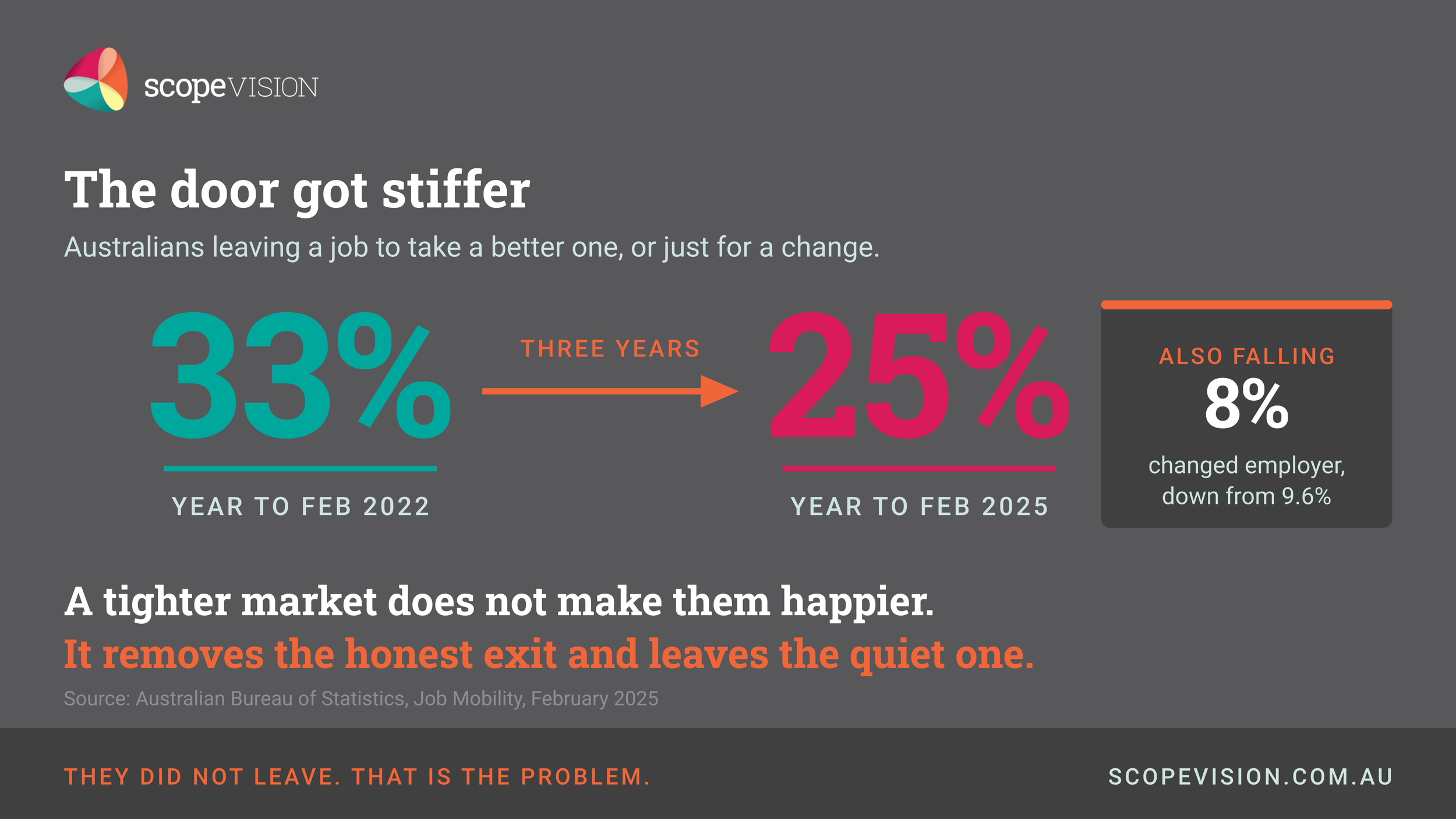
That sounds like good news for retention and it is not. A tighter market does not make your high performer happier. It removes the honest exit and leaves only the quiet one.
What it actually looks like
Nothing dramatic. That is what makes it hard.
They still deliver. The work is still on time and still good. What stops is everything around the work.
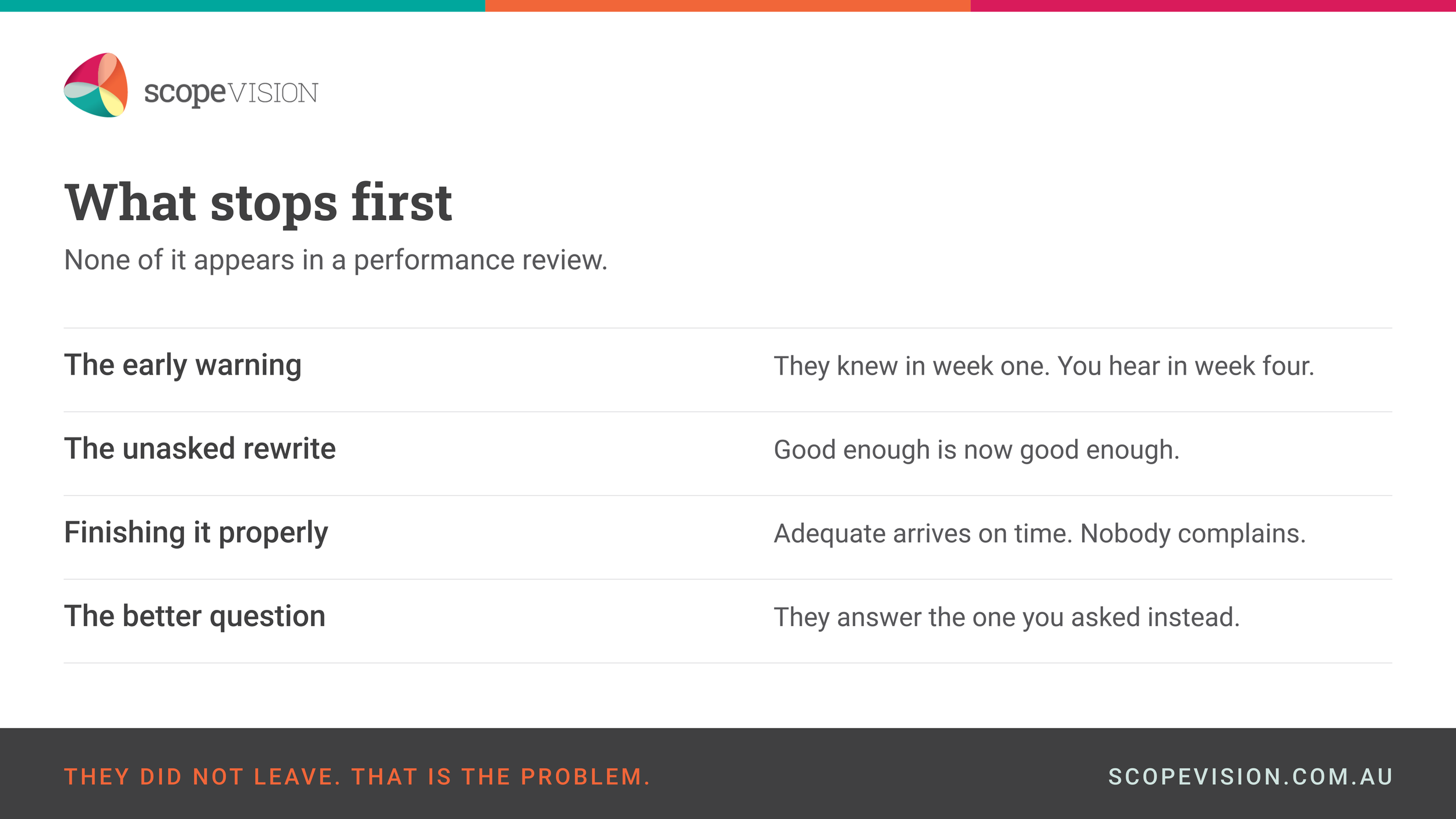
They stop flagging the problem three weeks early. They stop rewriting the thing nobody asked them to rewrite. They stop staying to finish it properly when finishing it adequately would do. They answer the question they were asked instead of the question you should have asked.
None of that shows up in a performance review. All of it was the reason they were your best person.
Which raises the obvious objection. If the work still gets done, what exactly have you lost?
Take the first one on that list. Your high performer used to tell you a problem was coming in week one, when it was a conversation. Now you hear about it in week four, when it is a decision, a cost and an apology to somebody. Nothing was hidden from you. They simply stopped doing the unpaid, unasked part where they watched further ahead than the job required.
Multiply that by every quiet correction they used to make before it reached you. That is what you are still paying for and no longer receiving.
I cannot put a number on that, and nor can the research. It is not measured because it never happened, which is exactly why it costs so much.
Why they do it, and why it is rational
Because discretionary effort is a bet, and they have stopped seeing the odds.
A high performer gives you more than the job requires on the understanding that it goes somewhere. That it is noticed, that it changes something, that the gap between them and the person coasting two desks away eventually gets acknowledged.
When it does not, they are responding to the information available.
And here is the part that stings. The thing that ramps your best person down is almost never something you did to them. It is something you did not do to somebody else.
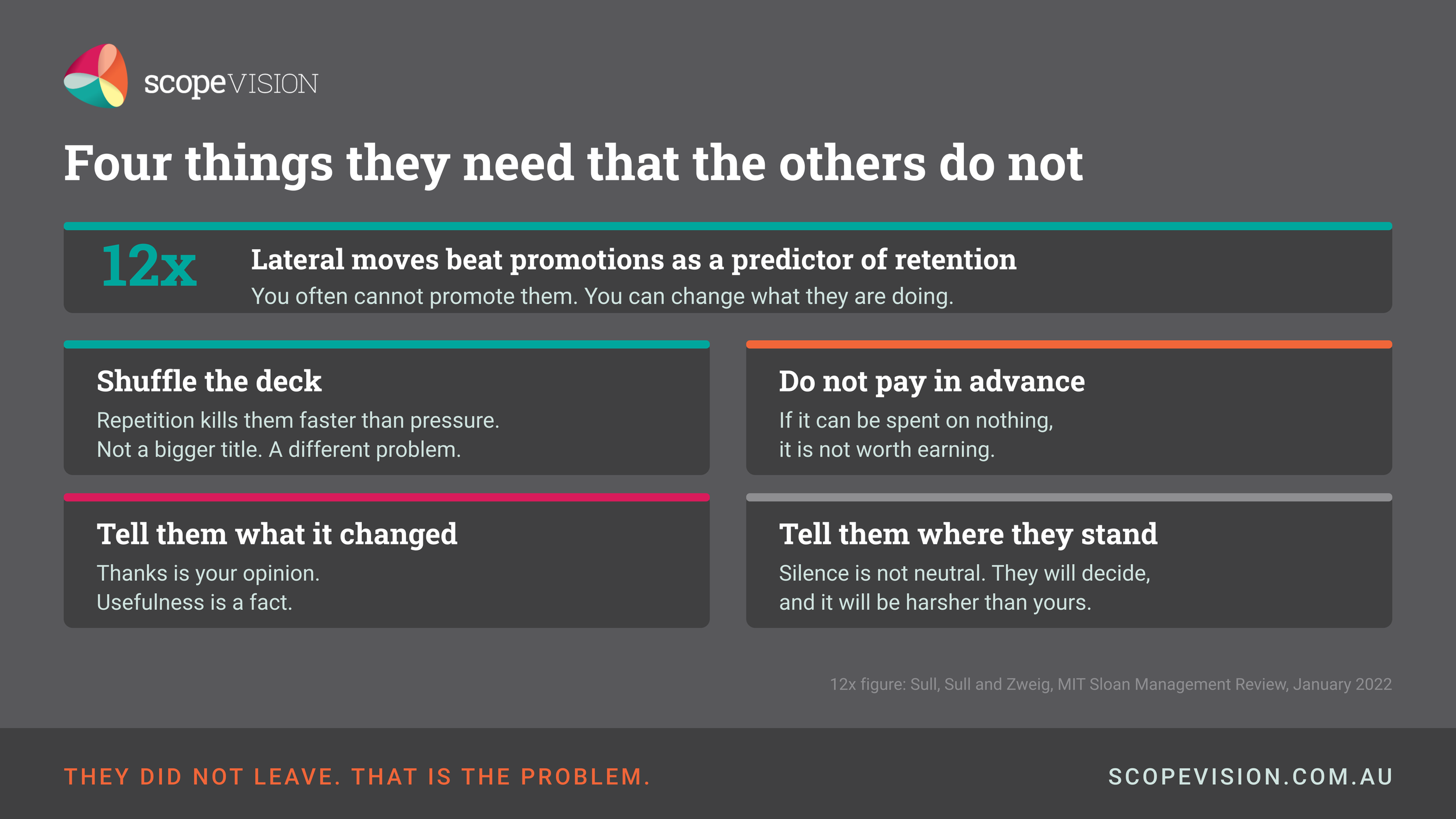
Four things they need that the others do not
Shuffle the deck before they are bored. Repetition kills a high performer faster than pressure does. The work that stretched them early in the year is the work they can do without thinking by now, and thinking is what you hired. And this is where the research gets useful rather than just interesting: in the same dataset, lateral opportunities were twelve times more predictive of retention than promotions. Not a bigger title. A different problem. Which is good news, because you often cannot promote them. You can almost certainly change what they are doing.
Do not pay in advance. The research called it recognition not linked to effort and results, which sounds like a failure to recognise anybody. It is not. It is recognition that arrives whether or not anything happened. Praise given before the work is done qualifies.
It is also worse than saying nothing, because it tells your high performer the currency is not real. If it can be spent on nothing, it is not worth earning.
Save it. Then actually spend it, on results.
Tell them what it changed. Not that it was appreciated. What it changed.
Thanks is your opinion of their work. Usefulness is a fact about it, and they would rather have the fact.
High performers run on work they can trace to something the organisation is actually doing. Show them the line from what they did to what it moved and you have not motivated them. You have removed the fog between their effort and its effect.
Tell them where they stand. Your best person is reading you more closely than anybody else on the team, because they have more riding on the answer.
Which means silence is not neutral. Say nothing about where they stand and they will decide, from whatever evidence is lying around, and the version they land on is almost always harsher than yours.
They are not fishing for reassurance. They are trying to work out whether the standard they are holding is one you share. Tell them, in plain terms, and you have answered the only question that has been running underneath all of this.
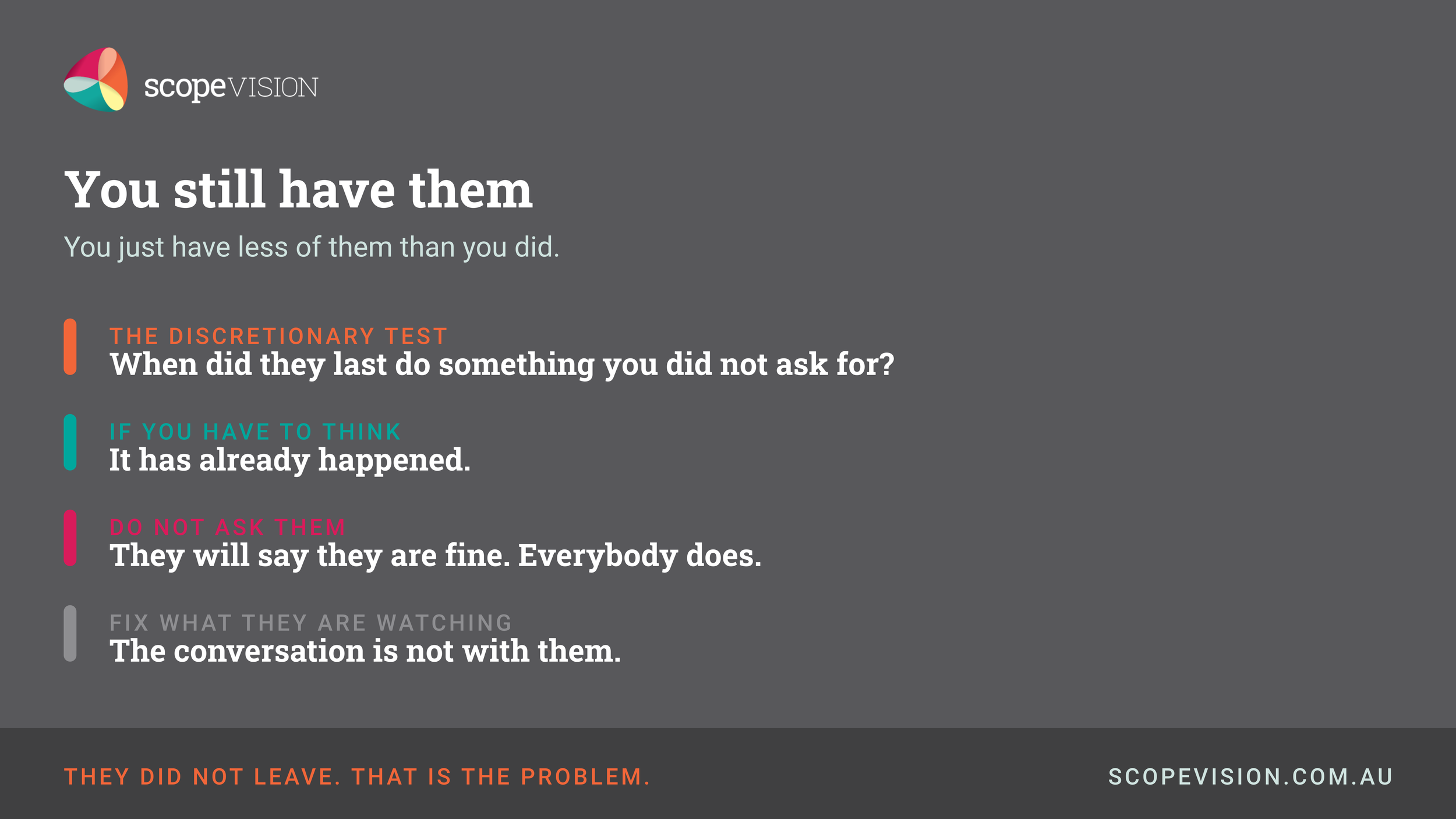
The Discretionary Test
One question, and you can run it about anybody on your team right now.
When did they last do something you did not ask for?
If the answer is recent and specific, they are still in. If you have to think about it, or you find yourself reaching back a few months, the ramp down has already happened and you haven’t noticed.
One caution. Some people never did much you did not ask for, because they are conscientious rather than expansive, and that is not a fault. So the test measures change, not level. What you are looking for is whether the answer today is different from what it would have been a year ago.
The test works because discretionary effort is the first thing to go and the last thing mentioned. Nobody announces that they have stopped going the extra mile. They just stop, and the work stays fine, and you find out eighteen months later when they resign for a job that is not obviously better.
What to do about it
If you have run the test and not liked the answer, do not go and have a conversation about engagement. They will say they are fine, because the truth is not a safe answer.
Go and fix the thing they have been watching. The tolerated behaviour, the decision nobody made, the person who has been getting away with it for months. That is the conversation, and it is not with them.
Then give them something they could fail at, and stay visible while they do.
They did not leave. You still have them. You just have less of them than you did, and the difference was never in the job description.

TEAM ENGAGEMENT
The person who ramped down will not tell you why.
So we do not ask them directly.
Our session works out what a team has stopped saying, what it has learned to tolerate, and what that is costing the people who still care.
Somewhere collaborative, and with somebody in the room
whose job it is to ask the awkward question.
See team engagement solutions Email MJ about your team
The second button opens your email app with the questions already in it. If nothing happens when you tap it, your device has no mail app set up, so use the contact page.
Driving results through people is what we do.
For students, and anyone who wants the evidence
Three sources, and they are not equally strong. Worth knowing which is which.
Sull, D., Sull, C. and Zweig, B. (2022) 'Toxic culture is driving the Great Resignation', MIT Sloan Management Review, 11 January. Reprint 63317. Available at: https://sloanreview.mit.edu/article/toxic-culture-is-driving-the-great-resignation/ (Accessed: [insert date]).
Australian Bureau of Statistics (2025) Job mobility, February 2025. Released 29 July. Available at: https://www.abs.gov.au/statistics/labour/jobs/job-mobility/feb-2025 (Accessed: [insert date]).
Gallup (n.d.) Talent walks: why your best employees are leaving. Available at: https://www.gallup.com/workplace/231641/talent-walks-why-best-employees-leaving.aspx (Accessed: [insert date]).
A note on the evidence. The MIT Sloan work is substantial: 34 million employee profiles, 1.4 million Glassdoor reviews, 538 companies, April to September 2021. It analyses what people wrote about their employers rather than testing anything under controlled conditions, and it is American. Only one multiplier is published, the 10.4 for toxic culture; everything else is rank order, and I have not invented figures to fill the gap. The ABS data is official and current. The Gallup piece is practitioner writing from their own client analytics, not peer-reviewed, and Gallup themselves say they can only speculate about why talented disengaged people leave fastest. It is here because it points the same way, not because it proves anything.
Cite this article
Reference list
Satterthwaite, M-J. (2026) Your best person is ramping down. Scope Vision. Available at: https://scopevision.com.au/blog/your-best-person-is-ramping-down (Accessed: [insert date]).
In text
(Satterthwaite, 2026)
Keep reading
Why do we tolerate porcupines in the workplace?
The conversation this article says you need to have. Here is how to have it.
Align your Team's Vision, Behaviour and Consequences
How the gap between the standard you publish and the standard you enforce opens in the first place.
Feedback: An Elephant or a Gift?
Telling them where they stand, done properly. Including the version that does more harm than silence.
13 Behaviours of High-Trust Leaders
None of the four things work without this underneath them.
Somebody came to mind
while you were reading this.
The like button just below is how I know this landed.
And if it was one of your own, that is the answer to the test.