Every trust behaviour has a forgery. It's usually your best one.
Ten years ago I wrote about Covey's 13 behaviours of high-trust leaders. It is still the most read thing I have ever published. Leaders love it. They print the list, pin it to the wall, tick themselves off against it and feel pretty good about their day.
Here is what I didn't say.
Every one of those 13 behaviours has a forgery. Not an opposite — a forgery. Forgeries are far more dangerous than opposites, because an opposite is easy to spot. Nobody mistakes a leader who never listens for a leader who listens well. But a leader who nods, holds eye contact, waits for the full stop and then says exactly what they were always going to say? That one passes.
Before you read the list: this isn't about character
If you go into the next section braced for a list of ways you're a fraud, you'll read defensively and get nothing out of it. So let me take that off the table first.
Counterfeits are not deception. They are almost never a decision. Sit in enough leadership debriefs and you stop seeing fakes and start seeing something far more interesting:
A counterfeit is a strength running under pressure with the situational read switched off.
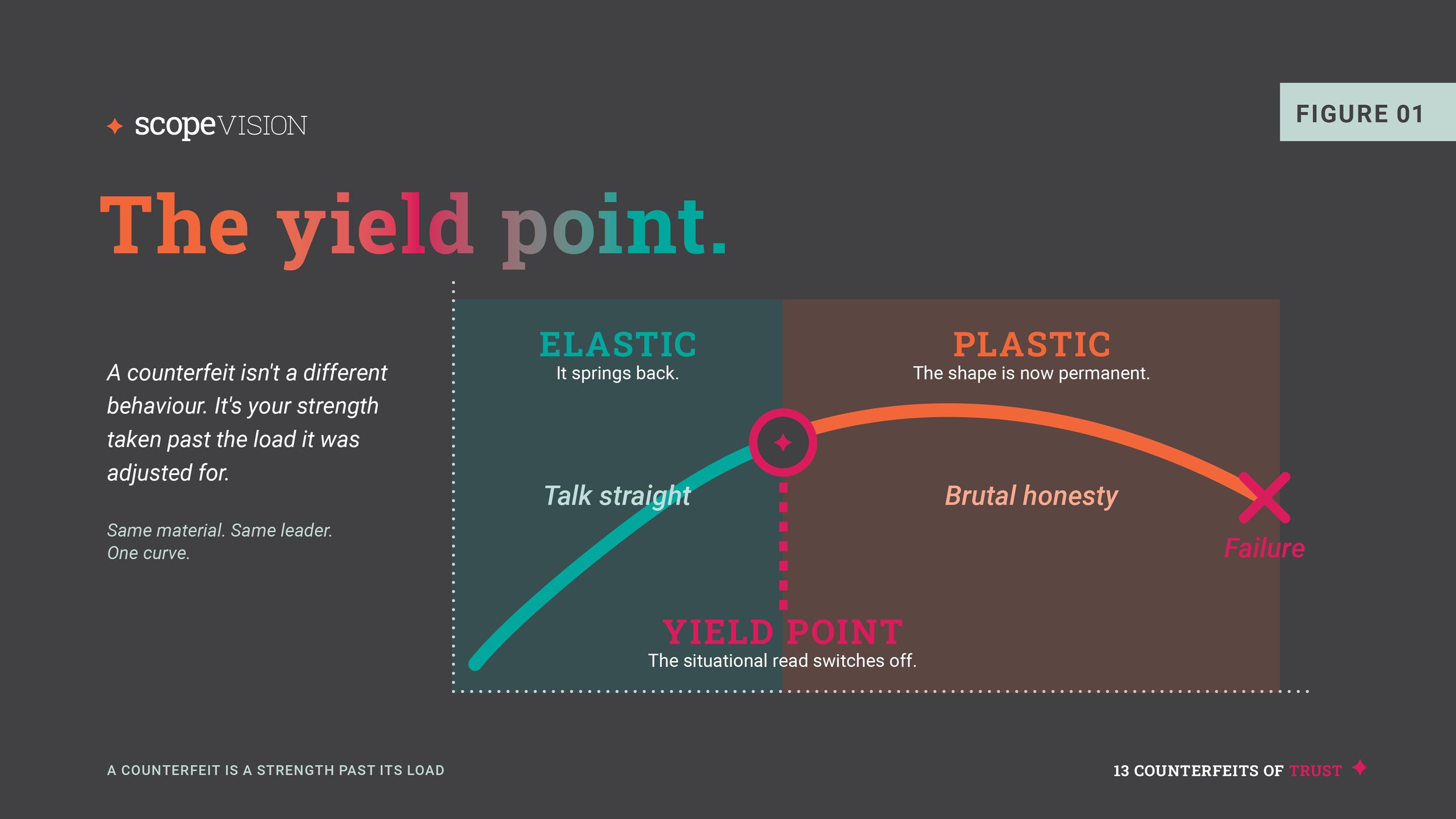
That idea isn't mine. It comes from two bodies of research worth knowing. Robert and Joyce Hogan's work on the "dark side" of leadership found that derailment isn't caused by a lack of ability — it's caused by strengths that become liabilities under stress, which is why they built an inventory to measure them (the Hogan Development Survey: 11 scales, 154 items). Robert Kaplan and Robert Kaiser made the same case in the Harvard Business Review: your greatest strength, overdone, is your likeliest undoing. Full citations at the end.
It's the same behaviour you're genuinely good at, with the volume stuck up and the adjustment missing. Straight talk under pressure becomes brutal honesty. Extending trust under pressure becomes abdication. Delivering results under pressure becomes results at any cost.
Which means the counterfeits you run are drawn from your strengths, not your weaknesses. You don't forge a behaviour you were never any good at. Nobody's counterfeit listening comes from being a poor listener — it comes from being a good one who has stopped noticing when they've stopped.
So the useful question isn't "am I a good leader?" It's much narrower, and much more answerable: what does my best behaviour turn into when I'm under load?
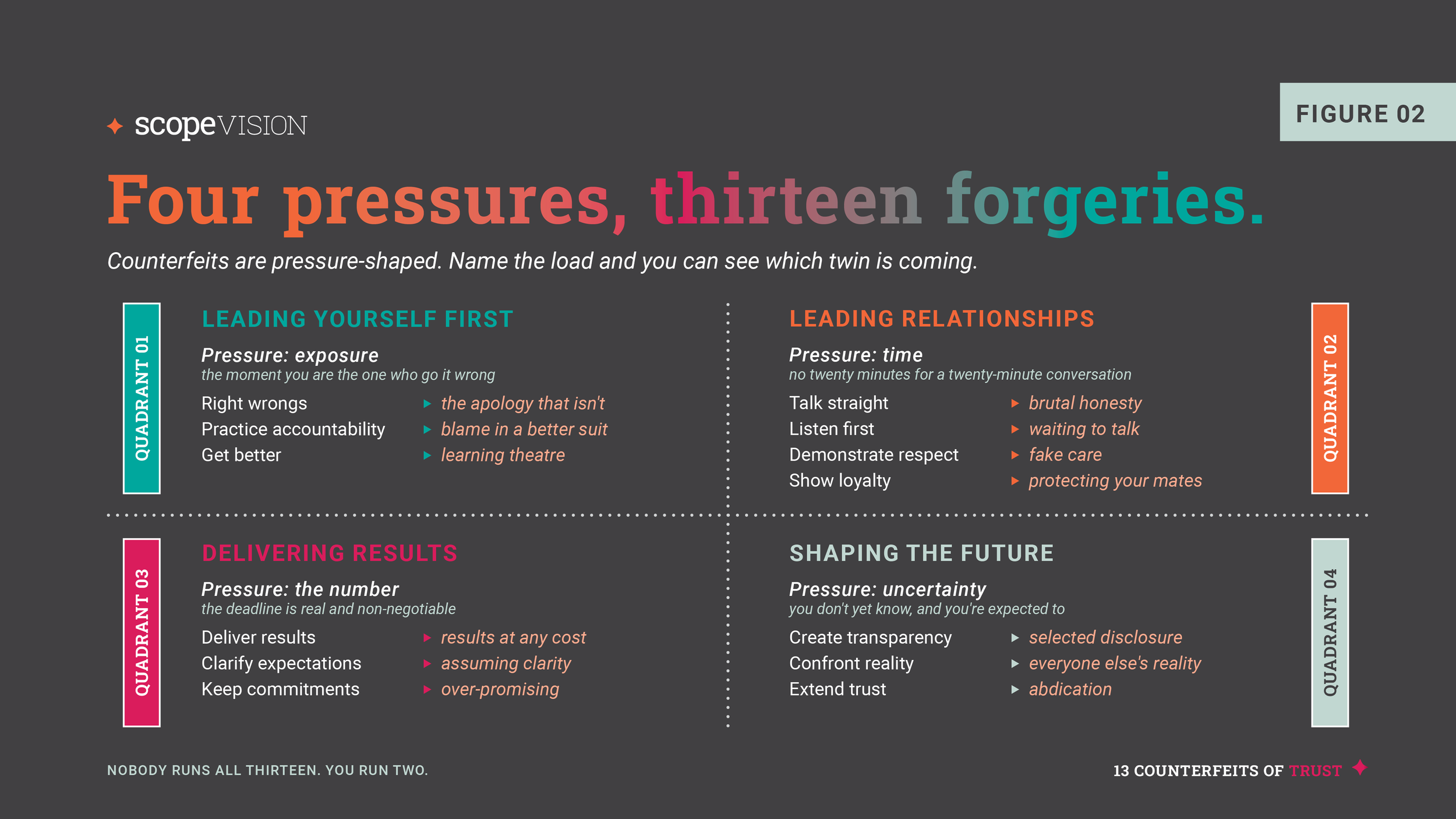
The 13 twins
Grouped the way we work them in a development conversation — four quadrants, each with its own pressure signature.
Ninety seconds
Which load are you carrying right now?
Pick the one that describes your last fortnight — not your career, not who you are. Just the last fortnight. Then open it.
“I’m the one who got something wrong.”
You’re carrying Exposure
The pressure is being visibly at fault.
Watch for
- the apology that isn’t
- blame in a better suit
- learning theatre
“I haven’t had time for the conversations I owe people.”
You’re carrying Time
The pressure is a shift with no room in it.
Watch for
- brutal honesty
- waiting to talk
- fake care
- protecting your mates
“There’s a number and a date, and neither is moving.”
You’re carrying The Number
The pressure is a deadline that genuinely will not move.
Watch for
- results at any cost
- assuming clarity
- over-promising
“I’m being asked for answers I don’t have yet.”
You’re carrying Uncertainty
The pressure is being expected to know before you do.
Watch for
- selective disclosure
- confronting everyone else’s reality
- abdication
If two of those felt true, that’s normal — most leaders carry two loads at once. Your counterfeits will cluster under whichever is heaviest. Read that quadrant properly below and skim the rest.
Leading yourself first — the pressure is exposure
The moment you are the one who got it wrong.
Right wrongs → the apology that isn't. "I'm sorry you felt that way." That's not an apology, that's a diagnosis. Covey said make restitution — reverse the call, fix the roster, ring the person you cut off in the meeting. Under exposure, the apology arrives faster than the reflection that should precede it.
Practice accountability → blame in a better suit. Accountability that only ever points at the people below you isn't accountability. It's aim.
Get better → learning theatre. Course collecting. Feedback asked for, then filed. Asking and ignoring is worse than never asking, because your team has paid you in honesty and received no change.
Leading relationships — the pressure is time
When you don't have the twenty minutes the conversation deserves.
Talk straight → brutal honesty. "I'm just a straight shooter." No you're not — you're rude with a permission slip. Straight talk without care isn't feedback, it's a serve with better branding. Note what's actually missing: not the honesty, the time you'd normally spend making it land.
Listen first → waiting to talk. The nod-and-reload. You're not listening, you're loading. They can see it in your face — and that's the exact moment they decide not to bring you the problem while it's still small.
Demonstrate respect → fake care. Asking about someone's weekend while scrolling your phone. Respect you perform is worse than respect you forget, because now they know exactly where they sit on your list.
Show loyalty → protecting your mates. Loyalty to whoever happens to be in the room, at the expense of whoever isn't. Everyone is watching who you carry, who you cover for, and who gets left holding the job.
Delivering results — the pressure is the number
When the deadline is real and genuinely non-negotiable.
Deliver results → results at any cost. You hit the number by burning the team through three weeks they will never get back. Congratulations, you’ve borrowed next month’s trust to pay for this week’s result. The interest rate is brutal.
Clarify expectations → assuming clarity. "I told them. Once. At a handover in March." Once isn't clarity — once is a rumour. If you can't hear it repeated back in their words, it didn't land.
Keep commitments → over-promising. "Leave it with me." Said fifteen times a week, delivered on twice. Under deadline the yes is cheap, because the cost lands on a future version of you. Make commitments cheap and they will be valued accordingly.
Shaping the future — the pressure is uncertainty
When you don't yet know the answer and are expected to.
Create transparency → selective disclosure. You brief the team generously on nine things so nobody notices you skipped the tenth. They already know which one you skipped. It was the only one they were listening for.
Confront reality → confronting everyone else's reality. Wonderfully brave about the team's problems, management's problems, the other shift's problems. Curiously quiet on your own contribution to any of them.
Extend trust → abdication. Handing over the job, calling it empowerment, then checking in four times before lunch. That's not trust; that's surveillance with a nicer name. It shows up hardest when you're least certain of the outcome.
Why you can't spot your own
Here's the cruel mechanics of it: intent is invisible from the inside and obvious from the outside.
You experience your intent directly — you know you meant well. Your team never gets access to that. They get behaviour, and they run it through years of prior evidence and their own history of leaders who said one thing and did another.
So you are the only one grading yourself on intent. Everybody else is grading you on impact.
The version you can actually measure
This isn't a philosophical point, and you don't have to take it on faith. In any decent 360, it has a number attached: the gap between how you rate yourself on a behaviour and how the people around you rate you on the same behaviour.
That gap is the counterfeit, quantified. Where you score yourself high and your team scores you low, you are almost certainly running the forgery and experiencing the genuine article. That's not an insult. It's the single most useful piece of data a leader can hold, and it is completely unavailable through introspection.
And if you have never sat a 360, many frontline leaders have not, you can run the same test by hand. Three people, one question, asked properly. There is a version of it at the end of this article.
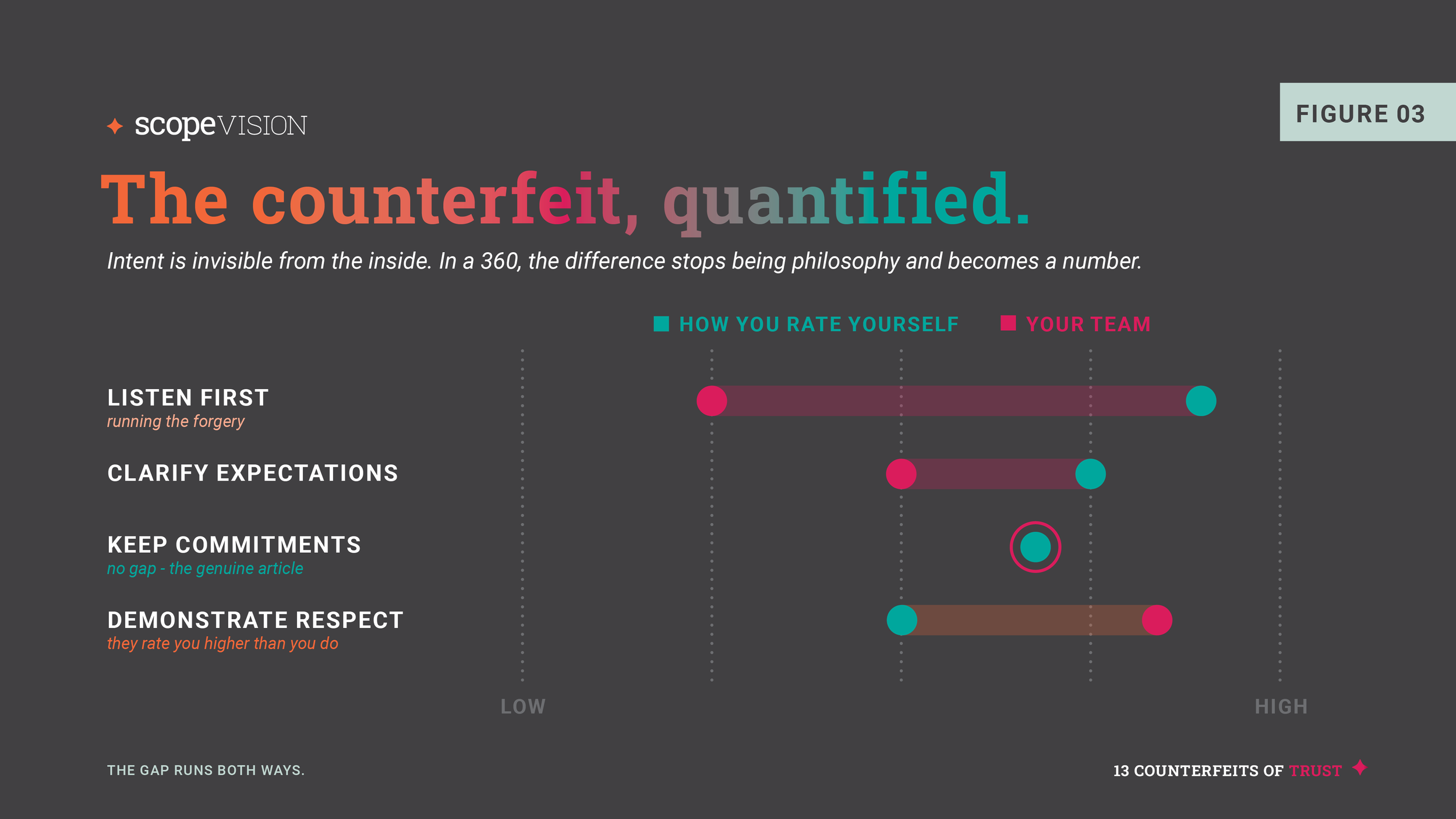
Worth saying plainly: the gap runs both ways. Plenty of leaders rate themselves well below where their team rates them — and if that's you, your development conversation is a different one entirely. It's not about counterfeits. It's about believing the evidence.
One honest complication, because it matters. Kaplan and Kaiser argue that conventional 360s are poor at detecting overused strengths, precisely because most rating scales run from weak to strong — so "more" always reads as "better" and a behaviour taken too far scores as excellence. Which means the counterfeit doesn't only hide in your low scores. Sometimes it's sitting in your highest one. When a behaviour is rated at the very top by everyone, the right question isn't "how do I keep this up?" It's "is this too much of a good thing?"
Your team worked out which of your behaviours are counterfeit a long time ago. They just never told you — because "your listening is fake" is not a career-enhancing sentence.
The counterfeit test
Three questions. Ask them from the outside, because the inside view is structurally compromised.
1. Would my team describe what I just did the same way I would?
If you'd call it "straight talk" and they'd call it "getting a serve", theirs is the version that counts. Their perception is your reality — and if you don't know the answer, that's the finding.
2. What was under load at the time?
Not what did I intend — what was the pressure? Exposure, time, the number, or uncertainty? Counterfeits are pressure-shaped, and once you know your signature you can see them coming instead of finding them in a report.
3. Did anything change afterwards?
Real trust behaviours leave evidence. A fixed problem. A reversed decision. A commitment met. If nothing shifted, it was theatre — and theatre is expensive.
Check the roots, not the fruit
Covey drew trust as a tree: integrity in the roots, intent in the trunk, capability in the branches, results in the fruit.
Counterfeits rot from the roots up — and you will see it in the fruit last.
Which raises a fair question, because this looks like a second mechanism. The yield point is acute — one moment, one conversation, a strength taken past its load. A tree rotting is chronic. Both can't be the story.
They are, and here's how they fit. The deformation is sudden. The desensitisation is slow. What erodes gradually isn't the behaviour — it's your capacity to notice you've crossed the line. Every time you go past yield and nobody names it, the situational read gets a fraction less sensitive, and the next crossing costs a little less to ignore.
So the load is acute and the erosion is chronic, and they feed each other. That's exactly why the fruit is the last thing to change. By the time the results go bad, you haven't been noticing for months — and auditing yourself from the top down will return a clean bill of health every time. The numbers are fine. The projects delivered. Everything's fine.
Start underground.
The good news, and it's better than you'd think
Counterfeits are fixable, and fast — because you already own the behaviour. You're doing the hard part. You're running it at the wrong volume, at the wrong moment, for a pressure you haven't named yet.
And here's the thought I'd actually like to leave you with.
Nobody counterfeits a worthless currency. Forgeries only appear where there is something genuinely worth forging. The fact that good leaders reach for the imitation under pressure is the strongest evidence we have that the real thing is worth something.
Finding a counterfeit in yourself isn't a failure. It's confirmation you're in the right market. You're just paying with the wrong note.
What to actually do on Monday
Pick one. The one that made you wince.
Then go and find out whether you picked right.
Because everything you've just read argues that you are the least reliable witness to your own behaviour — so ending on "have a good think about it" would be a bit rich. Ask three people who see you under pressure. Ask them for the behaviour, not the verdict: not "am I a good listener", but "when I'm flat out, what do I do that makes you stop talking?"
They will tell you. They've been waiting a while.
Trust isn't built in a workshop. It's built in the hundred small moments where you could have spent the counterfeit — and didn't.
Not "which twin did you recognise?" You've just read two thousand words arguing you're the last person who can answer that.
The only version worth asking is: which twin would your team name? And the only way to find out is to give them a safe way to say it.
HOGAN 360 AND COACHING
Here is the safe way to say it.
A 360 gives your team a way to name the twin without anyone having to be brave about it, and a debrief turns the number into something you can act on. Accredited in Hogan, DISC and Belbin, delivered one to one or across a leadership group.
Enquire Now opens an email with a few questions already in it. If nothing happens when you click, your device has no mail app set up. Use See mentoring instead.
For students, and anyone who wants the evidence
This piece isn't a research paper, but the argument rests on published work and you should be able to check it. If you're using it in a seminar, tutorial or coaching program, start here.
THE THIRTEEN BEHAVIOURS
Covey, S.M.R. (2006) The Speed of Trust: The One Thing That Changes Everything. New York: Free Press.
A note on attribution. This is Stephen M. R. Covey, the son, not Stephen R. Covey of The 7 Habits of Highly Effective People. The two are widely confused. I made that mistake myself in the 2016 version of that article, and it stood for ten years. Corrected in the 2026 revision, and here.
STRENGTHS THAT DERAIL UNDER PRESSURE
Hogan, R. and Hogan, J. (2001) 'Assessing leadership: a view from the dark side', International Journal of Selection and Assessment, 9(1-2), pp. 40-51. Available at: https://doi.org/10.1111/1468-2389.00162
Kaplan, R.E. and Kaiser, R.B. (2009) 'Stop overdoing your strengths', Harvard Business Review, 87(2), pp. 100-103.
Kaiser, R.B. and Hogan, J. (2011) 'Personality, leader behavior, and overdoing it', Consulting Psychology Journal: Practice and Research, 63(4), pp. 219-242. Available at: https://doi.org/10.1037/a0026795
Kaplan, R.E. and Kaiser, R.B. (2013) Fear Your Strengths: What You Are Best at Could Be Your Biggest Problem. San Francisco: Berrett-Koehler.
THE SELF/OTHER GAP
Hogan 360, developed by Peter Berry Consultancy with Hogan Assessments. An Australian-built instrument now used worldwide, benchmarked against a database of tens of thousands of 360s and hundreds of thousands of raters. It sets a leader's self-evaluation directly against manager, peer and direct-report ratings, which is the gap this article is about.
Four questions for a seminar or a leadership team
- If a counterfeit is a strength overused, is "counterfeit" the right word at all? What does the currency metaphor add, and what does it distort?
- Kaplan and Kaiser argue that standard 360 scales cannot see overuse. If your highest score might be your biggest risk, how would you redesign the instrument?
- This article claims intent is invisible from the inside. If that is true, what is the ethical status of judging a leader on impact alone?
- Hogan's work locates derailment in personality under stress. Covey locates trust in character. Are these the same claim in different vocabulary, or genuinely competing accounts?
Cite this article
Satterthwaite, M-J. (2026) 'The 13 Counterfeits of Trust', Scope Blog, 16 August. Available at: https://scopevision.com.au/blog/13-counterfeits-of-trust (Accessed: [insert date]).
In text: (Satterthwaite, 2026).
Keep reading
- 13 Behaviours of High-Trust Leaders. The original list, and the one this article is arguing with.
- Why do we tolerate porcupines in the workplace? What to do when the behaviour is not a counterfeit but a decision.
- The Keys to Holding Great Coaching Conversations. How to run the conversation once someone has named the gap.
You've just read two thousand words about feedback nobody wants to give.
Here's some that costs you nothing.
The like button just below is how I know.
And if a name came to mind while you were reading, send this to them instead. That's worth more than a like, and it's braver.