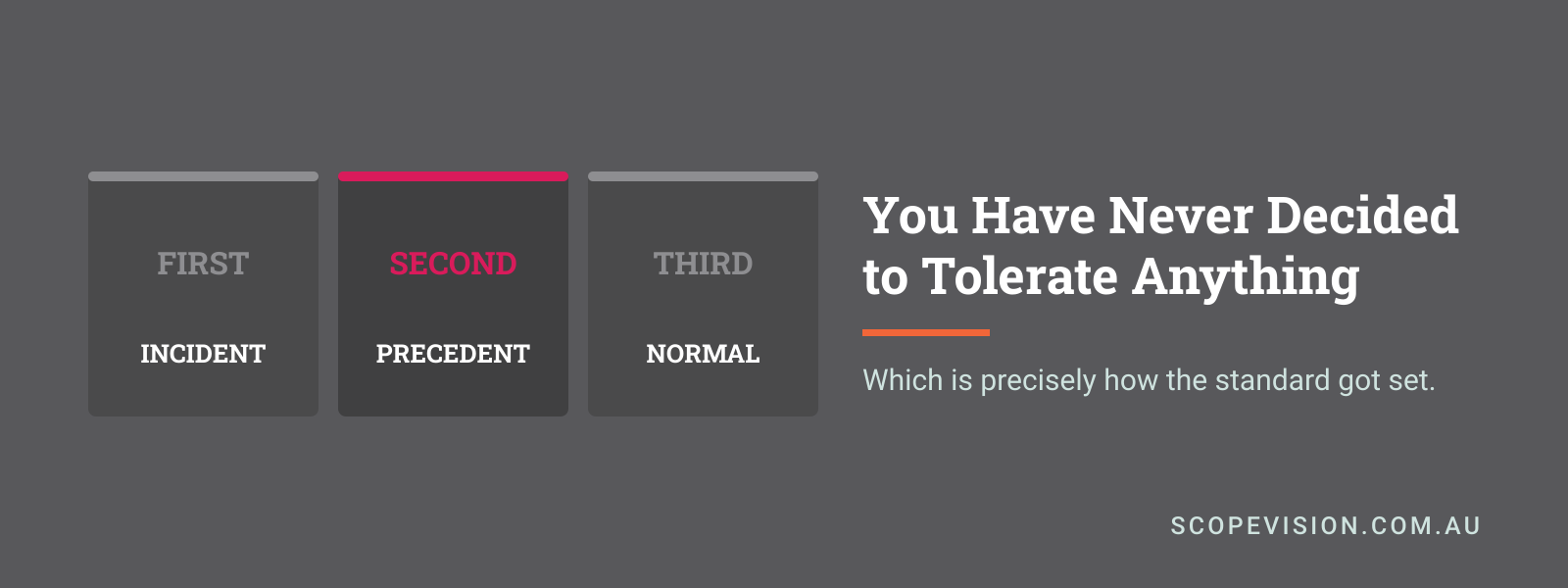
Which is precisely how the standard got set
Nobody sits down on a Monday and decides what their team will be allowed to get away with.
Which is a problem, because your team is operating to a set of standards right now, and not one of them is the standard you would have written.
How it actually happens
Somebody is forty minutes late. A job goes out that is not quite right. Two people speak to each other in a way you would not want overheard.
And you were busy, or you were not sure it was worth it, or you thought it was a one-off. So you let it go.
That was an incident.
Then it happens again.
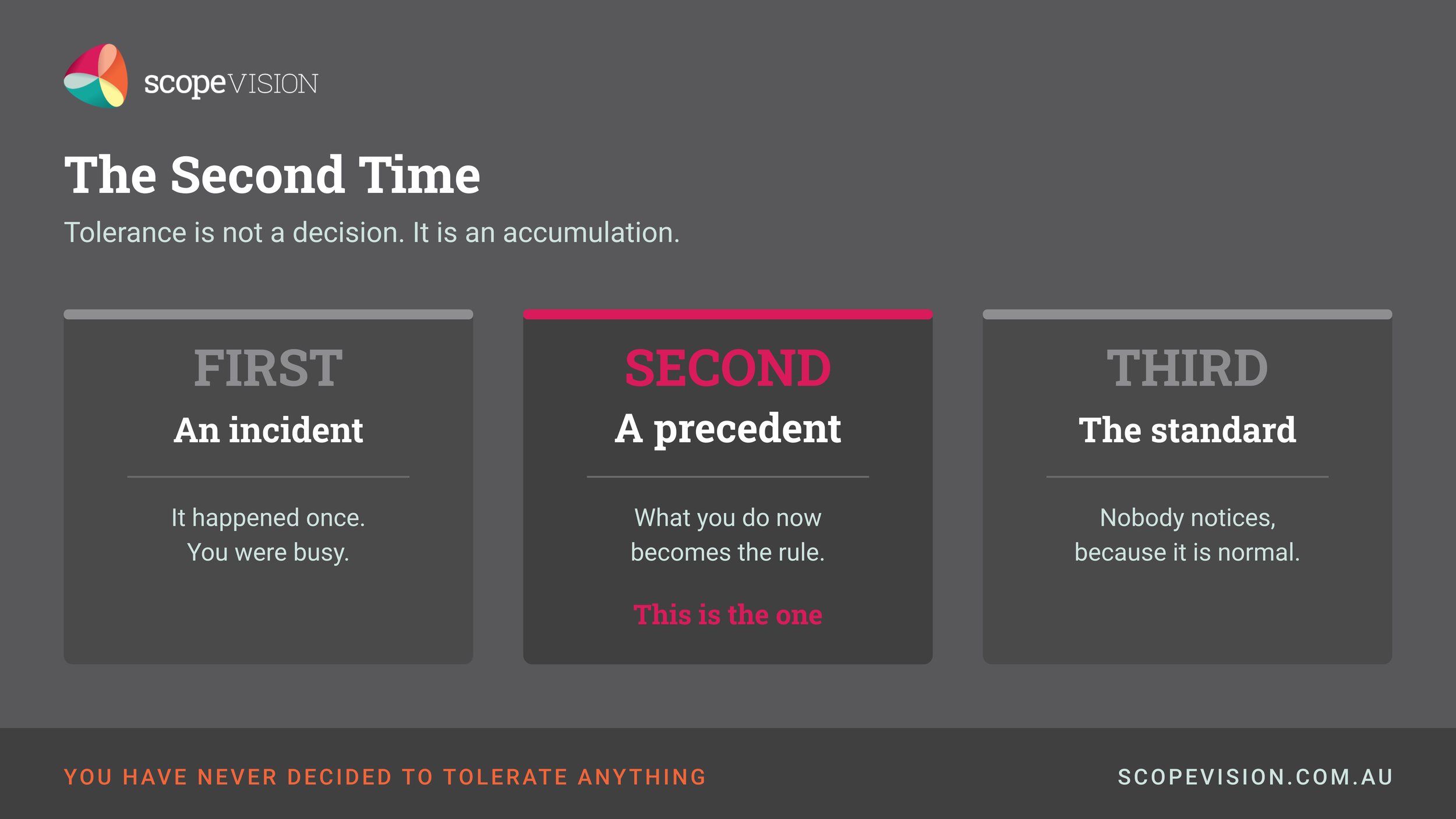
The second time is the decision, and it is the one you do not notice making. There is a pattern now, so no response is the response. It becomes a ruling. Whatever you do the second time, including nothing, sets the precedent, and the precedent rewrites how things are done here.
By the third there is nothing left to decide. It is just normal.
They are not listening. They are watching.
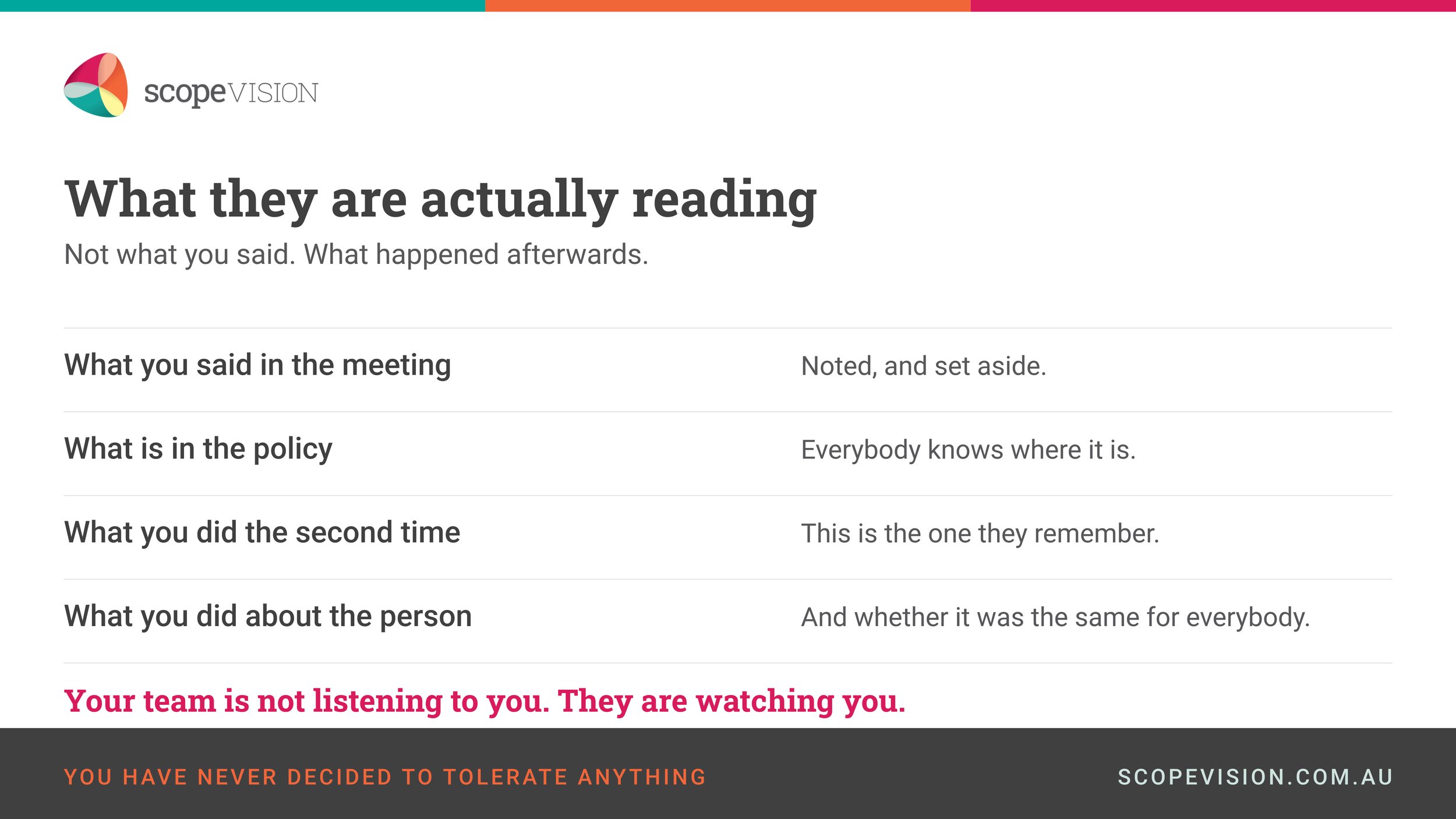
They are working from what happened next. Not what you said about lateness, but what happened the last time somebody was late. Not what the policy says about quality, but what you signed off anyway, and whose work it was.
That is not cynicism. It is accuracy. Words are free. Consequences are not, and people can tell the difference.
Four things every team is watching
Whatever the industry, whatever the shift, every team runs the same four checks.
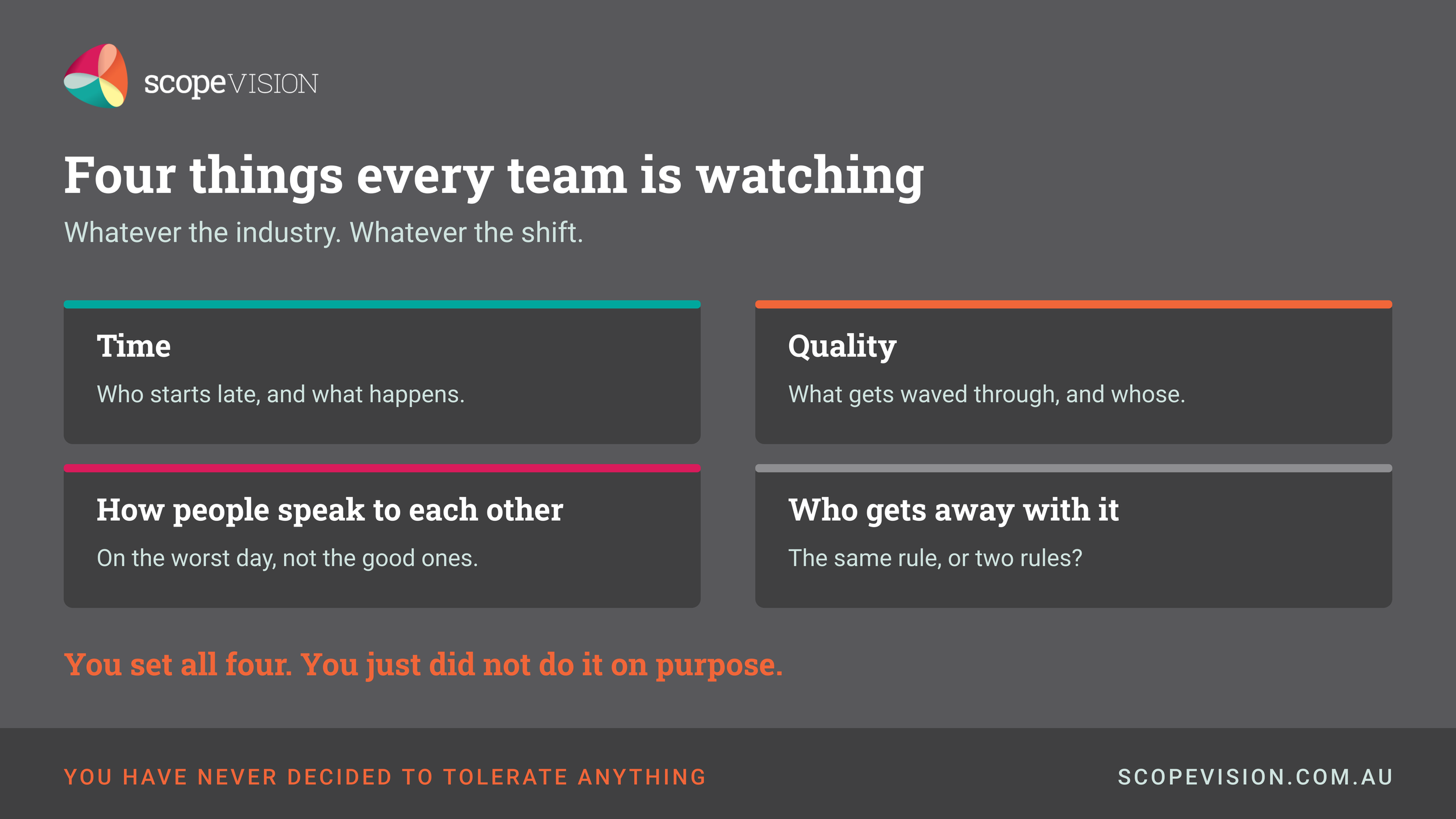
Time. Who starts when, and what happens when they do not.
Quality. What gets waved through, and whose.
How people speak to each other. Not on a good day. On the worst day, when something has gone wrong and somebody is under pressure.
And who gets away with it. The one that does the most damage, because it is not about the behaviour. It is about whether there is one rule or two.
You set all four. You just did not do it on purpose.
Why you are the last to know
Your tolerances are invisible to you for a structural reason, not a personal one.
You set them one at a time, over months, each in an identifiable moment. Somebody was going through something. It was the end of a hard week. The job still went out on time. You do not see a set of tolerances. You see a series of sensible individual judgements, each one defensible.
Everybody else sees only the result, because they were not there for the reasons.
And the people who can see it are the ones least able to say so. Not because they are frightened of you, but because they work alongside this person. They share the shift, the handover, the crib room. You can raise it and go home. They raise it and then sit next to it for the rest of the year.
Which is why waiting to be told is not a strategy. The cost of telling you falls on somebody with more to lose than you.
New starters are the most useful people you have, for about a fortnight. Ask them what surprised them, before they stop noticing.
You cannot enforce backwards
Something specific has probably come to mind by now. Somebody who has been doing something for a long time that you have let go.
Here is what most leaders do next. They decide it stops, they raise it, and it goes badly.
It goes badly because that person has not broken a rule. They have been doing something you saw and accepted, for long enough that it stopped being a question. The rule genuinely was different yesterday, and you made it normal.
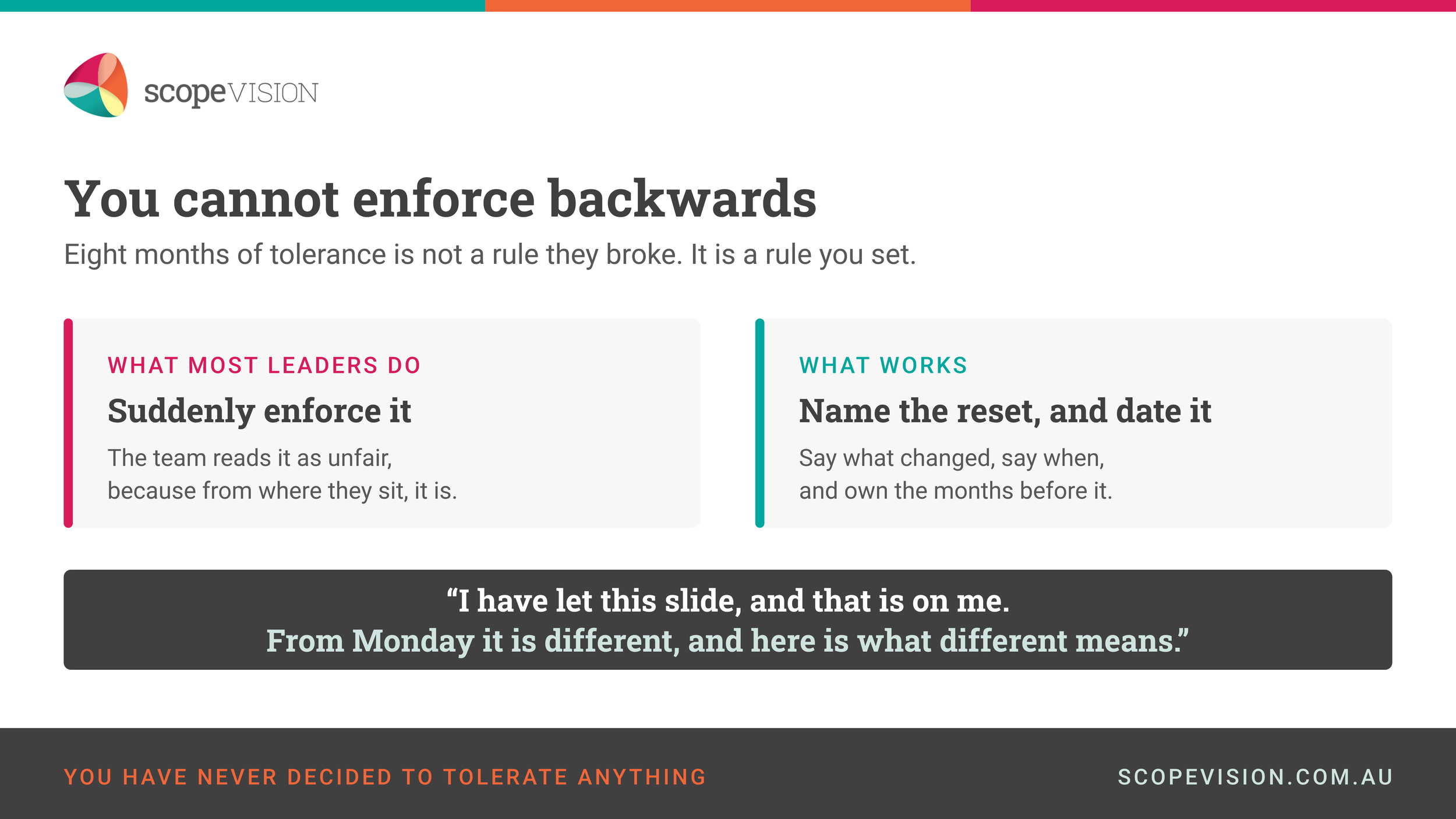
So you cannot go back. You can draw a line and explain where it is.
That means saying the uncomfortable. You let it slide, it is on you, and from a named date different is the new normal. Be specific, so nobody has to guess.
It costs you something to say. It costs more not to, because the alternative is a team that thinks the rules move with your mood.
The line everybody quotes
The standard you walk past is the standard you accept. A hundred toolbox talks and a thousand slides, usually credited to David Morrison, who said it as Chief of Army in 2013 in a speech that deserved its reputation.
Except it was not his line, and he said so. Two and a half years later, on national television in the week he was named Australian of the Year, Morrison named two people it did not belong to: himself, and his former speechwriter. It belonged, he said, to David Hurley, then Governor of New South Wales and later Governor-General.
Which is quietly perfect for this subject. The most quoted leadership line in the country became somebody else's without anybody deciding it should. That is what happens when repetition makes it the norm.
Standards work the same way.
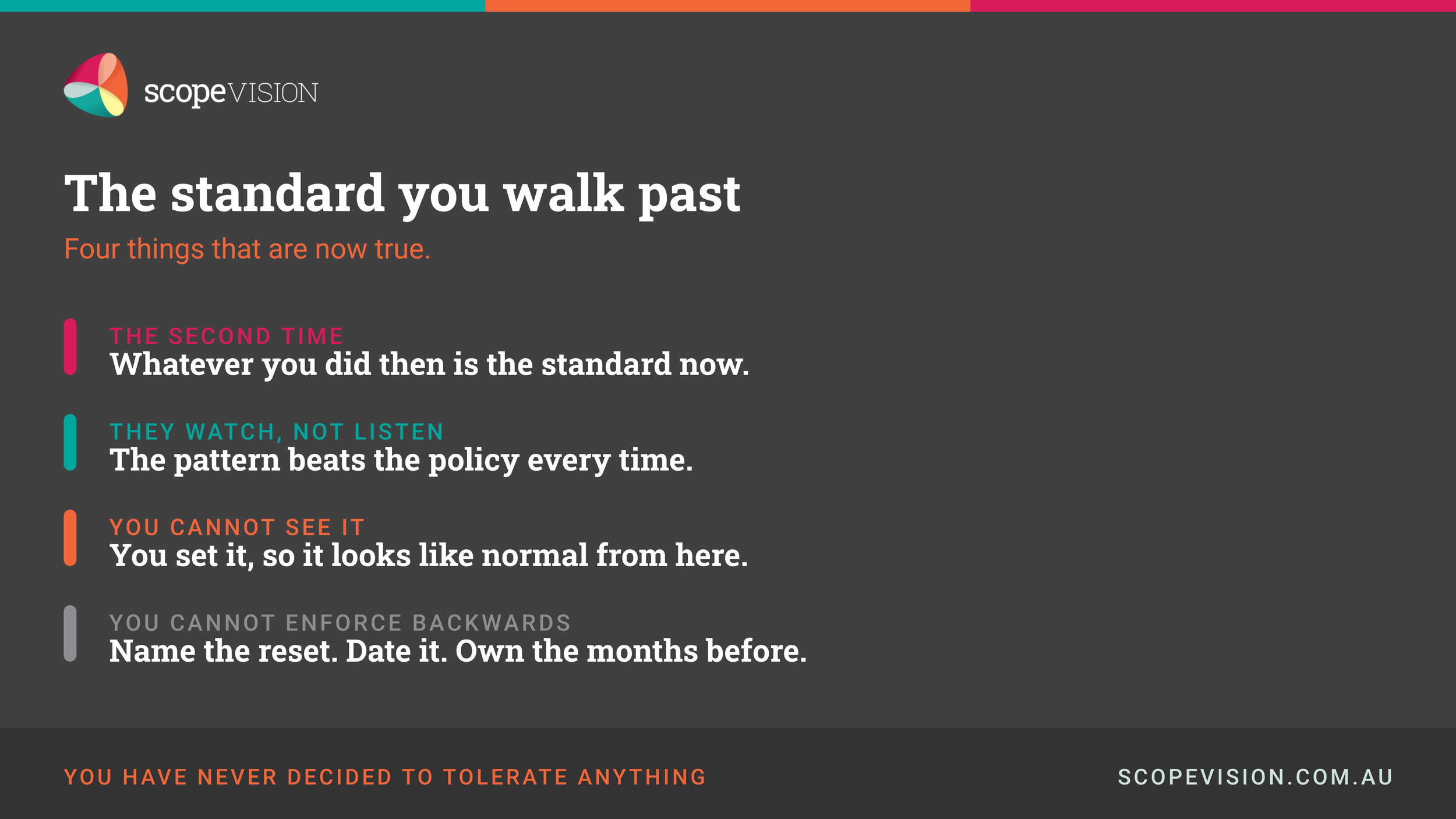
You will not fix this by writing a new set of standards. You have those already, and they are not the problem.
Go and find the thing you have walked past twice. Not the worst thing on your team. The one you have walked past twice, because that is the one that has already become a rule.
Then decide, on purpose this time, whether you want it to be normal.
TEAM ENGAGEMENT
Your team already knows what you tolerate.
They will not tell you directly, and now you know why.
Our session surfaces what a team has quietly agreed to, in a way that costs nobody their working relationships.
Somewhere collaborative, and with somebody in the room whose job it is to ask the awkward question.
See team engagement solutions Email MJ about your team
The second button opens your email app with the questions already in it. If nothing happens when you tap it, your device has no mail app set up, so use the contact page.
Driving results through people is what we do.
For students, and anyone who wants the evidence
One source, and the attribution is the interesting part.
Morrison, D. (2013) Chief of Army message regarding unacceptable behaviour [video]. Australian Army, June.
Australian Broadcasting Corporation (2016) Q&A, 1 February. Available at: https://www.abc.net.au/news/2016-02-02/qanda-david-morrison-fires-up-over-domestic-violence-claim/7131460 (Accessed: [insert date]).
A note on the attribution. Morrison delivered the line in a three-minute video to the Australian Army in June 2013. On Q&A in February 2016, in the week he was named Australian of the Year, he said the phrase belonged neither to him nor to his former speechwriter Cate McGregor, but to David Hurley. The record supports him: when Hurley's appointment as Governor-General was announced in December 2018, the Prime Minister's statement said Hurley first spoke the words. Everything else in this article is practitioner observation rather than research.
Cite this article
Reference list
Satterthwaite, M-J. (2026) You have never decided to tolerate anything. Scope Vision. Available at: https://scopevision.com.au/blog/you-have-never-decided-to-tolerate-anything (Accessed: [insert date]).
In text
(Satterthwaite, 2026)
Keep reading
Your Best Person Is Ramping Down
What your tolerances cost you, measured in the person who stopped mentioning things.
You Are Having These Conversations in the Wrong Order
Once you have drawn the line, this is who to talk to first.
Align your Team's Vision, Behaviour and Consequences
Twenty conversations to have before the drift starts, rather than after.
Why do we tolerate porcupines in the workplace?
For when the thing you have walked past twice is a person.
You thought of it
on the second paragraph.
The like button just below is how I know this landed.
And if someone came to mind while you were reading, send it to them. That is the better compliment.