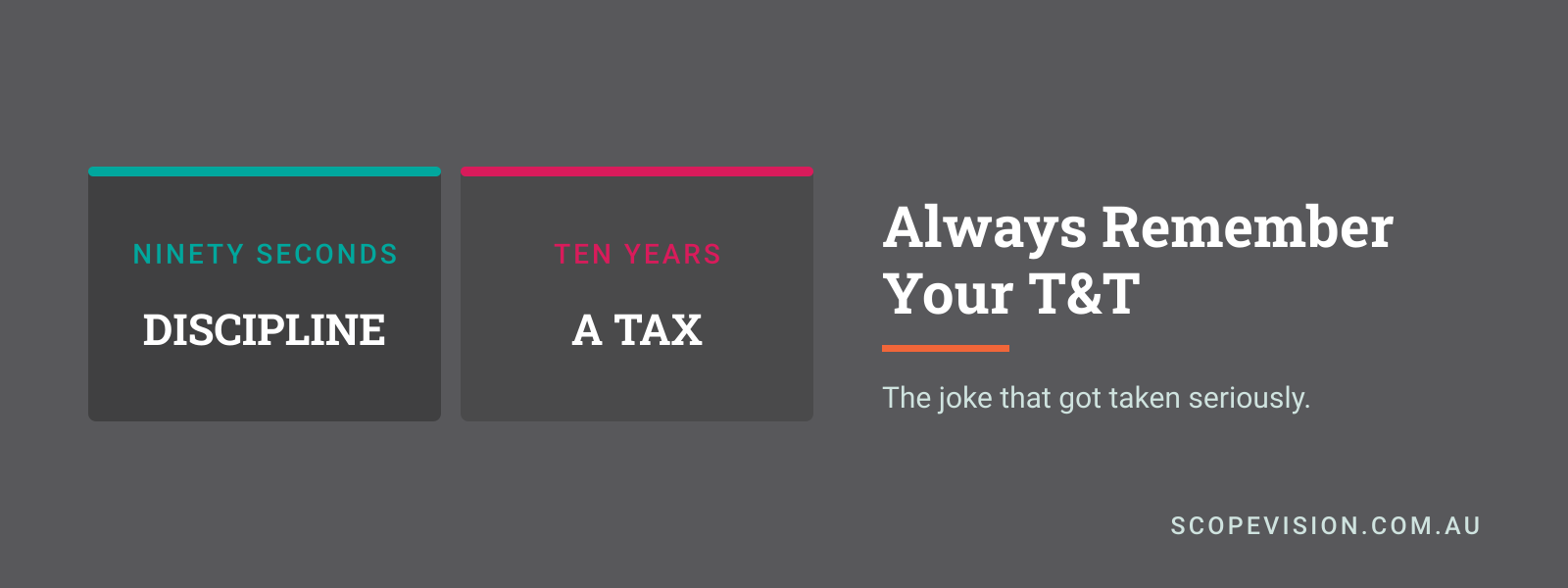
It was an off the cuff comment in a classroom, and it should have stayed there.
Originally published November 2016. Rewritten August 2026, and this version disagrees with the original.
Somebody in the room had just said something they immediately wished they had not. The kind of remark that is aimed at a laugh and lands somewhere else. And rather than let it sit, we named the recovery: tits and teeth. Straighten up, smile, carry on.
It got a laugh. Then it got used again the following week. Then it stopped being a joke and started being a standard.

A chimpanzee in reading glasses, underneath the word flawless. Nobody designs that as an aspiration. Which is why what happened next is my own fault.
I wrote it up as though I meant it
Ten years ago I published a definition of T&T on this blog. Somebody self-aware. Somebody who knows the right thing to think, say and do, in the appropriate manner, every time. Somebody whose behaviour remains flawless in all situations.
Read that back without the chimp attached.
I described a person who never slips, never shows strain, and is never caught off guard, and I called it a necessary leadership capability. The article even raised the obvious objection, whether wearing your T&T makes you fake, and then settled it by saying the class agreed it did not.
A room agreeing is not an argument. And what that room agreed was that flawlessness builds trust, which is the opposite of what the evidence says. Teams that speak up outperform teams that do not, and what makes people speak up is a belief that it is safe to (Edmondson, 1999). I have never met anybody who formed that belief about a leader who appeared never to falter, but that part is mine rather than hers.
The version that works
Which is not to say the phrase was wrong. It was right for about ninety seconds at a time, and I have a good example of that.
I train with Lora Gizzarelli, a gym owner who used to sit in my classes. Partway through a set, when I had stopped being able to pretend I was enjoying myself, she said the thing every trainer says.
You've got this. No pain, no gain. If it's burning, it's working.

A pessimist would call that a bullshit sandwich. And in the moment it was exactly what I needed, because it was not asking me to feel differently. It was telling me I had a choice about the next thirty seconds and that she was not going anywhere.

That is T&T doing its actual job. Not flawless. Not permanent. A short deliberate decision about how to carry the next bit, made by somebody who was visibly struggling and knew it.
The difference between that and the definition I published is the difference between a moment and a personality.
The harder version
This is where the article stops being funny.
There is a harder version of this, and it comes from the assessment work I do.
Hogan's whole premise is that there are two of you. There is who you think you are, and there is what everybody else has concluded, and only the second one determines what happens to your career. T&T is an attempt to manage the second directly.
The trouble is what the instruments actually measure. The behaviours that derail leaders do not show up in the managed version. They show up when the managing stops. Under pressure, at the end of a long week, in the moment you were not watching.
So a leader who is flawless in all situations does not have fewer derailers. They have derailers under management, and management is not the same as absence.
Which matters because management has a limit. It holds until the pressure exceeds it, and then it does not. And the people around that leader have no way of knowing where that line sits, because they have never seen it move.
What it costs, measured
I have my own numbers on this, and they are not flattering.
Across seventeen years of behavioural reports, the gap between how I naturally operate and how I present at work has been closing. Except in one place. My enthusiasm suppression has not moved in a decade. Eighteen points, every working day, dialling down warmth to meet rooms that read it as a lack of gravity, and then as a lack of credibility.
That is T&T, running as a permanent setting rather than a moment. And after all that time, I could not tell you which of my smiles are which.
No report can tell me how much of that I chose.
Discipline, or tax
Some of what you hold back is discipline. You are annoyed and you do not take it out on somebody. You are worried and you do not spread it before you have anything useful to say. That is not fakery. That is leading.
Some of it is not the job. It is a tax, and nobody told you it was being collected. You are dimming something real, permanently, because the room has decided that version of you is unprofessional. Nobody asked you to. There is no policy about it. You simply worked out what was acceptable here, and adjusted.
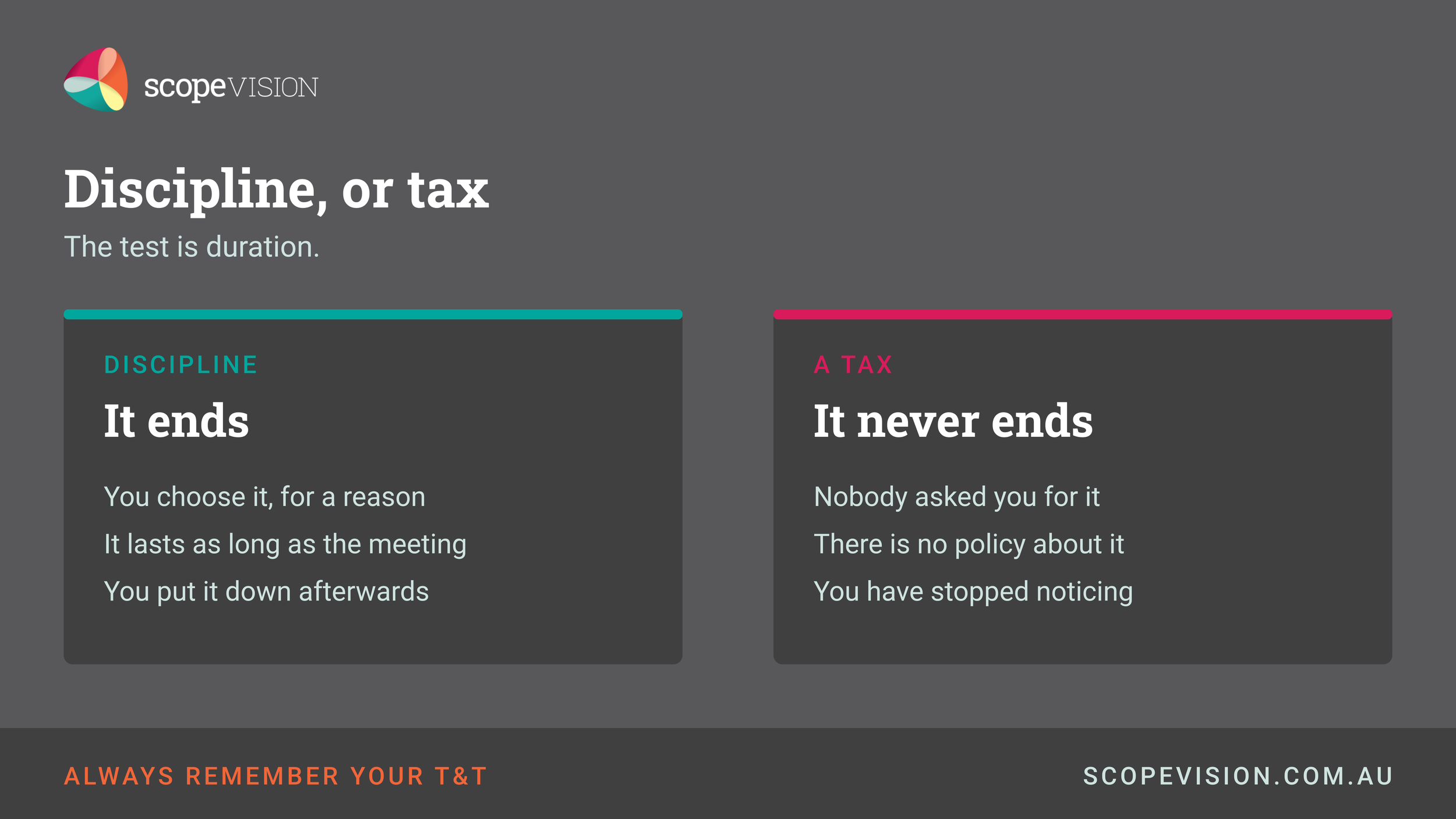
Discipline has an end. You put it down afterwards. A tax does not end, because it was never about a situation. It was about who you are allowed to be here.
So there is a test, and it takes about four seconds.
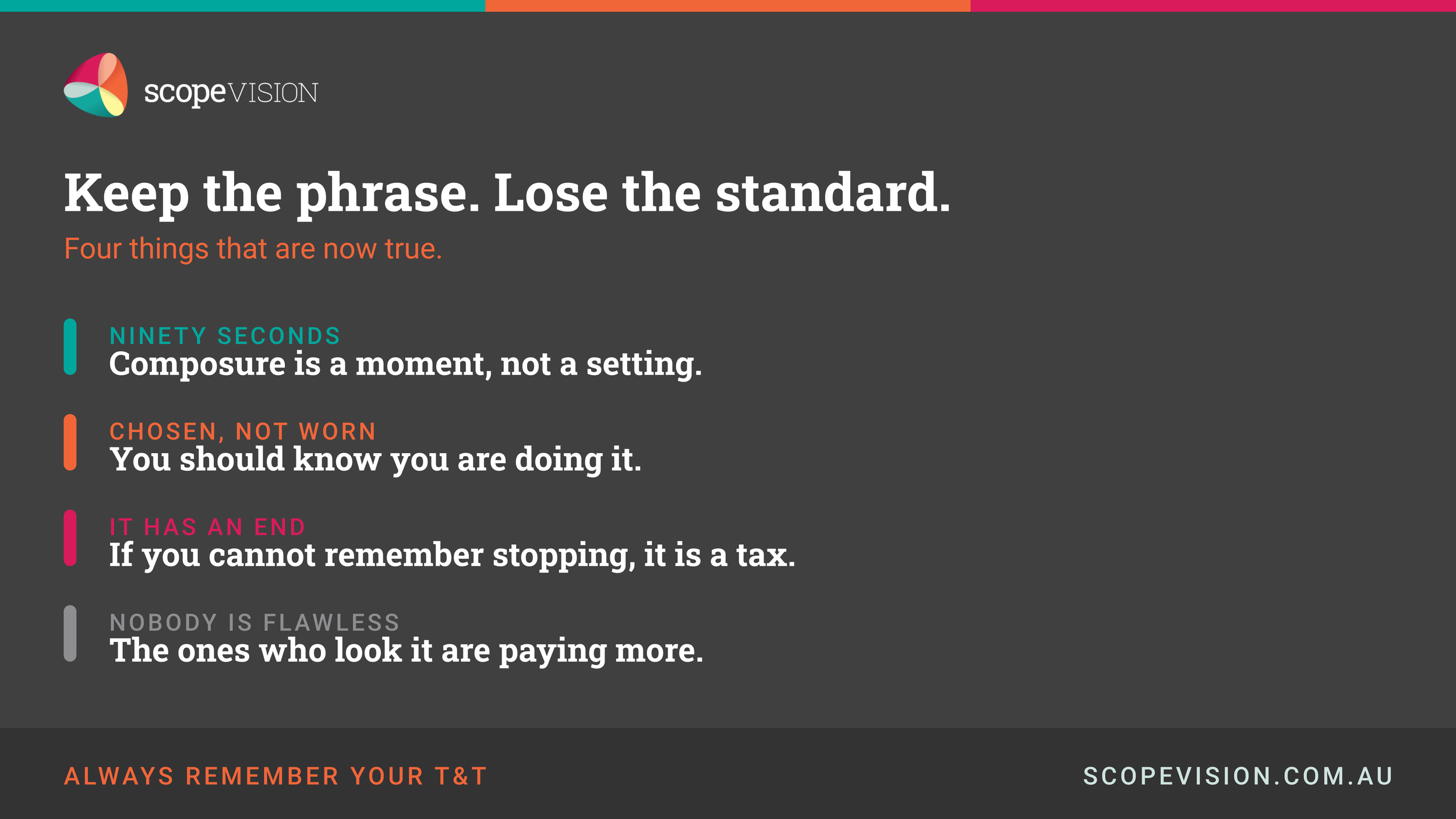
The Duration Test. If you cannot remember the last time you stopped holding it in, it is not discipline.
What I would tell that classroom now
The phrase was never the problem. Ninety seconds of deliberate composure, chosen by somebody who knows they are choosing it, is a genuine skill and I would still teach it.
What I got wrong was writing it up as a personality. Somebody flawless in all situations. Somebody you never catch off guard. I published that as an aspiration and then spent a decade watching people, including me, quietly try to be it.
Somebody in your team is doing this right now, and they will not mention it. You will only find out when they leave.
So keep the cards. Keep the phrase. Use it on a Tuesday when something has gone sideways and you have thirty seconds to decide how to walk into the next room. Then run the Duration Test on yourself, and be honest about the answer.
Just do not let it become the way you are. That was the joke.
IDENTITY AND REPUTATION
Find out what you are holding down.
Hogan-based coaching, one to one. What you are like, what people have concluded about you, and what shows up when the managing stops. Uncomfortable, useful, and considerably faster than finding out the hard way.
Email MJ about coaching Use the contact form instead
The first button opens your email app with the questions already in it. If nothing happens when you tap it, your device has no mail app set up, so use the contact form.
Driving results through people is what we do.
For students, and anyone who wants the evidence
Practitioner work, with three sources worth reading properly.
Edmondson, A. (1999) 'Psychological safety and learning behavior in work teams', Administrative Science Quarterly, 44(2), pp. 350-383. Available at: https://doi.org/10.2307/2666999
Hogan Assessments (n.d.) Hogan Development Survey. Available at: https://www.hoganassessments.com/assessment/hogan-development-survey/ (Accessed: [insert date]).
Hogan Assessments (n.d.) What is leadership? Available at: https://www.hoganassessments.com/guides-and-insights/what-is-leadership/ (Accessed: [insert date]).
A note on the evidence. Edmondson's study of 51 work teams establishes that psychological safety drives learning behaviour, and learning behaviour drives performance. It does not test whether a leader showing strain is what builds that safety. That connection is mine, drawn from practice rather than from her data. The identity and reputation distinction is Hogan's own, and so is the finding that derailing behaviours emerge under strain. Two things in this article are mine rather than theirs: the framing that those behaviours appear when the managing stops, and the argument about what a permanently managed derailer costs. Worth knowing also that Hogan's tools predict reputation specifically, not identity, whatever some second-hand summaries claim.
Cite this article
Reference list
Satterthwaite, M-J. (2016) Always remember your T&T: the joke that got taken seriously. Revised August 2026. Scope Vision. Available at: https://scopevision.com.au/blog/always-remember-your-tt-the-right-attitude-is-only-a-smile-away (Accessed: [insert date]).
In text
(Satterthwaite, 2016)
Keep reading
Seventeen Years, Four Reports, One Very Consistent Woman
The numbers behind this article. Seventeen years of watching my own adaptation, and the one gap that has not closed.
Feedback: An Elephant or a Gift?
The same problem, pointed outward. What happens when the composure is a performance and the other person can tell.
Align your Team's Vision, Behaviour and Consequences
Including the conversation about how much of yourself this team expects you to leave at the door.
Why do we tolerate porcupines in the workplace?
For when somebody's composure has slipped permanently and nobody will say so.
Ten years to notice.
Four seconds to check.
The like button just below is how I know.
And if someone came to mind while you were reading, send it to them. That is the better compliment.